
What is SAP Software? Meaning, Uses, and Examples

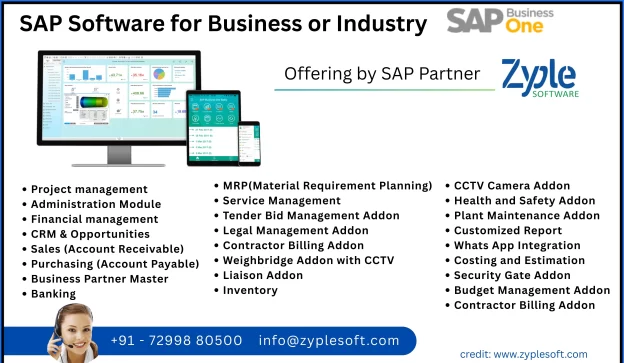
In the world of enterprise resource planning (ERP), SAP software stands as a dominant solution, widely adopted by organizations globally to improve their business processes. But what exactly is SAP software? How does it function and what makes it a preferred choice for many companies? This article dives deep into the meaning, uses, and examples of SAP software and highlights a top offering by SAP partner Zyple Software, known for delivering best SAP solutions.
What is SAP Software: Meaning and Definition
At its core, SAP software is an integrated suite of applications designed to help organizations manage their business processes in a unified system. It enables data sharing across departments, reducing redundancy and increasing productivity. Unlike standalone software that focuses on a single task, SAP integrates various business functions such as finance, human resources, supply chain, manufacturing, sales and customer service into one platform.
SAP software operates on a client-server architecture and often runs on a database management system to store and retrieve data in real-time. This enables businesses to have access to up-to-date and accurate information for decision-making.
Key Uses of SAP Software
1. Enterprise Resource Planning (ERP)
2. Financial Management
3. Supply Chain Management (SCM)
4. Human Capital Management (HCM)
5. Customer Relationship Management (CRM)
6. Business Intelligence and Analytics
Examples of SAP Software in Use
- Vijay Raja Group uses SAP Business One ERP to manage its company operations and production processes efficiently.
- Firefly integrates SAP B1 software to improve its manufacturing and finance operations across global locations.
- Vibhava Corporation leverages SAP to manage its diverse product portfolio and optimize marketing and sales.
- William Penn employs SAP B1 modules to ensure effective finance, project and inventory management worldwide.
How SAP Software Transforms Business Operations?
- Improved Data Accuracy: With centralized data storage, organizations avoid duplication and discrepancies, ensuring consistency.
- Enhanced Productivity: Automation of routine tasks frees employees to focus on strategic work.
- Scalability: SAP solutions grow with the business, supporting expanding operations and new business models.
- Regulatory Compliance: SAP incorporates compliance checks for tax laws, industry standards, and global regulations.
- Real-Time Reporting: Businesses can make faster, informed decisions based on up-to-date information.
- Customization and Integration: SAP can be tailored to meet specific industry needs and integrates with other software and platforms seamlessly.
SAP Software Modules Breakdown
- SAP FI (Financial Accounting): Manages financial transactions and accounting.
- SAP CO (Controlling): Supports internal cost control and reporting.
- SAP MM (Materials Management): Handles procurement and inventory.
- SAP SD (Sales and Distribution): Manages sales processes and order fulfillment.
- SAP PP (Production Planning): Oversees manufacturing processes.
- SAP HCM (Human Capital Management): Manages employee data and HR processes.
- SAP BW (Business Warehouse): Provides data warehousing and analytics.
- SAP CRM (Customer Relationship Management): Focuses on customer interactions and sales.
SAP Cloud Solutions and Digital Transformation
Why Partnership with SAP Partners?
- Assess and select the right SAP modules tailored to their unique needs.
- Ensure smooth migration from legacy systems to SAP platforms.
- Customize SAP solutions for industry-specific requirements.
- Provide ongoing support and training to maximize SAP ROI.