
SAP Business One ERP for Pesticide Industry
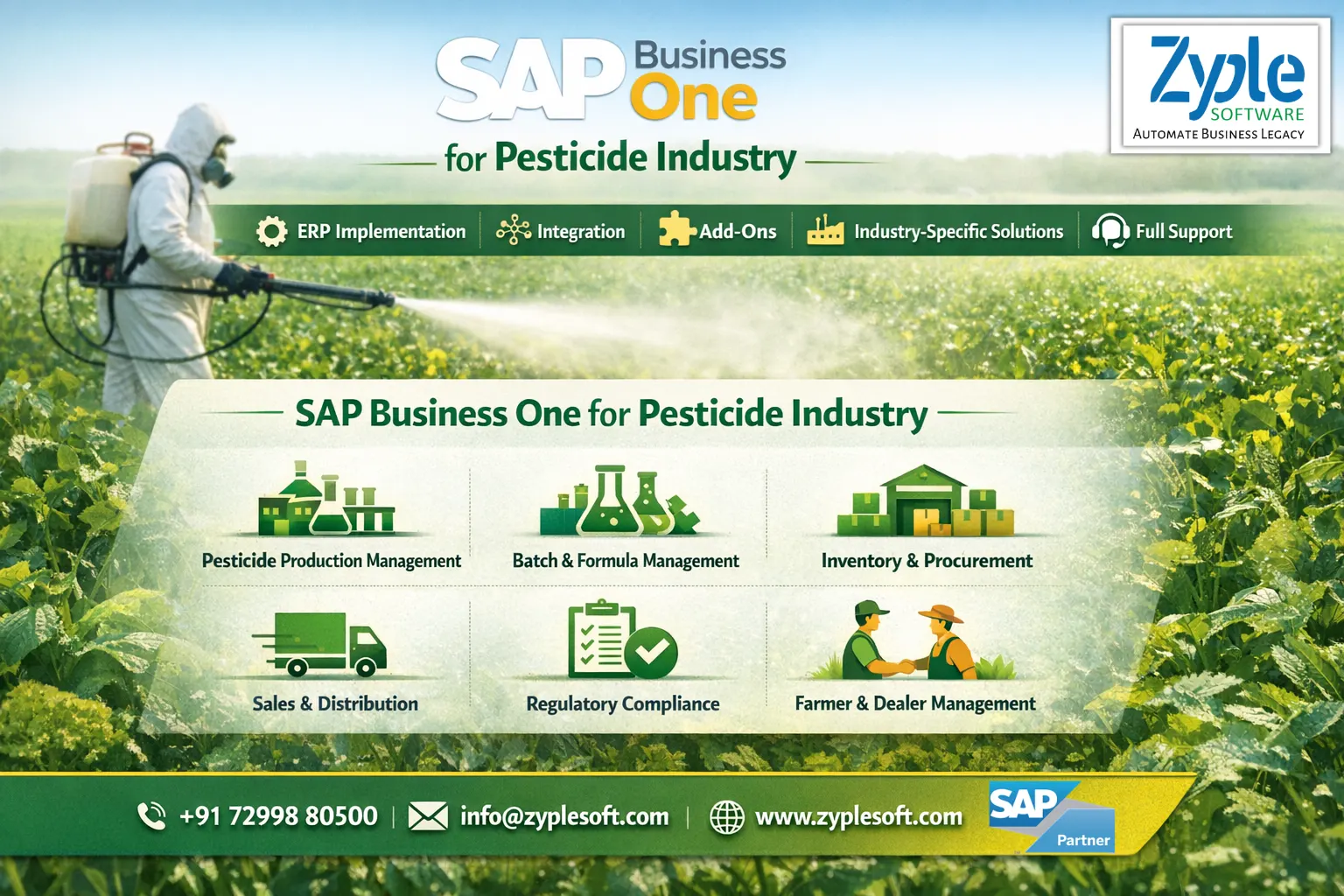
The pesticide industry operates in a highly regulated, seasonal, and distribution-centric environment. Many pesticide businesses depend on disconnected systems for production, inventory, sales, and compliance management, leading to limited visibility, manual documentation, stock imbalances, and delayed reporting. SAP Business One for pesticide industry delivers a unified platform that integrates production, quality, batch tracking, distribution, finance, and compliance, allowing real-time control and operational transparency across pesticide operations.
Challenges of the Pesticide Industry
The pesticide industry faces significant challenges, including stringent regulatory compliance (registration costs, bans), pest resistance requiring continuous innovation, and intense environmental and health scrutiny. Other key challenges include the need for sustainable alternatives (biopesticides), high R&D costs for new products, and disconnected supply chains.
1. Regulatory and Compliance Pressures
The pesticide industry faces high costs and time-consuming processes for the registration of new products. Government is increasingly imposing bans or restrictions on hazardous chemicals, requiring companies to continuously adapt to new environmental policies.
2. Pest Resistance
Pests are evolving to withstand commonly used chemicals, making current products less effective and forcing the industry to invest heavily in developing new, more potent formulations.
3. Environmental and Health Concerns
Pesticide residues are polluting soil, water, and air, leading to biodiversity loss and harm to non-target species. There is rising pressure regarding the acute and chronic health risks caused to farmers and consumers.
4. Shift Towards Sustainability
There is growing demand for eco-friendly alternatives, such as biopesticides. The industry faces the challenge of shifting from chemical-based products to biological ones, which often have shorter shelf lives and complex supply chain logistics.
5. Market and Economic Hurdles
The industry is dependent on imported raw materials, creating vulnerability to supply chain disruptions. Also, there is a need to educate farmers on correct usage to prevent misuse.
Features of SAP Business One for Pesticide Industry
1. Project Management
Planning, organizing, tracking, and controlling projects within the SAP B1 ERP system.
2. Human Resource Management
Maintaining employee records, tracking attendance, managing recruitment processes, and assessing workforce performance.
3. Sales and CRM
Handling sales activities and building strong relationships with customers.
4. Accounting
Managing and controlling all financial transactions.
5. Financial Management
Planning, evaluating, and controlling the financial resources effectively.
6. Production Planning and Control
Planning, scheduling, and handling manufacturing processes efficiently.
7. Purchasing
Handling the procurement of goods and services from suppliers.
8. Reporting and Analytics
Analyzing and providing meaningful reports for better decision-making.
9. Quality Control
Evaluating and maintaining the quality of products during purchasing, production, and delivery processes.
10. Inventory Management
Tracking, controlling, and managing the movement and storage of goods.
11. Service Management
Handling customer service operations and post-sales support.
12. Business Partner
Centralized master record to oversee all the information related to customers, vendors, and leads.
13. Industry-Specific Solutions
Managing the unique requirements and processes of different industries.
14. Material Requirements Planning (MRP)
Planning and handling the materials needed for production and operations.
15. Administration
Configuring, controlling, and managing system settings and user access.
Importance of SAP Business One for Pesticide Industry
The ERP system, SAP Business One is an essential enterprise resource planning (ERP) solution for the pesticides industry, allowing small and medium-sized enterprises (SMEs) to manage complex regulatory, safety, and production requirements within a single, integrated platform. It helps companies transition from manual, error-prone, and disconnected systems to a digitized, traceable, and efficient workflow.
1. Robust Regulatory Compliance and Safety
Automated management of safety data sheets (SDS) ensures that safety, environmental, and handling regulations are achieved. SAP B1 delivers inclusive tracking of hazardous substances, ensuring proper storage, handling, and documentation throughout the production cycle. The system delivers comprehensive audit trails and automates compliance reporting, minimizing the risk of penalties.
2. Batch/Lot Traceability and Quality Control
SAP B1 allows tracking from raw material receipt, through production, to finished goods distribution. Quality inspections can be embedded at different production stages, with automated alerts for deviations. The SAP software manages specific batch/lot criteria, helping in quick, efficient, and accurate recall processes if necessary.
3. Formulation Management
SAP B1 ERP helps record, manage, and standardize formulations to maintain high product quality across batches using SAP implementation.
4. Optimized Inventory and Supply Chain
The system evaluates the shelf life of raw materials and finished goods, minimizing spoilage. Inventory is updated automatically upon production or sales, minimizing overstocking and understocking. Material requirements planning (MRP) enables precise planning of production based on raw material availability and demand.
5. Cost Management and Profitability
SAP B1 ERP calculates the actual cost per batch, integrating material, labor, and overhead costs to deliver real-time visibility into product margins. By improving inventory control and production planning, the system helps reduce waste and minimize production costs.
6. Scalability
SAP Business One delivers enterprise-grade, industry-specific capabilities for small and medium-sized enterprises (SMEs) without excessive complexity.
Benefits of SAP Business One ERP for Pesticide Industry
SAP Business One software provides the pesticide industry an integrated solution to improve regulatory compliance, manage hazardous inventory, and optimize production formulas. It ensures precise batch traceability, minimizes waste through efficient inventory, and improves overall operational efficiency from raw material procurement to final delivery.
1. Batch Tracking and Quality Control
Allows full traceability of ingredients and batches, important for managing hazardous materials and maintaining compliance with safety regulations.
2. Regulatory Compliance
Automates documentation and reporting to achieve strict industry standards, such as good manufacturing practices (GMP) and environmental safety laws.
3. Formula Management
Securely stores, tracks, and handles complex, proprietary formulations to ensure consistent quality across production cycles.
4. Inventory Optimization
Delivers real-time visibility into inventory levels, decreasing overstocking and managing expiration dates, which is essential for chemical stability.
5. Production Efficiency
Facilitates manufacturing processes, improves material requirements planning (MRP), and optimizes resource allocation to reduce costs using SAP solutions.
6. Improved Supply Chain
Consolidates procurement, sales, and logistics, allowing better supplier management and faster, on-time customer delivery.
Conclusion of Pesticides ERP
Zyple Software provides SAP Business One ERP for pesticide industry, where pesticide companies gain a centralized platform to manage production, quality, inventory, distribution, finance, and compliance with full visibility and control.
Are you demanding an SAP Business One ERP for your business or industry?
Fill in all the details in the given contact form; our team will get back to you.