
SAP Business One ERP for Maritime Industry
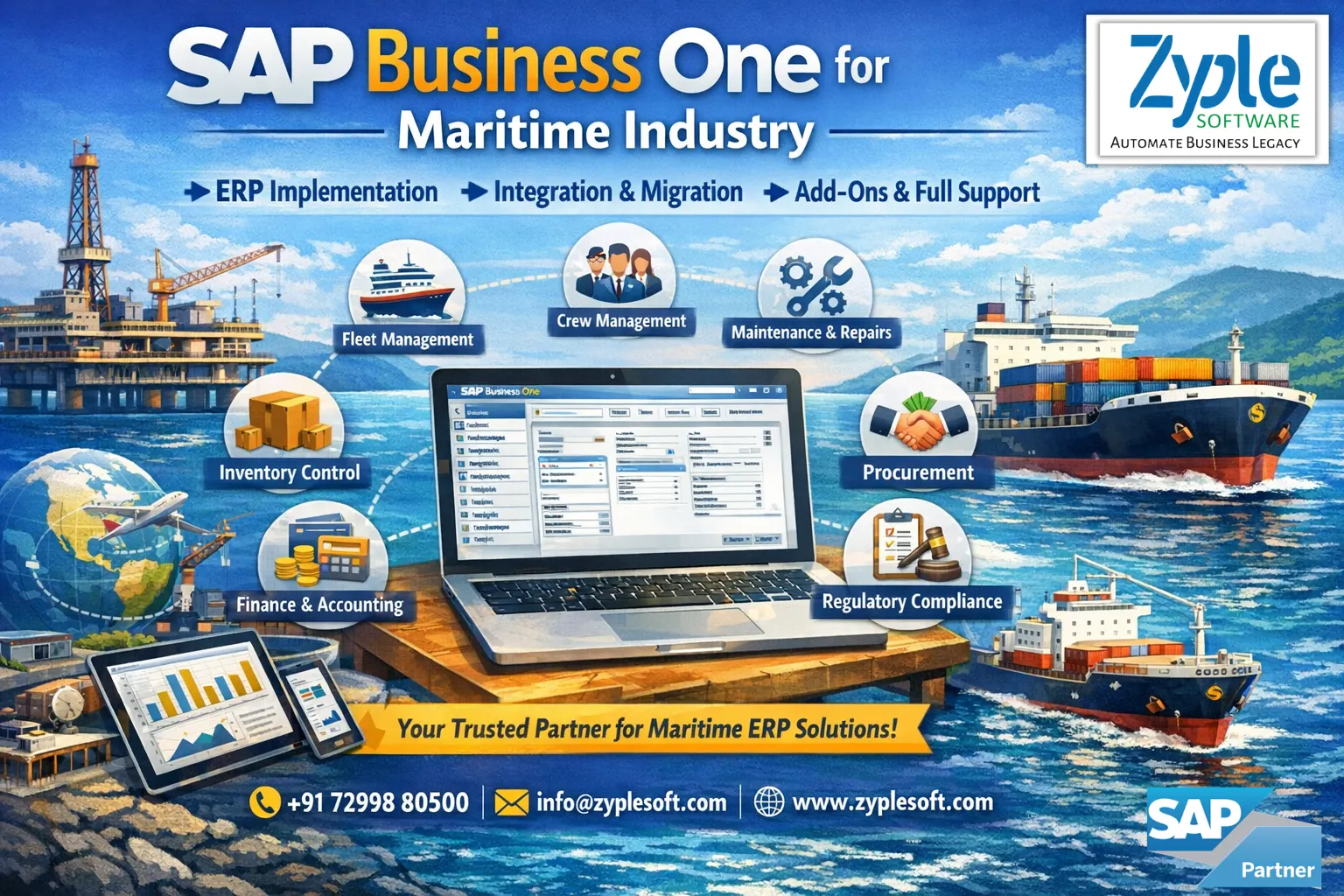
The maritime industry plays an important role in global trade, requiring accuracy and efficiency at every step. SAP Business One for maritime industry helps handle challenges like fleet management, regulatory compliance, and rising operational costs. SAP Business One ERP delivers designed solutions to facilitate logistics, improve customer relationships, and increase supply chain efficiency. With SAP B1 implementation, maritime companies can gain real-time insights, minimize operational costs, and boost performance.
Key Challenges in the Maritime Industry
The maritime industry is struggling with the range of challenges that require forward-thinking solutions for growth and efficiency. Companies must handle issues such as fleet optimization, rising operational costs, and compliance with stringent environmental regulations. The rapid pace of technological change, along with the need for smooth data integration, intensifies the pressure to remain competitive. To succeed, maritime businesses must focus on improving operational workflows, increasing customer experience, and adopting innovative digital tools.
Here are the key challenges confronting the maritime sector:
1. Rising Operational Costs
Rising fuel prices damage budgets, forcing maritime operators to seek innovative strategies for cost management and efficiency improvements.
2. Supply Chain Disruptions
Unforeseen disruptions in global supply chains can obstruct timely operations, necessitating flexible strategies to reduce impacts on maritime logistics.
3. Safety and Security Risks
Ensuring the safety of personnel and vessels amid rising security threats requires thorough risk management and training programs.
4. Increased Competition
The maritime industry is highly competitive, demanding businesses to innovate and deliver value-added services to stay ahead.
Features of SAP Business One for Maritime Industry
1. Fleet Management
Tracking, managing, and improving vehicle operations, including maintenance, fuel consumption, driver performance, and leasing.
2. Finance and Accounting
Automating key financial processes like general ledger, journal entries, budgeting, and bank reconciliation.
3. Production
Handling the end-to-end manufacturing process, including bills of materials (BOM) management, production orders, resource planning, and goods movements.
4. Purchasing
Handling the entire lifecycle of acquiring goods and services, from vendor selection to final payment.
5. Operation Management
Facilitating core processes, such as inventory, purchasing, production, and sales, into one system.
6. Manufacturing Integration
Integrating the ERP system with shop-floor systems, such as Manufacturing Execution Systems (MES), PLCs, and IoT devices, to synchronize production data, automate inventory updates, and gain real-time visibility.
7. Customized Report
It is a designed data analysis tool customized to display specific business metrics, KPIs, or information not available in standard, out-of-the-box reports.
8. Business Intelligence and Analytics
Real-time data analysis allows small and medium-sized enterprises (SMEs) to monitor performance, visualize data via dashboards, and make better decisions.
9. Forecasting
Predicting future customer demand, allowing businesses to optimize inventory levels, production schedules, and purchasing to avoid stockouts or excess stock.
10. Cost Management
Tracking, allocating, and analyzing expenses and revenues across different business units, departments, or projects to monitor profitability.
11. Sales and CRM
Handling the entire customer lifecycle, from initial lead, through sales opportunities, to quotations and orders.
12. Cash Flow Management
Real-time tracking and forecasting of incoming and outgoing money to maintain liquidity and guarantee financial stability.
13. Business Planning
Facilitating core processes to allow data-driven decision-making through real-time reporting, supporting on-premise or cloud deployment.
14. Bank Integrations
Secure, automated connection between the ERP system and banking platforms, allowing seamless, direct exchange of financial data.
15. Business Partners
Represents the master data for all external identities in a company interacts with customers, vendors (suppliers), and leads.
16. Add-Ons
Extensions that connect directly into the core ERP system to deliver specialized, industry-specific, or improved functionality.
Importance of SAP Business One for Maritime Industry
SAP Business One (SAP B1) is important for the maritime industry, providing an integrated, real-time ERP solution that facilitates shipbuilding, inventory, and supply chain operations. It improves project management, minimizes costs through automation, and ensures compliance with maritime regulations. Important reasons include improved data visibility, optimized resource management, and scalable, accurate financial reporting for shipyards and marine services using SAP implementation.
1. Integrated Project Management
Handles complex ship construction projects from planning to delivery, tracking milestones and costs in real-time.
2. Operational Efficiency and Automation
Automates procurement, inventory management, and supplier communication, minimizing manual workload and errors.
3. Improved Resource Management
Allows accurate, real-time monitoring of resources (materials, labor, and machinery) to avoid waste and minimize operational costs.
4. Financial Control and Compliance
Delivers accurate, audit-ready financial data and helps in managing industry-specific regulatory standards, minimizing penalties.
5. Real-Time Analytics and Reporting
Provides powerful dashboards for analyzing KPIs, helping managers make data-driven decisions on production and sales.
6. Scalability for Growth
Supports the expanding requirements of maritime businesses, including improved project complexity, through a scalable, flexible platform.
7. Supply Chain Optimization
Facilitates logistics by coordinating procurement and warehousing, improving overall profitability.
Benefits of SAP Business One ERP for Maritime Industry
SAP Business One (SAP B1) provides maritime companies a centralized, scalable SAP solutions to optimize fleet operations, manage complex shipbuilding projects, and improve supply chain efficiency. Core benefits include real-time financial oversight, improved inventory control, automated procurement, and regulatory compliance, ensuring increased profitability, minimized downtime, and faster on-time deliveries.
1. Operational Capabilities and Digital Transformation
Facilitates processes from order-to-cash, including purchase order generation from sales orders, minimizing manual inaccuracies and accelerating workflows.
2. Inventory and Logistics Management
Optimizes inventory levels for shipyards, preventing overstocking, and improves supply chain visibility for logistics, including tracking BP catalog numbers (vendor or customer part numbers).
3. Improved Fleet and Maintenance Control
Allows scheduling of preventive maintenance and real-time monitoring of vessel status to reduce costly downtime.
4. Financial and Contract Management
Allows tracking of freight contracts and supplier agreements, delivering detailed profitability analysis, financial reporting, and automated payment scheduling.
5. Real-Time Data and Reporting
Delivers 360-degree visibility into operations via interactive dashboards, allowing better, faster decision-making for managing complex, long-term projects.
6. Ease of Use and Integration
Grows with the business, enabling the addition of users and functionalities, ensuring a future-proof investment.
Conclusion of Maritime ERP
As a certified SAP Business One partner, Zyple Software brings unparalleled expertise and dedication to businesses seeking seamless SAP Business One services.
Do you pursue ERP software for your business or industry?
Fill in all the details in the allocated form; our team will get back to you.