Category Archives: Uncategorized

Jewellery Manufacturing ERP Software

Best Jewellery Manufacturing ERP Software for Business

Best Jewellery Manufacturing ERP Software for Business Management

Jewellery Manufacturing ERP Software

In today’s highly competitive market  jewellery manufacturing industry are facing issues into operation management. Enterprise Resource Planning (ERP) solutions are transforming how businesses in this niche operate, ensuring better visibility, control, and efficiency. One of the most powerful ERP systems tailored for jewellery manufacturing is SAP Business One, offered by Zyple Software, a trusted SAP partner.

Zyple Software understands the complexities and difficulties of jewellery production, from raw material procurement to final product dispatch. Their customized SAP Business One solution offers specialized modules and features designed to handle the unique challenges of this industry. Below is a detailed breakdown of the system’s features categorized into Inwards Process Flow, Outwards Process Flow, and Manufacturing Processes.

Features of Jewellery Manufacturing ERP for Digital Transformation

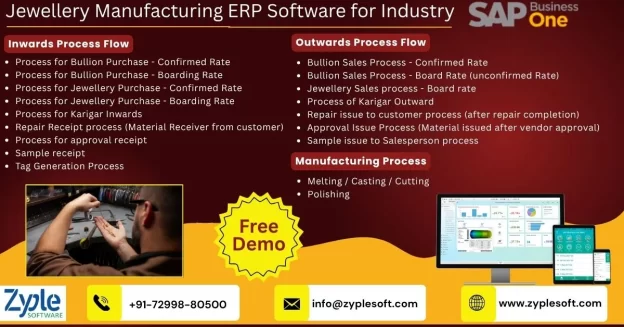
Inwards Process Flow

Managing raw material and item inwards is a critical part of jewellery manufacturing. Any mismatch, miscommunication, or manual error at this stage can lead to significant losses. Zyple Software offers SAP Business One solution with comprehensive features to streamline the entire inward process:

  1. Bullion Purchase – Confirmed Rate (CR): This feature handles the inward of bullion (gold/silver) based on a fixed, confirmed rate agreed upon with the supplier. It ensures that there’s no discrepancy in valuation or stock entry.
  2. Bullion Purchase – Boarding Rate (BR): Allows for purchases to be made based on a board (unconfirmed) rate, providing flexibility in situations where gold prices are volatile or rate confirmation is pending.
  3. Jewellery PurchaseConfirmed Rate (CR): Handles incoming finished or semi-finished jewellery items where the price has been finalized. This helps in accurate inventory and cost recording.
  4. Jewellery PurchaseBoarding Rate (BR): Supports purchases where the jewellery price is based on a board rate, offering flexibility in vendor interactions.
  5. Karigar Inwards Process: Manages the entry of work-in-progress or semi-finished items received from Karigars (artisans), ensuring proper tracking of issued and received quantities and quality.
  6. Repair Receipt Process: Used when receiving damaged jewellery from customers for repair. The system captures item details, estimated repair time, and cost for seamless tracking.
  7. Approval Receipt Process: Handles jewellery or sample items received from vendors for inspection or testing before approval, ensuring quality checks before final purchase or processing.
  8. Sample Receipt: Captures details of sample items received for display, trial, or future consideration, maintaining separate records from commercial inventory.
  9. Tag Generation Process: Once the items are received, the system can generate item tags with barcode or RFID, including all essential details such as weight, purity, rate, and more. This improves traceability and inventory management.

Outwards Process Flow

Outward operations involve dispatches, whether it’s for sales, sample viewing, or job work. SAP Business One by Zyple makes these operations smooth, traceable, and audit-compliant:

  1. Bullion Sales – Confirmed Rate (CR) : This allows the company to sell bullion at a pre-agreed price. The system handles pricing, billing, and inventory deduction efficiently.
  2. Bullion Sales – Board Rate (BR): Facilitates bullion sales at board rates, typically for immediate transactions or market-rate-dependent deals.
  3. Jewellery Sales – Board Rate (BR) : Allows jewellery sales using dynamic pricing models based on the board rate, enabling flexibility in sales negotiations.
  4. Karigar Outward Process: Tracks material issued to artisans for job work. This includes raw materials like gold or semi-finished jewellery, with tight integration to ensure return tracking.
  5. Repair Issue Process to Customer: After the repair work is complete, the system manages the return process to the customer with a complete audit trail.
  6. Approval Issue Process: Jewellery items issued to customers or partners for approval purposes are tracked accurately, reducing the risk of stock discrepancies.
  7. Sample Issue to Salesperson: Enables sales teams to take jewellery samples for client presentations or exhibitions. Each piece is tagged and tracked, ensuring it’s returned or converted to sale efficiently.

Manufacturing Process

Jewellery manufacturing involves multiple intricate processes that must be tracked meticulously to ensure cost accuracy, quality assurance, and timely delivery. SAP Business One by Zyple helps manage this with specialized workflows:

  1. Melting / Casting / Cutting: The software tracks raw material consumption, loss during melting, and conversion from bullion to casted items. It also maintains batch records and supports job tracking.
  2. Polishing: Polishing is a vital stage where rough pieces are transformed into finished, high-gloss jewellery. SAP Business One captures the movement of items to and from the polishing department, time taken, and any wastage or value addition.

By incorporating these processes into one integration ERP system, manufacturers gain visibility into each production stage, enabling real-time monitoring, cost control, and delivery tracking.

Why Choose SAP Business One by Zyple Software?

  • Industry-Specific Customization: Zyple’s solution is tailor-made for the jewellery manufacturing industry, addressing its unique workflow requirements.
  • Real-Time Data and Reporting: From inventory levels to order statuses, get up-to-the-minute information across departments.
  • Inventory Optimization: With detailed tracking of every item, from raw bullion to final jewellery pieces, overstocking and understocking are avoided.
  • Compliance and Traceability: Ensures regulatory compliance and provides traceability for every item throughout its lifecycle.
  • User-Friendly Interface: Despite its rich features, the system is easy to use and can be adopted with minimal training.

Let us Conclude: Jewellery Manufacturing ERP Software

In conclusion, the jewellery industry, with its complex workflows and high-value inventory, demands a robust ERP solution. SAP implementation by Zyple Software, is one of the most reliable and feature-rich ERP platforms tailored for this sector. From managing bullion purchases to tracking samples and handling intricate manufacturing processes, it delivers end-to-end control and visibility, empowering jewellery businesses to scale with confidence.
 Are you looking for ERP for your Jewellery business? Don’t worry. Fill you details in contact form. Our team will contact you soon.

    erp system examples

    What is an ERP System? Examples and Why It is Used

    What is an ERP System? Examples and Why It is Used

    erp system examples

    In today’s competitive business environment, managing different operations under one umbrella is crucial for efficiency and growth. That’s where ERP systems come in. But what is an ERP system, and why do so many companies from startups to global enterprises, rely on it? In this guide, we are going to explain about what ERP means, give you real-world examples like SAP Business One, and explain why ERP systems are so widely adopted.

    What is an ERP System?

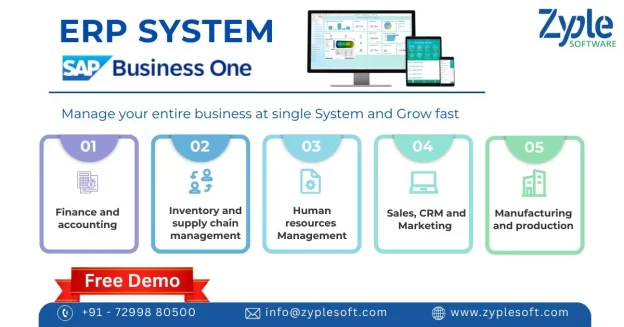
    ERP stands for Enterprise Resource Planning. It is a type of software that organizations use to manage and integrate their core business processes. These include areas such as:
    • Finance and accounting
    • Inventory and supply chain management
    • Human resources Management (HRMS)
    • Customer relationship management (CRM)
    • Sales and marketing
    • Manufacturing and production
    In essence, an ERP system acts as a centralized platform that connects all departments and workflows across an organization. Instead of using separate tools for payroll, inventory, and sales, an ERP consolidates them into a single, unified system.

    Key Features of an ERP System

    While ERP platforms vary by provider and industry, the best systems usually offer:
    • Centralized database for accurate, real-time data
    • Automation of routine tasks and workflows
    • Reporting and analytics for smarter decision-making
    • Custom modules tailored to business-specific needs
    • Scalability to support growth and expansion
    • Integration capabilities with third-party tools and services

    Why is an ERP System Used?

    ERP systems solve one of the most common challenges in business: operational efficiency. By uniting data and processes, an ERP helps businesses streamline operations, reduce errors, and make better decisions. 

    Here’s why companies invest in ERP solutions:

    1. Improved Productivity

    Manual processes are slow and prone to error. ERP software automates routine tasks like order processing, payroll, and financial reconciliation, freeing up employees for higher-value work.

    2. Real-Time Data Access

    With a centralized database, stakeholders can access real-time data across departments. This leads to better collaboration, faster decision-making, and more agile business operations.

    3. Cost Reduction

    Though ERP systems can require upfront investment, they save money in the long run by improving resource management, reducing operational delays, and minimizing waste.

    4. Regulatory Compliance

    ERP systems often come with built-in tools for compliance management, helping businesses stay on top of tax laws, financial reporting standards, and industry regulations.

    5. Enhanced Customer Service

    With integrated CRM and inventory tools, employees can access accurate customer data, order statuses, and service history in one place, improving customer satisfaction.

    Example of an ERP Software System

    One of the most widely used ERP System solutions for small to medium-sized enterprises (SMEs) is SAP Business One.
     
    SAP Business One is a comprehensive ERP software solution designed specifically for growing businesses. It provides integrated modules for financials, operations, sales, inventory, and customer management, all within a user-friendly interface.

    Key Modules of SAP Business One ERP

    1. Financial Management: Automate accounting, manage cash flow, and track expenses.
    2. Sales and CRM: Track leads, manage customer relationships, and streamline sales processes.
    3. Inventory Control: Gain real-time visibility into stock levels, manage warehouses, and optimize procurement.
    4. Purchasing and Procurement: Automate vendor transactions and improve purchase orders.
    5. Business Intelligence: Create detailed reports and dashboards to support strategic decisions.

    Why Businesses Use SAP Business One

    • Affordability: Designed for SMEs, SAP Business One offers enterprise-level functionality at a lower cost.
    • Scalability: As your business grows, SAP B1 can grow with you, adding users, modules, and integrations.
    • Ease of Integration: SAP Business One can be integrated with eCommerce platforms, shipping services, and other third-party software.
    • Global Compliance: Supports multiple currencies, languages, and tax regulations, making it ideal for global operations.
    • Cloud and On-Premise Options: Businesses can choose the deployment model that suits their needs.

    Who Uses ERP Systems?

    ERP systems are used across various industries including:
    • Manufacturing: To manage production schedules, inventory, and supply chain.
    • Retail: For point-of-sale integration, inventory tracking, and customer data management.
    • Healthcare: For patient record management, billing, and compliance.
    • Construction: To oversee budgeting, project timelines, and resource allocation.
    • Finance and Insurance: For risk analysis, account management, and regulatory compliance.
    From SMEs to multinational corporations, ERP systems help businesses scale, reduce costs, and stay competitive.
     

    Conclusion: Is an ERP System Right for Your Business?

    If your company struggles with fragmented data, inefficient processes or lacks visibility across departments, then an ERP system is likely a smart investment. Tools like SAP Business One demonstrate how even small to medium-sized businesses can benefit from automation, integration and real-time analytics.
     
    Investing in an ERP system not only streamlines operations but also positions your business for long-term success. With better insights, improved customer service, and greater control over resources, ERP software is more than just a tech upgrade – it’s a strategic advantage.
     
     
     If you are interested in ERP Software System for business, fill details in below given form. We will contact you soon.

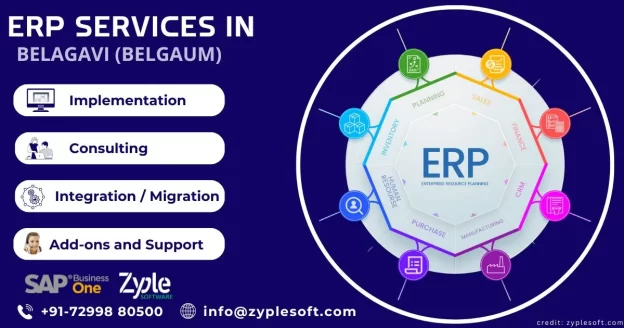
      erp services in Belagavi (Belgaum)

      ERP Services Provider in Belagavi (Belgaum)

      ERP Services in Belagavi (Belgaum)

      erp services in Belagavi (Belgaum)

      Small and medium-sized businesses in Belagavi are not different. Industry leaders are keeping up with weak business bottom lines, increased competition, minimum visibility in business operations, and changing customer trends. Make the path towards a resilient business by finding the right SAP Business One partner in Belagavi.

      From hydraulics to heavy forging, industries in Belagavi need powerful ERP systems to handle complex supply chains and maximize production workflows. The SAP Business One ERP solution has emerged as the best choice for all the SMEs to handle these intense business challenges. Zyple Software, the most trusted SAP Business One partner provides SAP Business One, an inclusive and affordable ERP solution.

      SAP Business One As a Right Solution for Enterprises in Belagavi (Belgaum)

      SAP Business One is a good choice for businesses in Belagavi and across Karnataka due to its ability to deliver real-time insights and provide cost-effective solutions for small and medium-sized enterprises (SMEs). It helps businesses optimize efficiency, improve decision-making, and scale operations effectively. 

      1.Streamlined Operations

      SAP Business One integrates different functions like finance, sales, purchasing, inventory, and customer relationship management into one platform, eliminating data storage and optimizing overall efficiency.

      2.Real-Time Insights

      The system delivers real-time data and analytics, allowing businesses to make better decisions based on accurate information.

      3.Cost-Effective Solution

      SAP Business One is designed for SMEs and provides a cost-effective way to manage budgets.

      4.Scalability

      As businesses grow, SAP Business One can scale with them, adapting to changing needs and complexities.

      5.Enhanced Control and Transparency

      The system delivers better control over business operations and increases transparency across different departments.

      6.Focus on Core Business

      By automating routine tasks and facilitating processes, SAP Business One enables businesses to focus on their core activities and growth strategies.

      SAP B1 ERP Services Provided in Belagavi (Belgaum)

      1.Implementation

      SAP Business One implementation services help businesses consolidate the software into their existing systems, ensuring a smooth transition and optimal performance.

      2.consulting

      SAP Business One consultant provide expert advice on system selection, customization, and ongoing support, helping businesses use the software to its full potential.

      3.Support

      Continuous support services are important for maintaining the system’s functionality and addressing any issues that may arise post-implementation.

      4.Customization and Add-Ons

      SAP Business One can be customized to meet specific business requirements, allowing for tailored solutions that align with unique operational needs. There are sector-based modules for manufacturing, construction, pharmaceuticals, textiles, retail, logistics, and more. Zyple Software is also offering SAP B1 add-ons to extend core functionality to meet specific business needs like advanced inventory, custom reporting, or industry-specific processes.
       

      5.Migration and Upgrades

      Transferring data from legacy systems or other sources into the latest SAP B1 environment. This process is important for successful implementation, upgrades, or system consolidations.

      6.Integration and Extensions

      It enables businesses to connect with various external systems and applications. This framework facilitates data exchange and automation, enabling streamlined business processes and improved data consistency across different platforms.

      7.Training

      Training programs are available to prepare users with the necessary knowledge and skills to effectively utilize the SAP Business One system.

      Industry Coverage Relevant to Belagavi (Belgaum)

      1.Heavy Tools

      Financial management, purchasing and operations, inventory management, production planning, sales and distribution, and CRM and marketing benefit heavy tool businesses.

      2.Automotive Exports

      Financials, sales and distribution, purchasing, inventory management, production, and CRM for efficient distribution of automotive exports.

      3.Aerospace

      Financial management, production, sales, purchasing, inventory, and CRM to increase defense operations.

      4.Foundry Exports

      Financial management, customer and sales management, purchasing and operations, inventory control, and export and import for efficient distribution of foundry exports.

      5.Tires

      Financial management, CRM and sales management, inventory control, production planning, and business intelligence benefit tire businesses.

      6.Aluminium Works

      Production, inventory management, sales and customer relationship management (CRM), and financials are useful for aluminium work businesses.

      7.Hand Loom and Power Loom Works

      Financial management, CRM and marketing, sales and distribution, inventory management, production, materials requirement planning (MRP), and reporting are crucial for hand loom and power loom work businesses.

      8.Heavy Forging

      Financial management, customer relationship management (CRM), sales and distribution, purchasing and operations, and production to optimize heavy forging operations.

      9.Construction and Real Estate

      Project management, financial management, inventory and materials management, and procurement are practical for construction enterprises.

      Why is Zyple the Best for SAP ERP Services in Belagavi (Belgaum)?

      1.Proven Expertise

      Zyple has an impressive track record in SAP implementation, specifically with SAP Business One. They have experience across different industries such as manufacturing, construction, retail, and pharmaceuticals, providing designed solutions for each.

      2.Industry-Specific Solutions

      Our company understands that every business is unique. They work closely with clients to configure and install SAP solutions that align with their distinct requirements and goals, ensuring optimal performance and efficiency.

      3.Innovation and Technology

      Our organization maintains pace with the latest SAP innovations, such as SAP B1 HANA and cloud platforms. They also develop their own add-ons to deliver clients with a competitive edge.

      4.Full Support

      Our company provides inclusive support, from primary consultation to continuous maintenance, ensuring a seamless and efficient SAP B1 implementation.

      5.Local Expertise

      With a team of experts, our company provides advisory, strategic consulting, and business road-mapping efficiencies.

      6.Cost-Effective Solutions

      Our company provides user-friendly and affordable services that grow with your business.

      7.Dedicated Support and Training

      Our organization provides continuous support and training to ensure that clients can effectively utilize their SAP systems and increase their investment.

      8.Strong Client Base

      Our company has a strong client base, including both SMEs and large enterprises, demonstrating their ability to deliver results across various business sizes and sectors.

      9.End-to-End Services

      Our company delivers an inclusive range of services, from primary consultation and implementation to  after implementation support and optimization.

      ERP Implementation Process Overview

      1.Planning and Assessment

      Determine project goals, identify specific needs, and choose the right ERP software packages for the organization.

      2.System Design and Configuration

      Customize the selected ERP software to align with the organization’s unique business processes and workflows.

      3.Data Migration

      Transition data from legacy systems to the latest ERP system, ensuring data accuracy and cohesion.

      4.Deployment

      Prepare for the transition to the new ERP system, such as data conversion, user training, and communication strategies.

      5.Ongoing Support

      Consistently monitor the system for performance and address any issues that arise.

      Business Outcomes for Industries in Belgaum

      • Optimization of production workflows, minimization downtime, and improvement of overall operational efficiency.
      • Real-time tracking and reporting help maintain optimal stock levels, decrease stockouts, and minimize carrying costs.
      • Robust quality control processes and tracking ensure compliance with industry standards.
      • Facilitating order processing, ensuring timely deliveries, and improving customer satisfaction.
       
      Are you exciting about ERP for your business? If Yes, then fill details in given form. Our team will contact you soon.
       

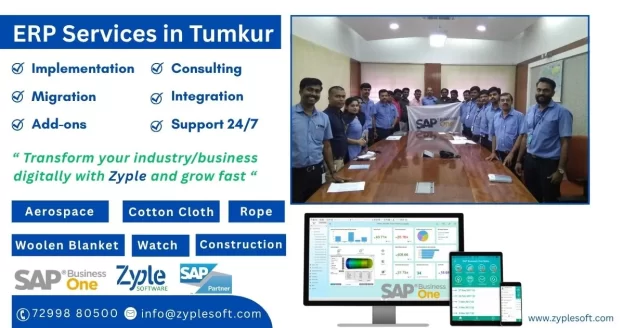
        erp services in tumkur

        ERP Services Provider in Tumkur

        ERP Services in Tumkur

        erp services in tumkur

        Tumkur, a vibrant city in Karnataka known for its agricultural produce, manufacturing units, and succeeding SME ecosystem, faces unique business challenges. From managing seasonal inventory surplus to handling complex accounting and supply chain logistics, companies in Tumkur need integrated, powerful ERP software. Zyple Software is a certified SAP Business One (SAP B1) partner providing ERP services in Tumkur to bring huge experience.

        There are many industries in Tumkur, such as aerospace, construction, cotton cloths, woolen blankets, ropes, and watches.

        Why SAP Business One ERP for businesses in Tumkur?

        SAP Business One is an ERP (Enterprise Resource Planning) solution that is the right fit for businesses in Tumkur. It helps businesses facilitate operations, improve efficiency, and gain better control over their finances and operations. Here are the benefits of SAP Business One for Tumkur businesses:

        1.Improved Efficiency

        SAP Business One integrates different business processes into a single system, eliminating data storage and improving overall efficiency.

        2.Better Decision-Making

        Real-time data and analytics within SAP Business One deliver valuable insights for better decision-making.

        3.Cost Savings

        By automating processes and increasing resource allocation, SAP Business One can lead to significant cost reductions.

        4.Scalability

        SAP Business One can be scaled to accommodate the growing needs of businesses, making it right for both small and medium-sized enterprises (SMEs).

        5.Industry-Specific Solutions

        SAP Business One offers designed solutions for different industries, ensuring that businesses can leverage its capabilities effectively.

        Your Renowned SAP B1 ERP Partner in Tumkur – Zyple Software

        Though headquartered in Bangalore, Zyple extends its services into Tumkur through remote consulting and on-site visits.
         
        The company is providing services that is ideal for Tumkur, such as

        1.Implementation

        Our organization provides SAP implementation services. This involves setting up the software, configuring it to achieve specific business needs, and ensuring a seamless transition.

        2.Support

        SAP Business One support services such as troubleshooting, resolving issues, and providing continuous maintenance to ensure the system runs efficiently.

        3.Training

        Many institutes in Tumkur provide SAP training. These courses can help individuals develop skills essential to utilize the software effectively.

        4.Consulting

        Our company delivers SAP consulting services, providing guidance on system selection, implementation strategies, and ongoing optimization.
         

        Industry Coverage Relevant to Businesses in Tumkur

        1.Aerospace

        Production, inventory management, quality management, supply chain management, cost accounting, and reporting and analytics to optimize aerospace operations.

        2.Construction

        Project management, resource management, and quality management making useful for construction businesses.

        3.Cotton Cloth

        Finance, sales and distribution, production, inventory management, and CRM for the efficiency of cotton cloth businesses.

        4.Woolen Blanket

        Financial management, inventory and production, purchasing, CRM, and business intelligence are efficient for woolen blanket distribution.

        5.Rope

        Financial management, customer and sales management, inventory control and purchasing, production planning, and business intelligence offerings to Tumkur’s rope enterprises.

        6.Watch

        Financial management, sales, inventory management, production, and business intelligence can be useful for watch manufacturers.

        Why Is Zyple the Best for SAP ERP Services in Tumkur?

        Our company is a best choice for SAP ERP services delivery in Tumkur due to their local expertise, certified SAP partnership, and inclusive, industry-specific solutions. They provide end-to-end services, from consulting to implementation and continuous support, making them a one-stop shop for businesses to facilitate their operations with SAP Business One.

        1.Local Enterprise

        As a Bangalore-based company, Zyple understands the distinct challenges and compliance requirements of businesses in the Indian market, including Tumkur.

        2.Certified SAP Partner

        Our company is a certified SAP Business One partner, ensuring quality implementation and trustworthy support.

        3.Industry-Specific Solutions

        Our company designs SAP solutions for different industry verticals, such as manufacturing, construction, trading, and distribution, ensuring they handle the unique needs of each business.

        4.End-to-End Services

        Zyple delivers a complete range of services, such as consulting, implementation, customization, and ongoing support, making the transition to SAP smooth.

        5.Focus on Business Efficiency

        Zyple helps businesses facilitate processes, gain real-time business insights, and make better decisions, ultimately leading to business growth.

        6.SAP Business One Expertise

        Our company specializes in SAP Business One, an all-in-one solution for small and medium-sized enterprises, such as finance, accounting, logistics, and customer relations.

        ERP Implementation Process Overview

        An ERP (Enterprise Resource Planning) implementation is a multi-stage process of integrating an ERP system into a business, such as planning, configuration, data migration, training, and ongoing support. It aims to facilitate operations, improve efficiency, and provide real-time data insights across different departments.

        1.Planning and Assessment

        Clearly express the business objectives for implementing the ERP system, such as improved efficiency, cost reduction, or better data management. Determine the specific modules and functionalities to be incorporated in the implementation, considering the organization’s needs and priorities. Develop a project team with representatives from various departments and stakeholders. Choose the right ERP solution based on the organization’s needs, budget, and technical requirements. Recognize gaps between the current systems and the new ERP system’s capabilities.

        2.Design and Configuration

        Customize the specific components and features of the ERP software. Plan how to migrate current data from legacy systems to the new ERP system. Consolidate the ERP system with other relevant systems within the organization.

        3.Development and Testing

        Develop and form the ERP system based on their design specifications. Meticulously test the system to ensure it meets the defined requirements and functionality. Involve primary users in testing the system to gather feedback and ensure user readiness.

        4.Deployment and Training

        Provide inclusive training to all users on how to use the new ERP system effectively. Execute change management strategies to help employees adapt to the new system and processes.

        5.Continuous Support and Maintenance

        Monitor the system’s performance and recognize any issues or areas for improvement. Provide continuous support to users, handling their questions and concerns. Regularly maintain and upgrade the system to ensure excellent performance and security.

        Business Outcomes for Industries in Tumkur

        • Optimization of inventory levels by delivering accurate forecasts, real-time tracking, and automated reordering, leading to decreased costs and minimized stockouts.
        • Improvement of production scheduling, optimized workflows, minimized downtime, and optimized overall operational efficiency, as well as facilitating just-in-time inventory management.
        • Facilitation of the procurement process, ensuring effortless management of materials and resources.
        • Real-time access to business information, enabling timely and better decision-making for different aspects of the business.
         
        Fill your details in contact form for ERP software. we will get back to you soon.
         

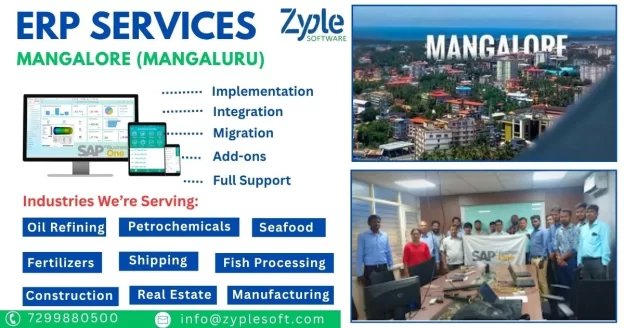
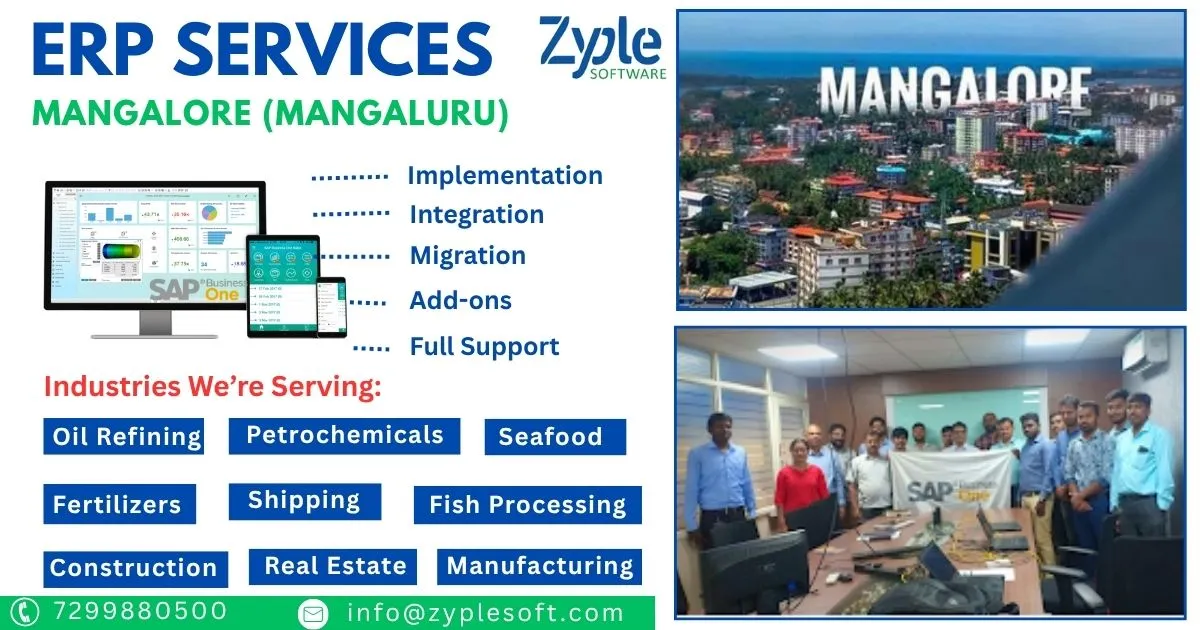
          erp services in mangalore (Mangaluru)

          ERP Services Provider in Mangalore (Mangaluru)

          ERP Services in Mangalore (Mangaluru)

          erp services in mangalore (Mangaluru)

          In today’s dynamic business environment, Enterprise Resource Planning (ERP) is no longer an opulence but a fundamental. They facilitate processes, improve productivity, and provide a uniform view of your business. At Zyple Software, we specialize in providing customized ERP solutions that cater to the unique needs of your business.

          There are industries in Mangalore such as oil refining, petrochemicals, fertilizers, shipping, seafood, and fish processing.

          Why SAP Business One ERP for businesses in Mangalore?

          SAP Business One is the right choice for businesses in Mangalore because it provides an inclusive, integrated solution to manage different business processes, improve efficiency, and drive growth. Its scalability and affordability make it suitable for small and medium-sized enterprises (SMEs) in the region, helping them facilitate operations and make better decisions.

          Here are the reasons why SAP Business One is beneficial for businesses in Mangalore:

          1.Improved Efficiency and Facilitated Operations

          It integrates all key business areas, such as sales, inventory, purchasing, operations, and financials, into a single system, eliminating repetitive data entry and improving overall efficiency. It automates routine tasks, relieving employees to focus more on strategic activities. It provides real-time data and analytics, allowing businesses to track performance, identify trends, and make better decisions.

          2.Improved Financial Management

          It provides robust tools for financial management, such as accounting, reporting, and cash flow management, leading to better financial control. It provides real-time insights into financial performance, helping businesses make better decisions about investment, pricing, and more.

          3.Optimized Inventory Management

          Helps businesses track inventory levels, manage stock movements, and optimize inventory to achieve demand, minimizing waste and costs. By facilitating inventory management, businesses can minimize holding costs, storage costs, and the risk of shortages or overstocking.

          4.Improved Customer Relationship Management

          Manages all customer relationship interactions and data in a single place, providing a complete view of the customer relationship. It enables businesses to personalize customer interactions, improve service, and build stronger relationships.

          5.Easy to use and Affordable

          SAP Business One is customized to scale with the growth of the business, adjusting to increasing transaction volumes, users, and data. It provides a cost-effective solution for SMEs, with flexible pricing options and lower total cost of ownership compared to traditional ERP systems.

          6.Local Support and Expertise

          Several SAP partners in Mangalore and Karnataka provide implementation, support, and customization services, ensuring businesses receive the necessary assistance. SAP solutions can be designed and extended to meet the specific needs of different industries in Mangalore, such as manufacturing, trading, and retail.

          SAP Business One ERP Services in Mangalore (Mangaluru)

          The company is offering end-to-end ERP support in Mangalore with a wide array of SAP Business One services, which are

          1.License Procurement and Installation

          Smart investment decisions can be made on license procurement and installation.

          2.Implementation and Customization

          Our company is one of the leading ERP service providers in Mangalore. Our team operates on the ASAP model of implementation. With over 50 successful SAP B1 implementations and a decade long expertise, we know how to achieve your special business orders.

          3.SAP Business One SQL to HANA Migration

          As a preferred ERP service provider in Mangalore, we handle all facets of SAP Business One, from SQL to HANA. This involves comprehensive assessment, planning, application readiness, data migration, thorough testing to go-live, and support.

          4.Add-Ons Development

          Our company provides more than 20 add-ons for more than 20 industries, such as WhatsApp integration, plant maintenance, and more. After implementing more than 20 SAP Business One add-ons across different industry verticals, we have gained unparalleled expertise to render you the exact business solution.

          5.Upgradation (Standard Products and Add-Ons)

           Move firmly to the newer version with our SAP Business One upgrade services.

          6.Cloud Hosting Services

          We deliver cloud hosting and managed services to keep your business application and IT infrastructure up and running on the cloud. We provide an innovative cloud hosting service custom-built to meet the unique needs of customers economically.

          7.Training and Documentation (On-Site and Off-Site)

          Gain all the essential support and training to start using this smart software without any complexity. We provide expert ERP solutions in Mangalore to match your accurate business needs.

          8. Support

          We render 24 x 7 support via our dedicated portal to handle all your questions and requests.

          Industry Coverage Relevant to Mangalore (Mangaluru)

          Here are industry-specific modules of SAP B1 for Mangalore businesses:

          1.Oil Refining

          From inventory management to inventory control and project management, it helps facilitate operations, improve efficiency, and optimize decision-making of oil refining businesses.

          2.Petrochemicals

          Financial management, inventory control, production planning, supply chain management, and regulatory compliance are beneficial for petrochemical businesses.

          3.Fertilizers

          Sales and customer relationship management, financial management, inventory and purchasing, production planning, and business intelligence optimize operations of fertilizer businesses.

          4.Shipping

          Financial management, customer and sales management, inventory control and purchasing, production planning, business intelligence, human resources management, service management, and administration to benefit shipping businesses.

          5.Seafood

          Inventory management, supply chain optimization, production planning, regulatory compliance, financial management, and business intelligence to facilitate operations, improve efficiency, and optimize overall business management of seafood businesses.

          6.Fish Processing

          Inventory management, production planning, supply chain management, financial management, and regulatory compliance to optimize fish processing operations.

          Why Zyple Is Right for SAP ERP Service in Mangalore

          1.SAP Business One Expertise

          Zyple Software is a certified SAP Business One partner with a strong focus on this distinct ERP solution.

          2.Industry Experience

          They have experience working with different industries, such as manufacturing, construction, retail, services, and more, allowing them to design solutions to specific needs.

          3.End-to-end Services

          Zyple provides a full suite of SAP services, such as implementation, customization, integration, and ongoing support.

          4.Scalable and Cost-effective Solution

          They deliver ERP systems that can grow with your business and are customized for both SMEs and larger enterprises.

          5.Proven Implementation Methodology

          Zyple’s 6-phased SAP implementation methodology ensures an organized and successful deployment process.

          6.Strong Support System

          They offer comprehensive support through various channels like email, WhatsApp, phone, and ticket portals.

          7.Customer Satisfaction

          Zyple is recognized for its customer-focused approach, with many businesses praising their professionalism and prompt delivery.

          ERP Implementation Process Overview

          1.Planning

          Evaluates the organization’s current systems and processes and defines the distinct business requirements the ERP system will need to support.

          2.Design

          Working with the ERP vendor to customize the specific components and aspects of the ERP software are incorporated in this phase.

          3.Build

          Incorporates building and configuring the specific components and features of the ERP system defined in the design phase.

          4.Deployment

          Setting up the new ERP system, data migration, and process migration to the latest system are included in this phase.

          5.Ongoing Support and Maintenance

          Involves consistent training and support for users and regular maintenance and upgrades to the system.

          Business Outcomes for Industries in Mangalore (Mangaluru)

          • It improves production scheduling, inventory control, procurement management, and real-time analytics.
          • It helps retailers manage sales, inventory, and customer relationships.
          • It ensures timely deliveries, minimizes stockouts, and optimizes overall supply chain efficiency.
          • It helps in tracking project progress, managing billing, and ensuring projects stay within budget.
           
          Are you looking for ERP for your Business or Industry? Fill you details in contact form. Our tam will reach you soon.
           

            SAP Business One for Printing Industry

            SAP Business One for Printing Industry

            SAP Business One for Printing Industry

            SAP Business One for Printing Industry

            In a world where digital transformation is rapidly reevaluating industries, the printing industry is no exception. Printing businesses are facing various challenges, such as fluctuating raw material costs, growing pressure to adopt sustainable practices, and the need to facilitate operations to stay competitive. As customer expectations rise and compliance requirements tighten, staying ahead demands more than only traditional methods. This is where SAP Business One ERP emerges as a powerful solution, driving efficiency, minimizing waste, and improving profitability in the printing industry.

            It’s an inclusive business management solution that automates essential processes, provides real-time insights, and empowers printing businesses to make data-driven decisions. To learn more, book a SAP B1 demo. SAP Business One enables you to optimize every aspect of your business, from procurement and production to quality control and customer satisfaction.

            Challenges of the Printing Industry

            Here are the challenges faced by the printing industry:

            1.Print Specifications

            A lot of times it happens that the same print specifications are required for more than one client. Rather than defining them over and over again, you can save time by keeping digital documents on the system and managing them easily. The SAP Business One ERP software establishes a centralized database for you where you can store all this information for quick access and maintain uniformity of data across the business.

            2.Demanding Extra Work

            If you are not using any computerized system and a central database for the business processes, your operations will have to rely on labor to perform even the easy operations. If you’re using disintegrated and non-synched software for different operations, your employees will have to hinge on advanced programming. This means additional work and labor charges.

            3.Poor Quality Control

            Most businesses in your space operate on “fire and forget.” With the absence of automated software, there is no system in place that oversees printer failures, errors in the process, or any data-related issues. Very likely, any such issue is reflected as an operator’s inefficiency with no stringent check. Hence, resulting in poor quality control.

            4.Non-Synchronized System

            It is doubtful that you only have a single thermal printer to perform all the activities. To ensure that you have the best floor productivity, all these printers of different hardware and models must work together. And that is not done easily manually. Having automated software makes it easy to manage and execute.

            5.Human Errors

            Brand identity is made up of different elements. Also, having a great brand identity hints at more business and higher profits. Without an automated system in place to monitor and manage your processes, you are dependent on laborers who can make mistakes that can cost you heavily. Referring to the design over and over again, reliance on programming, etc., makes the process prone to errors.

            Why the Printing Industry Needs SAP Business One

            1.Tackling Supply Chain Challenges

            The printing industry depends on a complex supply chain, where even minor delays can impede production timelines. Procuring raw materials such as ink, printing plates, papers, and fabrics requires thorough planning and tracking. SAP B1 centralizes supply chain data management, automates order processing, and monitors vendor performance in real time. This reduces procurement errors and ensures raw materials arrive on time, minimizing downtime and improving production efficiency.

            2.Streamlining Production for Maximum Efficiency

            Printing production involves various stages, each requiring precise control over raw materials, production schedules, and quality standards. SAP Business One introduces automated production planning that eliminates manual errors, increases machine usage, and minimizes downtime. By analyzing historical data, SAP B1 recognizes production obstacles and suggests improvements that lead to consistent product quality and higher output.

            3.Enhancing Quality Control and Compliance

            Consistency in quality is foremost in the printing industry, where defects can lead to product recalls, customer dissatisfaction, and regulatory penalties. SAP B1 provides updated quality monitoring and batch traceability, ensuring that each production cycle complies with guidelines. The system automatically generates compliance reports, assisting manufacturers in maintaining transparency and meeting international regulations.

            4.Smart Inventory and Warehouse Management

            Overstocking results in increased storage costs, while stockouts disrupt production and impact customer satisfaction. SAP solutions ensure maximum inventory levels through automated demand forecasting and smart regeneration strategies. With real-time updates on stock movements, manufacturers can prevent dead inventory and avoid excess holding costs.

            5.Financial Visibility and Profit Maximization

            Profitability in the printing industry relies on controlling operational costs and optimizing resource utilization. SAP Business One provides advanced financial management tools that deliver detailed insights into revenue streams, cost structures, and margins. By automating financial processes and generating real-time reports, SAP Business One ERP enables decision-makers to identify areas of improvement and take corrective actions promptly.

            Features of SAP Business One for Printing Industry

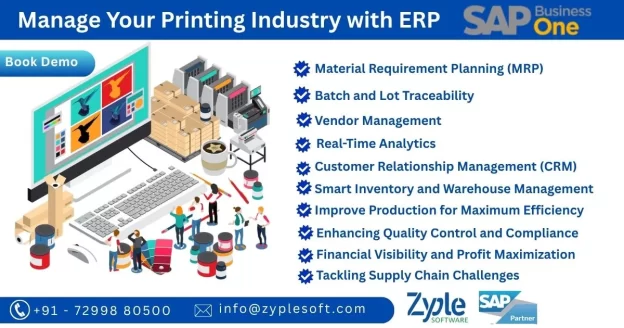
             1.Material Requirement Planning (MRP)

            Plan and schedule production efficiently by forecasting demand and ensuring suitable procurement of raw materials.

            2.Batch and Lot Traceability

            Monitor raw materials and finished products throughout the supply chain, ensuring quality control and compliance.

            3.Vendor Management

            Review supplier reliability, monitor procurement cycles, and maintain a steady supply of raw materials.

            4.Real-Time Analytics

            Gain quick insights into machine utilization, production efficiency, and downtime to improve operational performance.

            5.Customer Relationship Management (CRM)

            Optimize customer relationships through personalized service, better order tracking, and prompt resolution of inquiries.

            How SAP Business One Boosts Profitability in the Printing Industry

            1.Automating Repetitive Processes for Efficiency

            Order processing, invoicing, and compliance documentation are the manual workflows that are slow and unreliable. SAP B1 automates these tasks, decreasing manual intervention and enabling staff to focus on value-added activities. This not only maximizes operational speed but also minimizes the risk of major mistakes.

            2.Minimizing Waste Through Precision Planning

            Waste reduction is the priority in the printing industry, where surplus raw material usage and inefficient production schedules can ruin profit margins. SAP B1 uses predictive analytics and data-driven demand forecasting to decrease waste, increase raw material consumption, and position production schedules with customer demand.

            3.Strengthening Customer Relationships with Improved CRM

            In the printing industry, customer loyalty is built on delivering consistent quality, prompt deliveries, and responsive customer service. SAP B1 includes an integrated CRM module that enables businesses to oversee customer interactions, monitor order histories, and deliver personalized services. This promotes stronger customer relationships and improves satisfaction rates.

            4.Enabling Data-Driven Decisions

            Prompt and better decision-making is crucial for maintaining a competitive edge. SAP Business One prepares business leaders with updated analytics and financial insights, allowing them to recognize operational inadequacies, minimize expenses, and maximize profitability. Companies can revolve quickly to adapt to market changes and emerging trends using SAP B1.

            Conclusion of Printing ERP

            Zyple Software is an authorized partner in providing SAP implementation services, SAP solutions, HRMS, MES, and many more to more than 100 printing businesses and growing them.
             
            erp services in dharwad

            ERP Services Provider in Dharwad

            ERP Services in Dharwad

            erp services in dharwad

            Dharwad, a bustling industrial hub known for its diverse sectors, is experiencing unique challenges that demand innovative solutions. From electronics to rice mills, industries in Dharwad require robust systems to manage complex supply chains and increase production workflows. Zyple Software provides SAP Business One, a comprehensive ERP software that is designed to handle the unique needs of different industries.

            Why SAP Business One for businesses in Dharwad?

            SAP Business One is a useful ERP (Enterprise Resource Planning) solution for businesses in Dharwad because it provides a comprehensive, integrated system to facilitate operations, improve efficiency, and allow smarter decision-making, ultimately contributing to business growth and profitability. 

            Here are the reasons why SAP Business One is a good fit for the businesses in Dharwad:

            Integrated Operations

            SAP Business One integrates important business functions such as finance, sales, inventory, purchasing, and operations into a single system, eliminating data storage and repetitive entries. This results in increased efficiency and minimized errors.

            Enhanced Decision-Making

            Businesses in Dharwad can gain improved financial visibility and make better decisions on accurate, updated information using real-time data and reporting capabilities.

            Streamlined Processes

            This is specifically for businesses like those in the electronics or trading and distribution sectors in Karnataka.

            Scalability and Flexibility

            SAP Business One is designed to grow with the business, accommodating evolving needs and expansion plans without requiring continuous system overhauls. It can also be customized with various add-ons to meet specific industry or business requirements.

            Cost-Effectiveness for SMEs

            While providing enterprise-level features, SAP Business One is cost-effective for small and medium-sized businesses, providing the same powerful tools that big companies use.

            Improved Customer Relationships

            The system includes a robust CRM module to help businesses manage customer interactions, track sales opportunities, and improve customer service, which is crucial for sustained growth.

            Top ERP Services in Dharwad

            Installation and License Procurement

            It helps in choosing the best module of SAP B1 for your business. Thereby, it helps in selecting suitable installation and licensing procurement arrangements to make profitable business with the SAP Business One solution in Dharwad.

            Customization and Implementation

            It deals with full-stack deployment on-premise, in the cloud, or in hybrid setups. Module integration across finance, inventory, materials, and service can be done.

            SAP Business One SQL to HANA Migration

            There are few steps, such as evaluating all the processes, doing live testing, and delivering support, so that businesses can enjoy smooth and effortless migration.

            Add-Ons Development

            We are the certified SAP B1 add-ons partner catering to over 20+ industries to ensure that you do not miss out on any opportunities and business solutions.
             

            Industry Coverage Relevant to Dharwad

            Given Dharwad’s business profile, Zyple’s SAP B1 industry-specific modules are especially useful:

            Electronics

            Production, inventory management, purchasing, sales, finance and accounting, CRM, and business intelligence to optimize operations of electronics businesses.

            Textile

            Financial Management, Production and Operations, Inventory Management, Sales and Distribution, Customer Relationship Management (CRM), Purchasing and Procurement, and Analytics and Reporting to help textile businesses handle everything from raw material procurement and production planning to quality control, sales, and financial operations.

            Manufacturing

            Production management, materials requirement planning (MRP), inventory management, supply chain management, and sales and CRM are crucial for the manufacturing businesses.

            Heavy Engineering

            Financial management, project management, supply chain management, inventory management, and more to benefit heavy engineering businesses.

            Why Zyple is Best for SAP ERP Services in Dharwad

            1.SAP Partner Expertise

            Our organization is a recognized SAP Business partner with a focus on SAP B1, illustrating proficiency in delivering exceptional service and project outcomes.

            2.Tailored Solutions

            They highlight understanding unique business needs and configuring/implementing SAP solutions to align with those specific goals like customized add-ons and industry-specific approaches.

            3.Comprehensive Support and Training

            Our organization provides full support from initial consultation to consistent support to make sure a seamless and easy SAP B1 environment.

            4.Focus on Innovation and Modernization

            To gain a competitive advantage, they help businesses use cutting-edge technology, such as SAP B1 HANA and cloud platforms.

            5.Local Insight with Global Expertise

            While emphasizing local understanding, Zyple integrates this with global-grade SAP expertise to deliver solutions that are affordable, easy to use, and designed for businesses in Dharwad.

            6.Proven Track Record

            Zyple has extensive experience with SAP implementations across different industries in India, such as manufacturing, construction, retail, pharma and services.
             

            Overview of ERP Implementation Process

            1.Planning

            This important phase involves determining project scope, objectives, timelines, and budget. It also includes identifying key stakeholders, evaluating current business processes, and selecting the right ERP solution.

            2. Configuration

            Once the ERP system is preferred, it needs configuration to position with the organization’s distinct requirements and workflows. This may involve designing the software, setting up user roles and permissions, and defining data migration strategies.

            3.Data Migration

            Progressing data from legacy systems to the latest ERP system is a necessary step. This involves clearing, verifying, and transforming data to ensure accuracy and consistency in the latest system.

            4.Testing

            Unit testing, integration testing, user acceptance training (UAT), and performance testing are incorporated in this stage of ERP implementation.

            5.Training

            End-users require proper training on how to use the new ERP system effectively. This training should involve system functionality, navigation, and specific workflows pertinent to their roles.

            6.Deployment and Go-Live

            This may involve a progressive roll-out or a big bang approach, depending on the organization’s needs and complexity.

            7.Post-Implementation Support

            Continuous support is crucial for addressing user questions, resolving issues, and ensuring the system continues to meet the organization’s needs. This may incorporate technical support, maintenance, and system updates.

            Business Outcomes for Industries in Dharwad

            • Improved production scheduling, optimized inventory control, better procurement management, and inclusive real-time analytics for decision-making.
            • Boosted operational efficiency, improved decision-making, and minimized costs through automation and real-time insights.
            • Data security and providing real-time availability of information, which is important for managing financial transactions and client data.
            • Automation of many business processes, minimizing manual effort and improving overall operational efficiency across different departments.
            • Higher accuracy in data management and user-friendliness to accommodate business growth and changing needs.
            • Handling supply chain challenges by enabling efficient tracking of goods, managing inventory, and optimizing final delivery to customers. This can lead to minimized lead times and improved customer satisfaction.
            • Management of customer interactions, tracking sales opportunities, and optimization of overall customer service through better information management.
            erp services in palakkad

            ERP Services Provider in Palakkad

            ERP Services in Palakkad

            erp services in palakkad

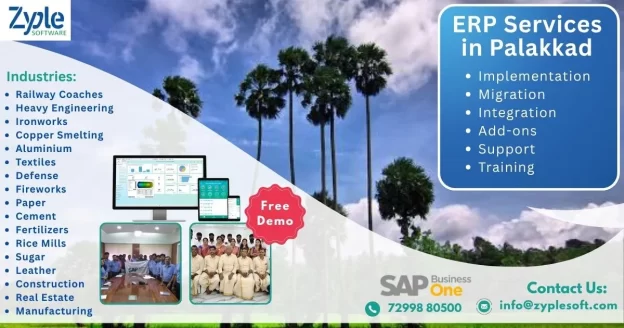
            In today’s increasingly fast-paced business environment, ERP software plays a key role in integrating a variety of everyday work processes ranging from taking customer orders and organizing operations to maintaining inventory and financial records. Also, optimizing the efficiency of business activities in any enterprise is crucial. ERP is also credited with rigorously managing and systematizing business resources in Palakkad industries such as:

            • Railway Coaches
            • Heavy Engineering
            • Ironworks
            • Copper Smelting
            • Aluminium
            • Textiles
            • Defense
            • Fireworks
            • Paper
            • Cement
            • Fertilizers
            • Rice Mills
            • Sugar
            • Leather
            Today, many companies in Palakkad continue to make the same old mistake of depending on legacy software to increase business productivity. Zyple Software offers SAP Business One, an advanced ERP system that is coordinated with the latest technologies in the industry and is known for infusing flexibility and mobility into clients’ everyday business processes. Our end-to-end ERP services ensure that every enterprise receives the most advanced ERP systems and SAP implementation solutions.
             

            ERP Services Offered in Palakkad

            License Procurement and Installation

            When it comes to license procurement, you should make better decisions. SAP Business One licenses can be explained in detail, such as what they are, how much the price is, and how much time it takes to install. Smart judgments about license procurement and installation can be made.

            SAP Business One SQL to HANA Migration

            All the aspects of the SAP Business One SQL to HANA migration can be managed easily. There are components of this process, such as thorough assessment, application readiness, gathering needs, planning, designing, data migration, go-live, and support.

            Training and Documentation

            Most of your investment in SAP Business One can be made with the help of teaching you how to use it. With all you need, begin to use this secure, easy-to-use and enterprise-ready software immediately.

            Support

            We deliver services through our committed support portal to manage all your questions and needs. Our organization provides essential business support and advice to ensure that your business application is consistently available and operational.
             

            Industry Coverage Relevant to Palakkad

            As per Palakkad’s business profile, Zyple’s SAP B1 industry-specific modules are especially beneficial:

            1.Railway Coaches

            It includes Production Planning (PP), Materials Requirement Planning, Inventory Control and Purchasing, Financial Management, and so on.

            2.Heavy Engineering

            Financial management, inventory and warehouse management, project management, sales and customer relationship management, and more are important modules in this sector.

            3.Ironworks

            Inventory management, production planning, quality control, and Supply Chain Management offering to Palakkad’s ironwork businesses.

            4.Copper Smelting

            Materials Requirement Planning (MRP), Purchase Planning, and Service Management to support copper smelting businesses.

            5.Aluminium

            Project Management, Resource Planning, Inventory Management, and Reporting and Analytics to benefit aluminium businesses.

            6.Textiles

            Quality management, CRM, and analytics to optimize textile operations.

            7.Fireworks

            Financial management, production planning, and business intelligence to assist fireworks businesses.

            8.Paper

            Production planning, inventory management, and financial management to benefit paper businesses.

            9.Cement

            We optimize cement operations through Inventory Management, Sales and Distribution, and Production.

            10.Fertilizers

            Quality control, purchase, inventory, and analytics to benefit fertilizer businesses.

            11.Rice Mills

            Financial Management, Sales and Distribution, Purchasing and Operations, and Inventory and Warehousing to support rice mill businesses.

            12. Sugar

            Financial Management, Production Planning and Control, Inventory Management, and Supply Chain Management to optimize sugar operations.

            13. Leather

            Customer and sales management, inventory and purchasing control, and business intelligence to support leather businesses.
             

            Why Zyple is Selected for SAP ERP Services in Palakkad

            1.Consultation and Needs Assessment

            ERP consultants in Palakkad can evaluate your business needs and suggest suitable SAP solutions.

            2.System Implementation

            They can help with the installation and configuration of SAP B1 software to position it with your specific requirements.

            3.Customization

            SAP B1 systems can be designed to fit unique business processes and workflows.

            4.Training and Support

            Many SAP Business One partners deliver training for your staff on how to use the SAP B1 ERP system effectively, along with the ongoing support.

            5.Integration

            They can integrate SAP with your current systems to create a balanced IT environment.
             

            Business Outcomes for Industries in Palakkad

            • SAP B1 offers optimized production scheduling, increased inventory control, improved procurement management, and comprehensive real-time analytics for decision-making.
            • SAP B1 supports managing sales, inventory, and customer relationships, leading to increased efficiency and customer satisfaction.
            • SAP B1 helps manage the supply chain, inventory, and customer orders for wholesale distributors, ensuring timely deliveries, reducing stockouts, and improving overall supply chain efficiency.

            Steps in ERP Implementation Process 

            1.Discovery and Planning

            In this stage, the ERP project team generally contains an executive sponsor, a project manager, and representatives from the departments that will use the system. Involving senior management is crucial to ensure the project gets the resources it needs and to provide the backing required to implement change across the organization. The team may select an ERP system during this stage, as the organization expands a clear idea of its requirements.

             2.design

            The design stage operates from comprehensive requirements and an understanding of current workflows to enlarge a thorough design of the new ERP system. This includes designing new, more effortless workflows and other business processes that take advantage of the system. It’s important to involve users in the design stage, since they have the most intimate understanding of existing business processes. Involving them in the design also helps to ensure that they’ll embrace the new system and take full advantage of it.

            3.Development

            The development stage can begin where there are clear design requirements. This involves configuring where it is necessary and designing the software to support the redesigned processes. It may also include developing incorporation with any of the organization’s current business applications that won’t be replaced by the ERP system.

            4.Testing

            Testing and development may occur simultaneously. For example, the project team may test certain modules and features, develop fixes or adjustments based on the results, and retest, or it may test one ERP module while another is still in development. Initial testing of the primary functions of the software should be followed by rigid testing of the full capabilities of the system, such as allowing some employees to test the system for all their day-to-day activities. This stage should also incorporate testing of the migrated data and include introductory and end-user training.

            5.Deployment

            This is the stage where project managers should be readily available to answer questions, assist users in understanding the system, and attempt to fix any issues. It may take time for users to adjust to the system and achieve the expected productivity gains.

            6.Support and Updates

            Training your ERP implementation post deployment helps to keep users happy and ensure the business achieves the useful benefits. During this stage, the project team will be responsible for listening to the user feedback and adjusting the system accordingly. Certain additional development and configuration may be needed as new features are added to the system.
             
            healthcare erp software

            What is Healthcare ERP?

            What is Healthcare ERP Software?

            healthcare erp software

            It is a software system that integrates different business processes within a healthcare business. It facilitates operations, improves communication, and optimizes data management across different departments, ultimately aiming to enhance patient health care and operational efficiency.

            What is ERP in healthcare?

            Enterprise Resource Planning (ERP) systems are important in supply chain management and inventory control. It involves integration of different aspects of the supply chain management, from procurement and supply chain management to distribution and inventory tracking.

            ERP Software which is suitable for the Healthcare Industry in India

            SAP Business One is an inclusive ERP system that can be productively utilized in the healthcare industry to facilitate operations, improve patient care, and optimize financial management. Integration of different aspects of healthcare operations into a single platform, such as patient management, appointment scheduling, inventory control, financial accounting, and compliance, can be done using this ERP software.

            Types of ERP Systems in Healthcare

            There are different types of ERP systems available in the market, and you should find the right choice for your healthcare business. Let’s have a look at them:

            1. On-Premise ERP System

            Healthcare servers and devices host everything giving them complete server ownership using on-premise ERP system. Facilities that require a high level of security and privacy typically choose this type of ERP system.

            2. Cloud-Based ERP System

            It guarantees that the data is updated in the centralized software and is accessible to everyone who has permissions in this type of ERP system. For support, updates, training, and customization, the software vendor will be responsible.

            3. Hybrid ERP System

            Its purpose is to provide flexibility to host and set up services as per their requirements.

            Key Features of Healthcare ERP

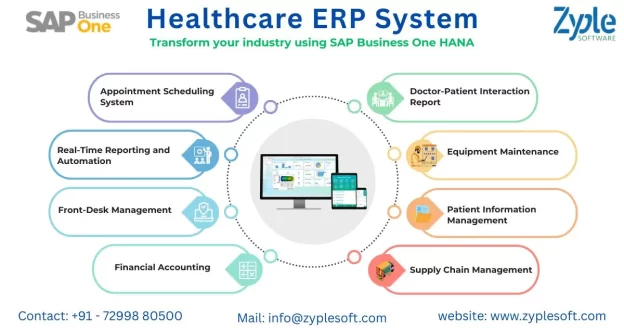
            1. Appointment Scheduling System

            It has a record of the time, date, and place of scheduled appointments as well as medical examinations or forecasts of indoor, outdoor, or remote patients.

            2. Doctor-Patient Interaction Report

            It is a single platform for all important schedules, past and future examination dates, prescriptions, and test reports of patients in a comprehensive manner.

            3. Front-Desk Management

            The ERP software for the healthcare industry has a unique module to support the admin to  handle various processes at once from a single, interactive dashboard.

            4. Financial Accounting

            This is one of the most crucial features of a healthcare ERP solution that facilitates financial processes and helps you to plan the budget accordingly.

            5. Equipment Maintenance

            This feature helps your organization operate the equipment and connected devices in various procedures and report immediately if any of these need servicing.

            6. Real-Time Reporting and Automation

            The specialized ERP healthcare software can automate processes and deliver real-time reports on predetermined actions and diagnoses or medications.

            7. Patient Information Management

            This feature of the healthcare ERP system helps organizations to facilitate patient data storage, recovery, and capture.

            8. Supply Chain Management

            Integration of supply chain management is important for healthcare businesses to ensure the easy accessibility of medical supplies, facilitate procurement processes, and control costs. Purchase order tracking, vendor management, inventory management, and demand forecasting are included.

            9. Human Capital Management

            It facilitates staff recruitment and onboarding, tracks credentials, and supports career growth with predictive analytics.

            Benefits of ERP in Healthcare

            With technological advancements in the industry, many healthcare corporations are considering software integration for business growth as it provides personalized solutions and delivers quality services. When it comes to integrating an ERP system in healthcare, you must know its benefits and role in the growth of your facility.

            1. Managing Medical Records

            With the help of SAP solutions, the end users will be able to add, update, access, and monitor the medical records of every patient. This will minimize time consumption and complexities and overburden the staff, leading to a more focused approach to patients’ concerns.

            2. Gaining Data Privacy

            When you have a healthcare ERP system, it enables you to add authorizations and permissions for each user based on their role in the healthcare facility. This will guarantee your data is safe from online threats and breaches. Also, securing patients’ information helps to acquire their trust and deliver better care.

            3. Saving Operational Costs

            To ensure a seamless process in the healthcare sector using SAP services, maintaining a balance between labor costs and inventory is important. Healthcare providers can monitor their expenditures and define labor costs in detail.

            4. Following Industry Protocols

            Healthcare businesses are always bound to follow standard protocols. With SAP implementation, businesses can ensure that all operations are secure, transparent, and monitored regularly. Whether it is legacy systems, record-maintaining methods, audits, or upgrading systems, everything will be organized.

            5. Analysis and Planning

            Gaining real-time insights about patient visits, costs, inventory, labor, and more helps you analyze your labor performance. This information can be accessed by the top management to understand the area of improvement and plan for a better solution for their patients.

            6. Collaborations

            Different processes coincide in a small or large healthcare facility, which might be challenging to keep track of. The process becomes easy and productive if your team knows how to embrace an enterprise system. Collaborating with them in a unified system will keep everyone connected and updated.

            Things to Consider While Choosing the Best ERP System for Healthcare

            1. Identify Your Healthcare Needs

            There are many types of healthcare providers, including medical facilities, clinics, health insurance providers, and pharmaceutical companies, having distinct needs and requirements.

            For instance, hospitals might need an ERP system with features, such as medical billing, bed allocation, and patient management while facilitating inventory management. Instead, ERP services are prioritized by clinics to increase clinical processes and centralize patient data via EHR (Electronic Health Records) integration.

            2. Evaluate ERP Industry-Based Features

            Healthcare ERP systems don’t have a one-size-fits-all approach. Therefore, evaluating industry-specific features is essential. Look for a healthcare ERP solution that supports data security and complies with regulatory compliance standards and medical device integration.

            3. Consider Integration Capabilities

            Healthcare enterprises depend on different systems, such as patient portals, laboratory systems, and EHRs, functioning smoothly. Therefore, while choosing an ERP system for a healthcare business, it’s important to ensure that it integrates seamlessly with your existing systems.

            4. Assess Vendor Capabilities

            You should pay heed to these vital aspects when evaluating your potential ERP software development services:

            • Cloud or On-Premise: There is a need to select between a cloud-based ERP system (remote access, affordable, scalable) or an on-premise ERP system (higher upfront cost, greater control).
            • Support and Training: Examine the degree of client support your service provider delivers.
            • Client Feedback: Meticulously research your vendor’s reputation by reviewing client feedback, testimonials, and case studies from other healthcare providers.
            • Upgrades and Maintenance: Select an ERP software company that provides frequent software updates, scalability options, and security patches, which will help you achieve the ever-changing needs of the healthcare organizations.

            5. Work With Experts

            Before taking the final call, seeing the ERP system up and running is critical. You can schedule SAP B1 demos to evaluate the system’s performance, features, and usability under real-life conditions.

            Conclusion of Healthcare ERP System

            Zyple Software provides SAP Business One ERP to transform your healthcare operations to address your company’s unique needs. If you’re looking to facilitate patient care, optimize financial management, or improve compliance, this ERP software is here to revolutionize your practice.

            Read Also: SAP Business One for Healthcare Industry

            retail erp software

            Retail ERP Software

            What is Retail ERP Software?

            retail erp software

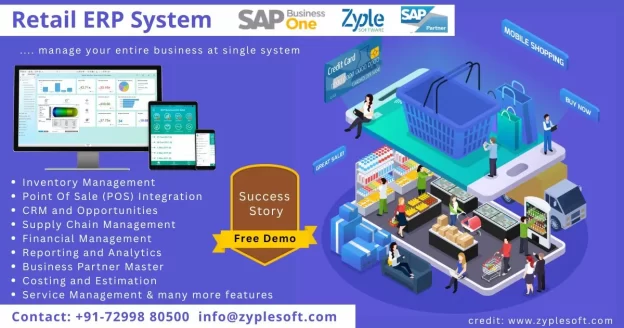
            It is an inclusive software system customized to integrate and manage various business operations within a retail environment. It helps facilitate processes like inventory management, point-of-sale (POS) operations, customer relationship management (CRM), and supply chain management, giving retailers a centralized view of their business. By automating tasks and providing real-time data insights, these ERP systems optimize efficiency, improve decision-making, and ultimately contribute to increased profitability and customer satisfaction.

            The Best ERP Software for Retail in India

            SAP Business One is the most popular ERP software for retail businesses in India, specifically for small and medium-sized enterprises (SMEs). Its strength lies in its ability to facilitate retail operations, improve customer experiences, and provide comprehensive insights through its integrated platform.

            Retail ERP Examples

            1.SAP B1

            It is an ERP solution that can be designed for the retail sector. It provides features such as inventory management, sales, and financial management.

            2.NetSuite

            It is a leading cloud-based ERP system with a powerful retail focus. It provides modules such as inventory management, sales, financials, and more.

            3.Microsoft Dynamics 365

            It is an inclusive ERP solution with robust retail capabilities, such as sales, inventory management, and customer relationship management.

            4.Oracle Retail

            It is a suite of solutions specifically customized for the retail industry. It is known for its strength in areas like supply chain management, point-of-sale systems, and more.

            Benefits of Retail ERP Software

            Behind every retail success story is a web of compound operations aimed at handling inventory and creating pleasant customer experiences. ERP systems facilitate operations and build agility, efficiency, and customer satisfaction. Here are common benefits provided by retail ERP systems.

            1. Streamlined Operations

            In the retail sector, customer demands shift quickly, and different sales channels operate simultaneously, making it important to have real-time visibility and coordination across every part of the business to avoid stockouts, delays, or missed sales opportunities. SAP solutions cut through the noise by pulling everything, such as inventory, sales, and supply chain operations, into a single platform.

            2. Enhanced Data Management

            Retail data is the lifeblood of smart decision-making. Also, managing it with spreadsheets and disconnected systems is nearly unfeasible. SAP services improve data management by collecting information from every corner, such as sales figures, customer trends, and supply chain performance, and turning it into clear, actionable insights. With an ERP system, for instance, retailers can recognize which products are hits with customers, spot trends early, and quickly adapt pricing or promotions.

            3. Comprehensive Financial Insights and Reporting

            Without a clear financial view, it’s easy to miss core details, like how much revenue is being drained by inefficiencies or where profitability could be boosted. A retail ERP system centralizes financial data, from daily sales transactions to vendor payments, and turns it into inclusive, real-time reports. Rather than waiting for monthly statements, retailers can dive into comprehensive financial insights whenever they need them to track margins or prepare for tax season, for example. This capability delivers the foundation of managerial flexibility and rapid adjustments so that retailers can stay at the top of financial performance at all times.

            4. Improved Customer Experience

            A great customer experience is the heart of every successful retail business. But when systems are disconnected, delivering it consistently can be a challenge. By linking everything from inventory to sales data in one place, a retail ERP system allows retailers to deliver smoother, faster service to reduce out-of-stock frustrations and speed up checkouts. These systems also allow retailers to personalize customer interactions and respond quickly to the needs to create customer experiences that keep customers satisfied and coming back.

            5. Accurate Demand Forecasting

            By analyzing sales data, seasonal trends, and supplier performance in a timely way, an ERP system provides tools to forecast demand more precisely. Rather than overstocking slow-moving items or running out of best sellers during peak time, retailers can exactly anticipate what their customers need and when.

            6. Effortless Automation

            Behind every retail operation, there’s a cluster of repetitive tasks, including manual inventory updates, order tracking, and invoice processing, that can eat up valuable time. A retail ERP system transforms these tedious tasks through automation. Inventory levels are updated quickly after each sale, and purchase orders are generated automatically when stock runs low. This not only saves time. It eliminates human errors and clears employees to focus on higher-value work, such as engaging with customers or planning for growth.

            7. Scalability

            As a retail business grows, managing operations can quickly become immense. What worked when a company had a single store or online channel can suddenly feel deficient. An ERP solution can scale with a business when a retailer wants to open a new location, expand into e-commerce, or add more products to its lineup. There’s no need for more spreadsheets or extra disconnected systems. Everything from inventory to sales tracking expands efficiently, delivering retailers with the power to scale without headaches. Growth is no longer a challenge, and it’s an opportunity using a retail ERP system.

            Key Factors in Selecting the Right Retail ERP Solution

            Selecting the right retail ERP system is all about finding the proper fit for a company’s unique business needs. The best solution is one that handles a business’s complexity, integrates seamlessly with existing tools, and delivers real value long after SAP implementation. When evaluating retail ERP solutions, think about the following six factors:

            1. Business Size and Complexity

            The size and complexity of a retail business are main considerations when choosing an ERP system. A small boutique with few shelves of products doesn’t need the same level of sophistication as a multi-location retailer juggling inventory across physical and online stores. A neighborhood shop might look for a simple item to monitor sales and restock items, while a large department store may require an ERP system that can comfortably manage thousands of SKUs and synchronize operations.

            2. Industry-Specific Requirements

            In retail, every sector faces unique specific challenges that demand designed solutions. The right retail ERP system accommodates these differences and provides specific capabilities to handle them. For instance, the grocery store needs real-time inventory tracking to avoid spoilage, while the clothing boutique will benefit more from a system that governs seasonal collections and size variations.

            3. Integration with Existing Systems

            Retailers already depend on tools like POS systems, ecommerce platforms, and CRM software. If a new ERP system doesn’t appropriately connect with them, things may start to break down. The right ERP system efficiently integrates with ERP services to keep data flowing seamlessly and operations thriving without a hitch.

            4. Ease of Use and Flexibility

            For almost every company, growth is the goal. That’s the reason why ease of use and flexibility in an ERP system are so crucial. As a business expands, opening new stores or diving deeper into e-commerce, its systems need to expand with it. The right ERP system evolves alongside the business to manage increased inventory, support additional sales channels, and adapt to new market demands. Picture a small shop expanding into becoming a multilocation retailer. Flexibility helps the system shift gears, scale up, and customize new requirements as the business changes, so it’s always ready for the next opportunity.

            5. Cost and Return on Investment (ROI)

            When reviewing the cost of a retail ERP system, it’s easy to focus on the immediate expense. A smart ERP choice refines operations and actively promotes growth by reducing inefficiencies, minimizing costly errors, and speeding up functions like inventory management and customer orders.

            6. Vendor Reputation and Support

            It’s also about the company behind it. Retailers require partner relationships they can depend on for smooth implementation, regular updates, and quick problem-solving when issues arise. Ensure you research customer reviews, case studies, and industry feedback to see how vendors handle long-term relationships, system updates, and problem resolution for retail businesses similar to yours.

            Features of Retail ERP

            Inventory Management

            These ERP systems provide instantaneous visibility into inventory levels across all locations, such as stores and warehouses. This helps avoid stockouts and overstocking, optimize inventory turnover, and manage product lifecycles effectively.

            Point Of Sale (POS) Integration

            Integration with POS systems allows seamless sales transactions, real-time sales data capture, and accurate reporting.

            Customer Relationship Management (CRM)

            Retail ERP systems often incorporate CRM functionalities to manage customer data, track interactions, personalize marketing efforts, and improve customer loyalty.

            Supply Chain Management

            Features like demand forecasting, order management, and supplier management help increase the flow of goods from suppliers to customers as well as ensure timely delivery and efficient fulfillment.

            Financial Management

            Retail ERP software systems automate financial processes, such as accounting, accounts payable, accounts receivable, and reporting, optimizing accuracy and efficiency.

            Reporting and Analytics

            These systems provide detailed reporting and analytics capabilities, delivering insights into sales performance, customer behavior, and operational efficiency.

            Conclusion of Retail ERP Systems

            Zyple Software provides SAP Business One ERP, an inclusive solution for managing important business functions, such as inventory management, order processing, financials, and customer data. With real-time visibility, retailers can increase stock levels, improve order fulfillment, and build better customer experiences across online, in-store, and mobile channels.