Category Archives: SAP B1

SAP Business One ERP for Pesticide Industry
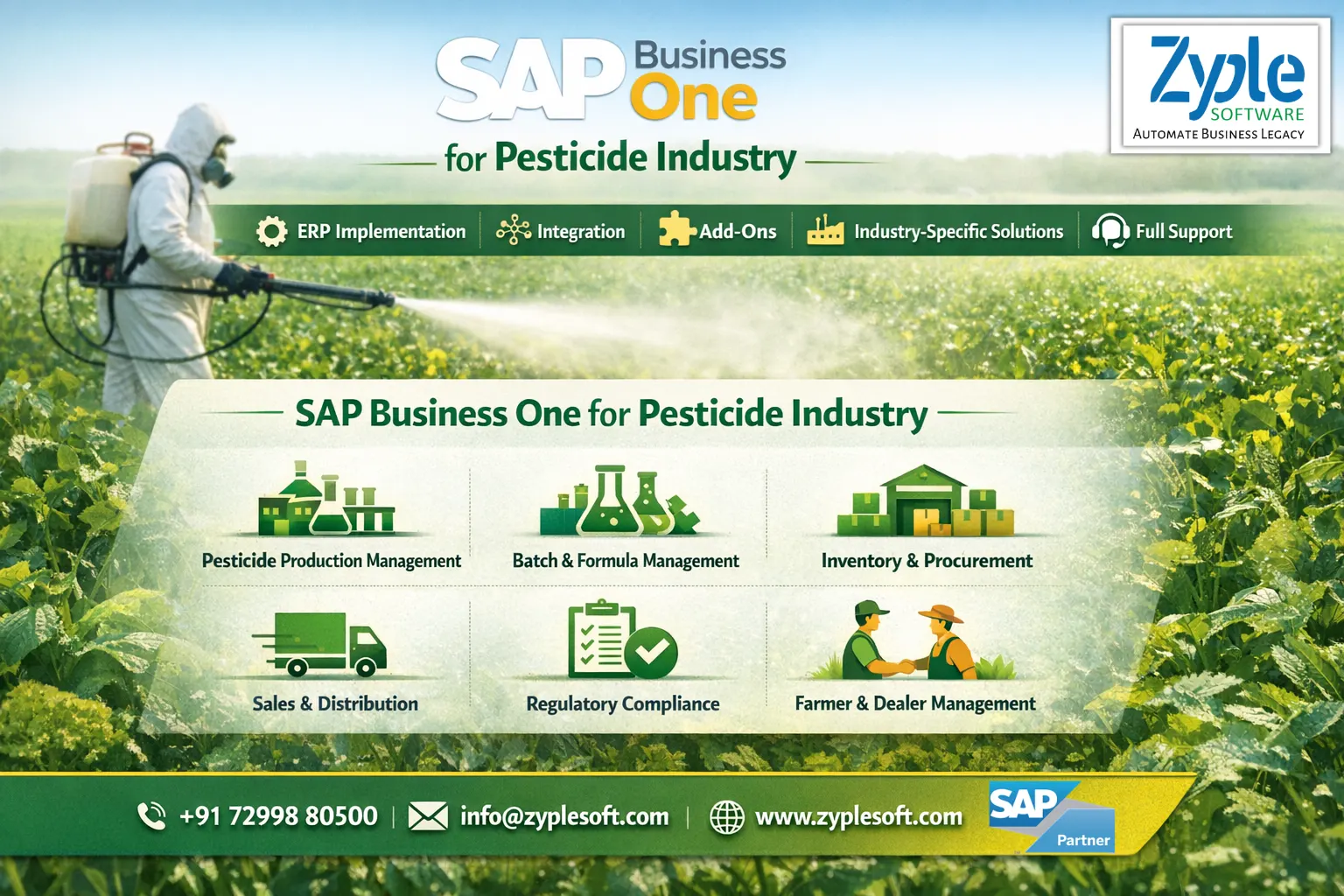
SAP B1 for Pesticide Industry

SAP Business One ERP for Pesticide Industry

SAP Business One ERP for Pesticide Industry

The pesticide industry operates in a highly regulated, seasonal, and distribution-centric environment. Many pesticide businesses depend on disconnected systems for production, inventory, sales, and compliance management, leading to limited visibility, manual documentation, stock imbalances, and delayed reporting. SAP Business One for pesticide industry delivers a unified platform that integrates production, quality, batch tracking, distribution, finance, and compliance, allowing real-time control and operational transparency across pesticide operations.

Challenges of the Pesticide Industry

The pesticide industry faces significant challenges, including stringent regulatory compliance (registration costs, bans), pest resistance requiring continuous innovation, and intense environmental and health scrutiny. Other key challenges include the need for sustainable alternatives (biopesticides), high R&D costs for new products, and disconnected supply chains.

1. Regulatory and Compliance Pressures

The pesticide industry faces high costs and time-consuming processes for the registration of new products. Government is increasingly imposing bans or restrictions on hazardous chemicals, requiring companies to continuously adapt to new environmental policies.

2. Pest Resistance

Pests are evolving to withstand commonly used chemicals, making current products less effective and forcing the industry to invest heavily in developing new, more potent formulations.

3. Environmental and Health Concerns

Pesticide residues are polluting soil, water, and air, leading to biodiversity loss and harm to non-target species. There is rising pressure regarding the acute and chronic health risks caused to farmers and consumers.

4. Shift Towards Sustainability

There is growing demand for eco-friendly alternatives, such as biopesticides. The industry faces the challenge of shifting from chemical-based products to biological ones, which often have shorter shelf lives and complex supply chain logistics.

5. Market and Economic Hurdles

The industry is dependent on imported raw materials, creating vulnerability to supply chain disruptions. Also, there is a need to educate farmers on correct usage to prevent misuse.

Features of SAP Business One for Pesticide Industry

1. Project Management

Planning, organizing, tracking, and controlling projects within the SAP B1 ERP system.

2. Human Resource Management

Maintaining employee records, tracking attendance, managing recruitment processes, and assessing workforce performance.

3. Sales and CRM

Handling sales activities and building strong relationships with customers.

4. Accounting

Managing and controlling all financial transactions.

5. Financial Management

Planning, evaluating, and controlling the financial resources effectively.

6. Production Planning and Control

Planning, scheduling, and handling manufacturing processes efficiently.

7. Purchasing

Handling the procurement of goods and services from suppliers.

8. Reporting and Analytics

Analyzing and providing meaningful reports for better decision-making.

9. Quality Control

Evaluating and maintaining the quality of products during purchasing, production, and delivery processes.

10. Inventory Management

Tracking, controlling, and managing the movement and storage of goods.

11. Service Management

Handling customer service operations and post-sales support.

12. Business Partner

Centralized master record to oversee all the information related to customers, vendors, and leads.

13. Industry-Specific Solutions

Managing the unique requirements and processes of different industries.

14. Material Requirements Planning (MRP)

Planning and handling the materials needed for production and operations.

15. Administration

Configuring, controlling, and managing system settings and user access.

Importance of SAP Business One for Pesticide Industry

The ERP system, SAP Business One is an essential enterprise resource planning (ERP) solution for the pesticides industry, allowing small and medium-sized enterprises (SMEs) to manage complex regulatory, safety, and production requirements within a single, integrated platform. It helps companies transition from manual, error-prone, and disconnected systems to a digitized, traceable, and efficient workflow.

1. Robust Regulatory Compliance and Safety

Automated management of safety data sheets (SDS) ensures that safety, environmental, and handling regulations are achieved. SAP B1 delivers inclusive tracking of hazardous substances, ensuring proper storage, handling, and documentation throughout the production cycle. The system delivers comprehensive audit trails and automates compliance reporting, minimizing the risk of penalties.

2. Batch/Lot Traceability and Quality Control

SAP B1 allows tracking from raw material receipt, through production, to finished goods distribution. Quality inspections can be embedded at different production stages, with automated alerts for deviations. The SAP software manages specific batch/lot criteria, helping in quick, efficient, and accurate recall processes if necessary.

3. Formulation Management

SAP B1 ERP helps record, manage, and standardize formulations to maintain high product quality across batches using SAP implementation.

4. Optimized Inventory and Supply Chain

The system evaluates the shelf life of raw materials and finished goods, minimizing spoilage. Inventory is updated automatically upon production or sales, minimizing overstocking and understocking. Material requirements planning (MRP) enables precise planning of production based on raw material availability and demand.

5. Cost Management and Profitability

SAP B1 ERP calculates the actual cost per batch, integrating material, labor, and overhead costs to deliver real-time visibility into product margins. By improving inventory control and production planning, the system helps reduce waste and minimize production costs.

6. Scalability

SAP Business One delivers enterprise-grade, industry-specific capabilities for small and medium-sized enterprises (SMEs) without excessive complexity.

Benefits of SAP Business One ERP for Pesticide Industry

SAP Business One software provides the pesticide industry an integrated solution to improve regulatory compliance, manage hazardous inventory, and optimize production formulas. It ensures precise batch traceability, minimizes waste through efficient inventory, and improves overall operational efficiency from raw material procurement to final delivery.

1. Batch Tracking and Quality Control

Allows full traceability of ingredients and batches, important for managing hazardous materials and maintaining compliance with safety regulations.

2. Regulatory Compliance

Automates documentation and reporting to achieve strict industry standards, such as good manufacturing practices (GMP) and environmental safety laws.

3. Formula Management

Securely stores, tracks, and handles complex, proprietary formulations to ensure consistent quality across production cycles.

4. Inventory Optimization

Delivers real-time visibility into inventory levels, decreasing overstocking and managing expiration dates, which is essential for chemical stability.

5. Production Efficiency

Facilitates manufacturing processes, improves material requirements planning (MRP), and optimizes resource allocation to reduce costs using SAP solutions.

6. Improved Supply Chain

Consolidates procurement, sales, and logistics, allowing better supplier management and faster, on-time customer delivery.

Conclusion of Pesticides ERP

Zyple Software provides SAP Business One ERP for pesticide industry, where pesticide companies gain a centralized platform to manage production, quality, inventory, distribution, finance, and compliance with full visibility and control.

Are you demanding an SAP Business One ERP for your business or industry?

Fill in all the details in the given contact form; our team will get back to you.
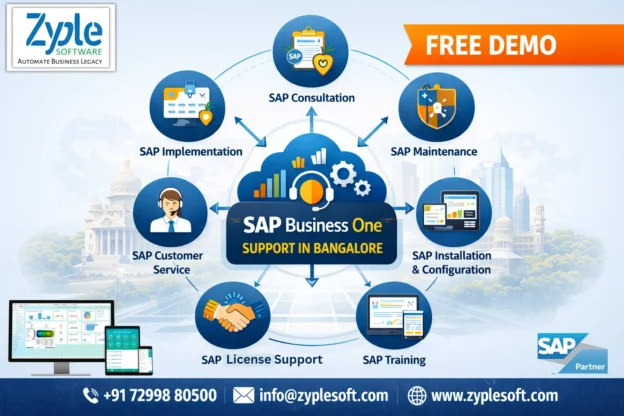
    SAP Business One Support in Bangalore

    SAP Business One Support in Bangalore

    SAP Business One (B1) Support in Bangalore

    SAP Business One Support in Bangalore

    What is SAP Business One Support for SMEs?

    SAP Business One support is a structured service designed to ensure the stability, performance, and long-term reliability of SAP Business One systems for small and medium-sized businesses in Bangalore. With professional SAP Business One support in Bangalore, businesses receive expert assistance to keep their ERP running seamlessly everyday.

    For SMEs in Bangalore, SAP Business One plays an essential role in minimizing operational risk. It includes functional and technical issue resolution, system monitoring, and continuous maintenance, helping businesses prevent downtime, data inconsistencies, and workflow disruptions.

    As businesses grow, their ERP environment becomes more inticrate. SAP Business One support ensures your system remains adaptable and future-ready, supporting new users, processes, integrations, and upgrades while maintaining performance and security.

    SAP Business One support allows SMEs in Bangalore to operate with confidence, knowing their ERP system is consistently monitored, maintained, and improved to support long-term business success.

    Why SAP Business One Support Is the Right Choice for Your Company in Bangalore?

    SAP Business One support delivers businesses in Bangalore with a reliable and future-ready framework to keep their ERP system stable, secure, and fully operational. More than just technical assistance, SAP Business One support ensures consistency across finance, sales, inventory, and operations, day after day.

    Whether your team is working from the office, remotely, or across multiple locations, SAP Business One ERP support in Bangalore ensures uninterrupted access to accurate business data. With expert monitoring, prompt issue resolution, and structured maintenance, your system remains performant and reliable at all times.

    By choosing expert SAP Business One support, businesses in Bangalore gain the confidence to scale, adapt to processes, and adopt processes, knowing their ERP environment is consistently maintained and supported by certified SAP experts. If you’re focused, book demo of SAP b1.

    SAP Business One Support Services Provided by Zyple in Bangalore

    1. 24/7 Technical and Functional Support

    • Dedicated support team to rectify system issues and user queries.
    • Consistent monitoring to ensure SAP B1 ERP system stability.
    • Faster response via support portals and helpdesk services.

    2. Post-Implementation Support

    • Assistance after SAP B1 ERP go-live to ensure seamless operations.
    • It includes bug fixing, troubleshooting, and performance optimization.
    • Consistent improvements and system fine-tuning.

    3. SAP Business One System Maintenance and Monitoring

    • It includes health system health checks and preventive maintenance.
    • Performance monitoring to prevent downtime.
    • Ensures high availability and safe SAP environment.

    4. Functional and Technical Support

    • It includes functional support for modules like finance, sales, inventory, and production.
    • Technical support covering database, server, and backend issues.
    • Support for both SAP B1 SQL and SAP B1 HANA.

    5. Upgrades and Patch Movement

    • It includes support for SAP Business One ERP version upgrades.
    • Add-on updates and collaboration management.
    • Ensures your system stays current and safe.

    6. User Training and Guidance

    • It includes on-site and remote training sessions for end-users.
    • Documentation and best practices for effortless system usage.
    • Helps increase user adoption and ROI.

    7. Add-On and Integration Support

    • Support for custom SAP Business One add-ons and third-party integrations.
    • Troubleshooting integration issues with external platforms.
    • Continuous improvement of business workflows.

    8. Data Management and Migration Support

    • Support with data corrections and management.
    • Migration support (e.g., SAP B1 SQL to SAP B1 HANA).
    • Data accuracy and integrity are ensured.

    9. Cloud and Infrastructure Support

    • It includes managed cloud hosting services.
    • Support for SAP B1 ERP infrastructure and server environments.
    • Ensures secure and adaptable SAP B1 ERP operations.

    10. Consulting and Continuous Improvement

    • Ongoing consulting to improve business processes.
    • Suggestions for SAP Business One ERP utilization.
    • Helps align SAP B1 with changing business needs.

    Importance of SAP Business One Support in Bangalore

    SAP Business One (SAP B1) support in Bangalore is important for ensuring seamless, localized ERP operations for SMEs and growing enterprises. Zyple Software has expertise in providing  implementation, consulting, add-on development, licensing, integration, migration, and support services to industries like manufacturing, construction, real estate, agriculture, financial services, healthcare,technology, energy, logistics, retail, infrastructure, EPC, and professional services in Bangalore.

    1. Regional Compliance and Expertise

    In Bangalore, Zyple has in-depth knowledge of local regulations, such as GST and other statutory requirements in India.

    2. Customized Implementation and Support

    Zyple assists in designing SAP Business One for specific workflows, providing both implementation and post-implementation assistance using SAP software.

    3. Rapid Problem Resolution

    Zyple ensures quick response times for technical support, reducing operational downtime and ensuring business continuity.

    4. Specialized Expertise

    Support teams in Zyple provide specialized services including SAP B1 SQL to SAP B1 HANA migration, cloud deployment, and system optimization to improve business efficiency.

    5. Industry-Specific Solutions

    Localized support enables implementing industry-specific modules, such as manufacturing, retail, construction, real estate, and logistics in the Bangalore region.

    Benefits of SAP Business One Support in Bangalore

    SAP Business One ERP support in Bangalore provides local expertise for manufacturing, retail, construction, real estate, and IT firms to improve, customize, and maintain their ERP systems. Main benefits include real-time decision-making, automated financial management, optimized supply chains, and improved regulatory compliance. Specialized local support ensures adaptability to support business growth.

    1. Local Industry Expertise

    Zyple provides specialized support for local industries in Bangalore, including manufacturing, retail, construction, real estate, logistics, EPC, and IT, with customized solutions for localized challenges.

    2. Improved Operational Efficiency

    Support services help businesses improve operations by integrating key functions, like finance, purchasing, and inventory, into one system, minimizing manual errors using SAP implementation.

    3. Real-Time Data and Analytics

    With support from Zyple, businesses can use SAP B1 HANA for real-time visibility into operations, allowing better, faster decision-making.

    4. Customization and Integration

    Zyple provides custom SAP solutions and integration with tools like CRM, HRMS, and banking systems, ensuring the software fits specific business workflows.

    5. Regulatory Compliance

    SAP B1 support helps companies like Zyple Software stay adherent to local Indian regulatory requirements and reporting standards.

    6. Scalability for Growth

    SAP Business One support ensures the ERP system expands with the company, adjusting new users and operations without interrupting workflows.

    Conclusion of SAP Business One ERP Support in Bangalore

    Zyple provides an array of support services, where companies can quickly update the program, select a plan for additional automation, and ensure the effective execution of upcoming projects.

    Are you looking for SAP B1 support in Bangalore for your business or industry? Contact with SAP Business One Partners in Bangalore near by you. (Example: Zyple Software)

    Fill in all the details in the dispensed contact form; our team will reach out to you.

      SAP Business One License in Bangalore

      SAP Business One License in Bangalore

      SAP Business One License in Bangalore

      SAP Business One License in Bangalore

      Discover Customized SAP B1 Software Pricing Structure in Bangalore

      We understand that the SAP Business One cost differs based on factors such as company size, user count, data complexity, and integration needs. As a trusted SAP Business One license partner in Bangalore, we specialize in crafting personalized blueprints to outline the exact SAP Business One pricing for your organization.

      With over decades of industry experience, the SAP Business One license in Bangalore helps you navigate through the complexities of SAP B1 software price and licensing costs, considering factors like purchasing process, database options (SAP B1 SQL or SAP B1 HANA), hosting preferences (cloud, on-premises, and co-located), and necessary maintenance and support.

      Whether it is manufacturing, construction, real estate, retail, or any other sector, our designed approach ensures that the SAP Business One cost remains within budget and aligns perfectly with the unique business model and SAP pricing.

      SAP Business One License Services Provided by Zyple in Bangalore

      1. License Procurement and Consultation

      • Helps businesses select the right license type (professional, limited, and more).
      • Delivers guidance on pricing, user count, and scalability.
      • Ensures you invest in the most affordable licensing model for your business needs.

      2. License Installation and Configuration

      • The entire setup of SAP B1 licenses on your system (on-premise or cloud).
      • Ensures correct activation and configuration of user licenses.
      • Arranges licenses with business roles and access levels.

      3. License Optimization and Management

      • Analysis of current licenses to avoid under or over utilization.
      • Helps handle user authorizations and compliance.
      • Advises on license upgrades or additional users as there is growth of business.

      4. Cloud Licensing and Subscription Models

      • Provides cloud-based SAP Business One licensing.
      • Helps minimize infrastructure costs with subscription-based licensing options.
      • Supports hybrid and adaptable licensing setups.

      5. License Upgrade and Migration Support

      • Assistance in upgrading licenses during version upgrades and SAP B1 SQL to SAP B1 HANA migration.
      • Ensures a seamless transition without data or access issues.

      6. Compliance and Audit Support

      • Helps in maintaining SAP licensing compliance.
      • Supports internal audits with correct license tracking and documentation.
      • Minimizes risks related to unauthorized usage.

      7. End-to-End Licensing and Implementation

      Zyple generally combines licensing with SAP implementation, add-on development, integration, migration, and training and support.

      What is the Cost of SAP Business One License in Bangalore?

      SAP Business One license cost in Bangalore significantly differs by licensing model, user type, and database choice. Perpetual licenses range approximately from ₹80,000 to ₹1,60,000 per user. Cloud subscription models generally start around ₹7,500 per user per month.

      What are the different types of licenses in SAP Business One?

      SAP Business One (SAP B1) licenses are named-user based, customized for different roles, like Professional (full access), Limited (Finance, Logistics, or CRM), and Starter Package (for small teams). They are available via perpetual or subscription models and deployed on-premise or in the cloud. Here are the types of SAP Business One licenses:

      1. Professional User License

      A professional user license delivers full access to all modules and functionalities within SAP Business One. This license is suitable for users who need inclusive access to perform a wide range of tasks across the system.

      Key Features:
      • All modules and functionalities can be accessed.
      • Suitable for senior management and key users.

      2. Limited User Licenses

      Limited user licenses are customized for users who require access to specific areas of SAP Business One. There are three major types of limited user licenses:

      Limited CRM User

      This type of limited user license is focused on sales, service, and CRM capabilities. It is suitable for sales and customer service teams.

      Limited Financial User

      This type of limited user license is focused on financial and accounting capabilities. It is ideal for finance and accounting staff.

      Limited Logistics User

      This type of limited user license is focused on inventory, production, and procurement capabilities. It is suitable for warehouse and logistics personnel.

      3. Starter Package User License

      The Starter Package is customized for small businesses with less complex needs. It provides core functionality at a lower cost, delivering a cost-effective entry point for companies new to ERP systems.

      Key Features:
      • Basic accounting, sales, purchasing, and inventory capabilities.
      • Cost-effective and scalable as the business grows.

      How To Choose The Right License in Bangalore?

      Choosing the right license depends on your business requirements and the roles of your employees. Here are some reasons to help you decide the right license:

      1. Identify User Roles and Responsibilities

      Understand the specific tasks and responsibilities of every user. This will help you decide whether they need full access or limited access to certain functionalities.

      2. Evaluate Business Needs

      Analyze your current business processes and future growth plans. If you anticipate requiring advanced functionalities, a professional user license might be ideal.

      3. Consult with an SAP B1 partner

      An SAP B1 partner like Zyple Software can deliver valuable insights and recommendations based on their experience and expertise. Zyple can help you outline the best licensing strategy for your business.

      Benefits of SAP Business One License in Bangalore

      SAP Business One (SAP B1) licenses provide businesses in Bangalore a centralized platform to facilitate operations across finance, supply chain, and CRM. In Bangalore, SAP Business One ERP delivers real-time insights for faster decision-making and enables manufacturers to achieve high profitability through automated workflows and minimized manual errors.

      1. Operational Efficiency

      Facilitates business functions, minimizes manual data entry, and eliminates errors by allowing departments to share data seamlessly using SAP software.

      2. Industry Customization

      It includes customized SAP solutions for Bangalore’s diverse industries, like manufacturing, retail, construction, real estate, aerospace, automotive, healthcare, and more.

      3. Real-Time Data

      Access important business data anytime from anywhere, enabling the purchase department to check inventory in real-time and accounts to update automatically after sales.

      4. Scalability and Flexibility

      The modular design enables businesses to add functionalities as they grow, with cloud options delivering functionality to add or remove licenses based on immediate needs.

      5. Cost Efficiency

      Minimizes capital expenditure for SMEs by eliminating the need for heavy hardware or in-house servers, particularly through cloud hosting.

      Conclusion of SAP B1 License in Bangalore

      Zyple Software is an authorized SAP B1 partner in Bangalore specializing in implementation, digital transformation, migration, licensing, integration, add-on solutions, and consulting for manufacturing, construction, real estate, agriculture, logistics, financial services, healthcare, retail, technology, energy, infrastructure, EPC, and professional services industries. Understanding the different SAP Business One licenses is essential for making better decisions that align with your business goals.

      If you’re captivated, you can book a demo of SAP Business One.

      Are you seeking the SAP Business One ERP system for your business or industry?

      Fill in all the details in the defined contact form; our team will reach out to you.

        SAP Business One ERP for Concrete Industry

        SAP Business One for Concrete Industry

        SAP Business One ERP for Concrete Industry

        SAP Business One ERP for Concrete Industry

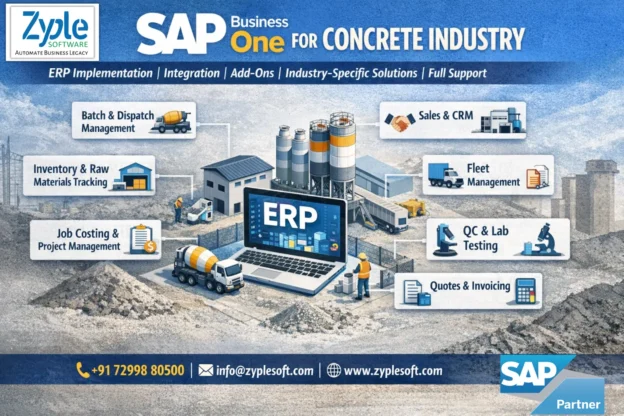
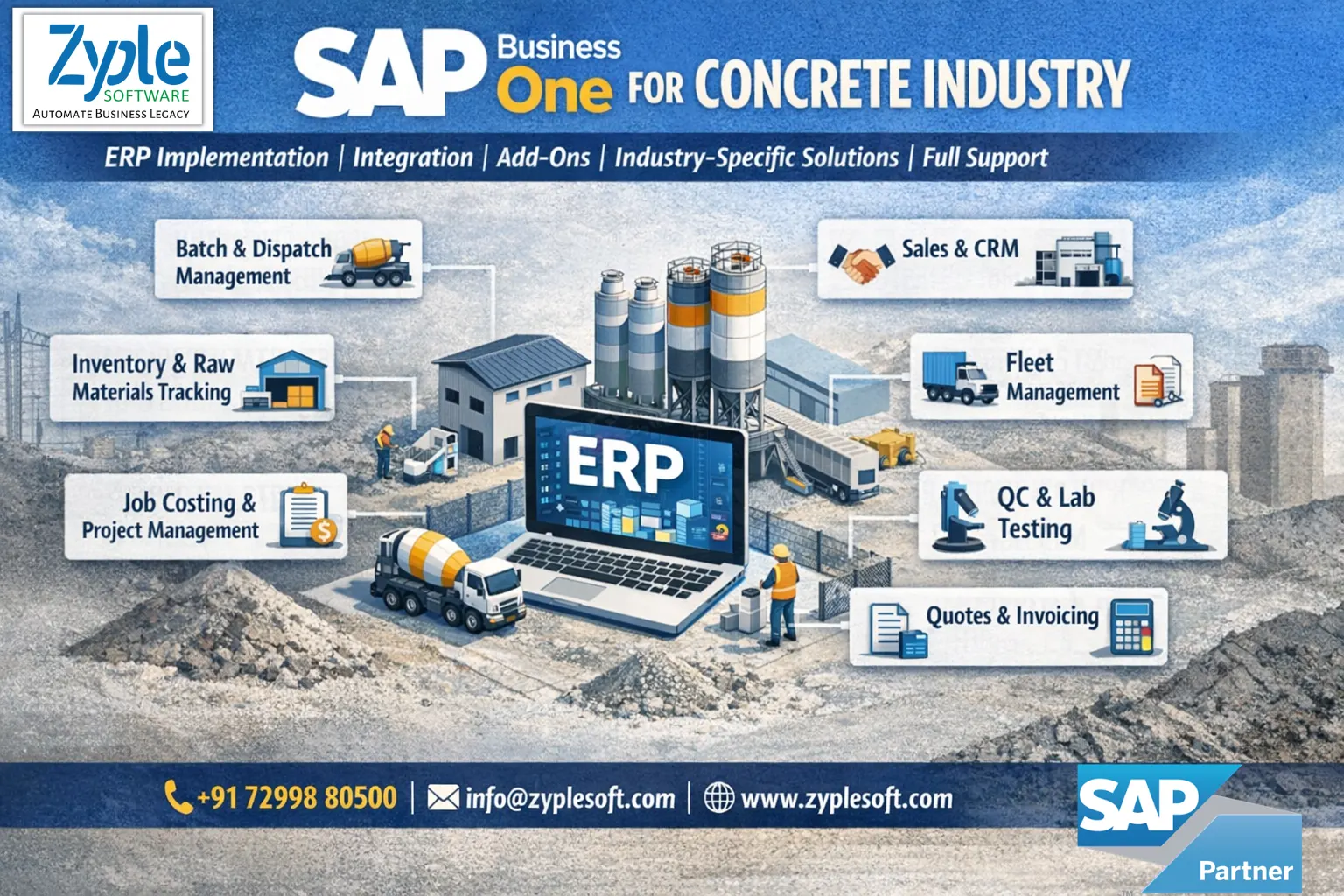
        The concrete industry faces mounting pressure to boost efficiency, control costs, and achieve sustainable growth. In the competitive market, SAP solutions enable concrete manufacturers to optimize operations and stay ahead of the curve. With advanced tools for reducing waste, improving supply chain management, and increasing real-time decision-making, SAP Business One for concrete industry helps concrete companies unlock new levels of productivity.

        Challenges of the Concrete Industry

        The concrete industry is currently facing immense challenges, primarily focused on decarbonization, rising material costs, and severe labor shortages. Main issues include the urgent need to reduce CO2 emissions from concrete production, adapting to sustainable, low carbon mixtures, and managing the high energy costs in manufacturing.

        1. Decarbonization and Sustainability

        Pressure from investors and government to minimize the carbon footprint is prompting a shift towards lower clinker content, supplementary cementitious materials (SCMs), and portland-limestone cement (PLC).

        2. Rising Costs and Materials

        Huge costs of cement and materials, combined with supply chain disruptions and higher energy prices for production.

        3. Labor Shortages

        There is a lack of skilled labor and talent to fill aging workforce positions, which impacts project timelines and quality.

        4. Durability and Quality Control

        Ensuring long-term durability against melting cycles and chemical attacks while maintaining strict quality control standards.

        5. Regulatory Compliance

        Meeting tight and complex environmental regulations is difficult.

        6. Water Usage

        High water consumption, specifically in producing, cooling, and creating cement products.

        Features of SAP Business One for Concrete Industry

        1. Project and Site Management

        • Handles multiple construction or concrete supply projects simultaneously.
        • Tracks project-wise costs, budgets, and timelines.
        • Monitors site-wise material consumption and profitability.
        • Online visibility into project progress and delays.

        2. Job Costing and Profitability Analysis

        • It includes accurate costing per cubic meter, project, and batch.
        • Tracks raw material, labor, transport, and overhead costs.
        • Compares budget vs. actual cost to control margins.
        • Helps minimize cost overruns in large infrastructure projects.

        3. Raw Material and Inventory Management

        • Handles cement, aggregates, sand, admixtures, and additives.
        • Online stock visibility across plants and sites.
        • It includes batch-wise and lot tracking for quality control.
        • Prevents shortages and overstocking with MRP (Material Requirements Planning).

        4. Production and Batch Management

        • Plans and monitors RMC or concrete production cycles.
        • It includes batch tracking for consistency and quality compliance.
        • Monitors plant performance and output.

        5. Fleet and Logistics Management

        • Handles concrete mixer trucks and delivery schedules.
        • Improves dispatch planning for multiple sites.
        • Tracks delivery timelines and minimizes delays.
        • Increases collaboration between plant and site.

        6. Equipment and Asset Management

        • Tracks machinery like batching plants, mixers, and plants.
        • Monitors maintenance schedules and downtime.
        • Improves equipment utilization and lifespan.

        7. Vendor and Subcontractor Management

        • Handles suppliers of raw materials and transport vendors.
        • Tracks subcontractor work, contracts, and payments.
        • Ensures compliance with agreements and timelines.

        8. Financial Management and GST Compliance

        • It includes integrated accounting, banking, and tax management.
        • GST, invoicing, and reporting.
        • Real-time financial view across projects and plants.
        • Cash flow and profitability evaluation.

        9. Procurement and Supply Chain

        • It includes automated purchase planning based on demand.
        • Supplier comparison and procurement optimization can be done.
        • Minimizes material delays with better planning.
        • Complete supply chain visibility.

        10. Contract, BOQ, and Billing Management

        • Handles BOQ (Bill of Quantities) and tendering.
        • Running account billing and milestone-based invoicing.
        • It includes contract tracking and documentation.
        • Measurement book and site billing connection.

        11. Real-Time Reports and Dashboards

        • Real-time dashboards for production, sales, and finance.
        • KPI tracking aspects like cost, delivery, utilization, and margins.
        • Quick decision-making with analytics.
        • Compares multiple projects side by side.

        12. Mobility and Remote Access

        • Accessing ERP from plant, site, or office.
        • It includes mobile-enabled approvals and reporting.
        • Suitable for multi-location concrete operations.

        13. Quality Control and Compliance

        • Tracks mix quality and batch consistency.
        • Maintains compliance with construction standards.
        • It includes document management for audits and approvals.

        Importance of SAP Business One for Concrete Industry

        The enterprise resource planning (ERP) software, SAP Business One (SAP B1) system, is essential for the concrete industry by integrating, facilitating, and automating core operations, like production, inventory, and finance, into one system. It improves profitability through real-time tracking, formula version control, and optimized material requirements planning (MRP), important for maintaining consistent quality and controlling costs in manufacturing.

        1. Production and Formula Management

        SAP B1 enables precise formula control, allowing manufacturers to manage the mix, ensure quality control, and maintain the necessary temperature and pressure standards for cement clinkers and concrete production.

        2. Inventory Optimization

        The system delivers real-time tracking of raw materials (aggregates, cement) and finished goods, preventing overstocking or stockouts, which improves cash flow management.

        3. Material Requirements Planning (MRP)

        MRP automates procurement planning based on production schedules, ensuring timely material availability to achieve demand using SAP implementation.

        4. Real-Time Financial Insights

        It delivers thorough financial tracking, including cost accounting for production, which helps in identifying cost drivers and improving profitability.

        5. Traceability and Compliance

        SAP B1 ensures full traceability of raw materials and batches, which is important for meeting industry regulations and conducting root-cause analysis in case of quality issues.

        6. Sales and Distribution Management

        It handles the entire process from customer quotation to invoicing, providing integration with third-party software like dispatch systems.

        Benefits of SAP Business One ERP for Concrete Industry

        SAP Business One (SAP B1) ERP for the concrete industry facilitates operations by optimizing inventory, automating production scheduling, and delivering real-time financial tracking to minimize waste and lower costs. It allows precise tracking of raw materials (cement, aggregates) and improves supply chain efficiency from procurement to delivery, ensuring compliance with industry standards.

        1. Optimized Inventory and Batch Tracking

        SAP software handles raw material stock levels (e.g., cement, sand, gravel) to minimize wastage and prevent shortages. Tracks batch numbers to maintain consistent, high-quality concrete, which is important for regulatory compliance and safety.

        2. Facilitated Production Planning

        Automates workflows and scheduling for batching plants, reducing downtime, and increasing productivity, enabling efficient use of machinery and labor.

        3. Real-Time Financial and Cost Control

        Delivers instant visibility into production costs, operational expenses, and profitability, allowing manufacturers to handle costs effectively using SAP solutions.

        4. Scalability and Regulatory Compliance

        Allows companies to grow by standardizing processes and automating documentation to meet environmental and safety regulations.

        Conclusion of Concrete ERP

        Zyple Software is an approved SAP B1 partner in India specializing in implementation, digital transformation, migration, licensing, integration, add-on solutions, and consulting.

        The ERP company, Zyple Software, specializes in providing implementation and support services for the concrete industry. SAP Business One is helpful for the concrete industry and improves its overall efficiency.

        If you’re immersed, you can book a demo of SAP Business One.

        Are you soliciting the SAP Buisness One ERP solution for your business or industry?

        Fill in all the details in the defined contact form; our team will get back to you.
          Infrastructure Management Software

          Infrastructure Management Software

          Infrastructure Management ERP Software

          Infrastructure Management Software

          What is Infrastructure Management System?

          It is a software system that delivers centralized control over IT components, such as servers, networks, storage, and data centers, to optimize performance, availability, and energy efficiency. Infrastructure management software improves asset tracking, monitoring, and automated provisioning, supporting physical, virtual, and cloud environments.

          Which is the Best Software for Infrastructure Management?

          SAP Business One is the best software for infrastructure management. It serves as an inclusive ERP for infrastructure management, specifically in construction, real estate, infrastructure, industrial, EPC, and facility management sectors. It handles project lifecycles, maintenance, and resources; supports asset and equipment master tracking, predictive maintenance, and project estimation; ensuring efficient resource allocation and cost savings.

          Types of Infrastructure Management Software

          1. IT Infrastructure Monitoring (ITIM) System

          This type of software focuses on performance evaluation, fault detection, and network management.

          2. Data Center Infrastructure Management (DCIM) System

          This type of software monitors and handles physical data center infrastructure, including power and cooling.

          3. Cloud Infrastructure Management System

          This type of software handles public or hybrid cloud resources.

          Key Components of an Infrastructure Management System

          1. Network Management

          This involves monitoring and handling the organization’s network infrastructure to ensure optimal performance and connectivity. It includes tasks like modifying network devices, handling bandwidth, and ensuring network security.

          2. Server Management

          Servers are the mainstay of an IT infrastructure. Server management includes installing, configuring, and maintaining servers to ensure they operate efficiently and safely. This also involves handling server resources, such as CPU, memory, and storage.

          3. Storage Management

          As data continues to grow exponentially, storage management becomes increasingly essential. This involves handling data storage systems, ensuring data availability, and optimizing storage resources to meet business demands.

          4. Cloud Infrastructure Management

          With the growing adoption of cloud computing, managing cloud resources is an essential aspect of infrastructure management. This includes handling cloud-based services, ensuring data security, and managing cloud costs.

          5. Security Management

          Protecting the IT infrastructure from cyber threats is the key priority. Security management involves implementing and handling security measures, such as firewalls, intrusion detection systems, and encryption protocols, to safeguard this infrastructure.

          6. Automation and Monitoring

          Automation tools and monitoring systems are important for proactively managing the infrastructure. These tools help in automating routine tasks, evaluating system performance, and detecting potential issues before they escalate.

          Features of Infrastructure Management ERP Software

          Here are the features of SAP B1 as infrastructure management ERP software:

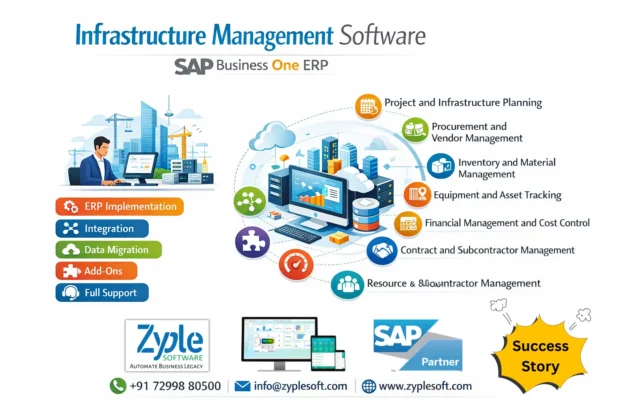
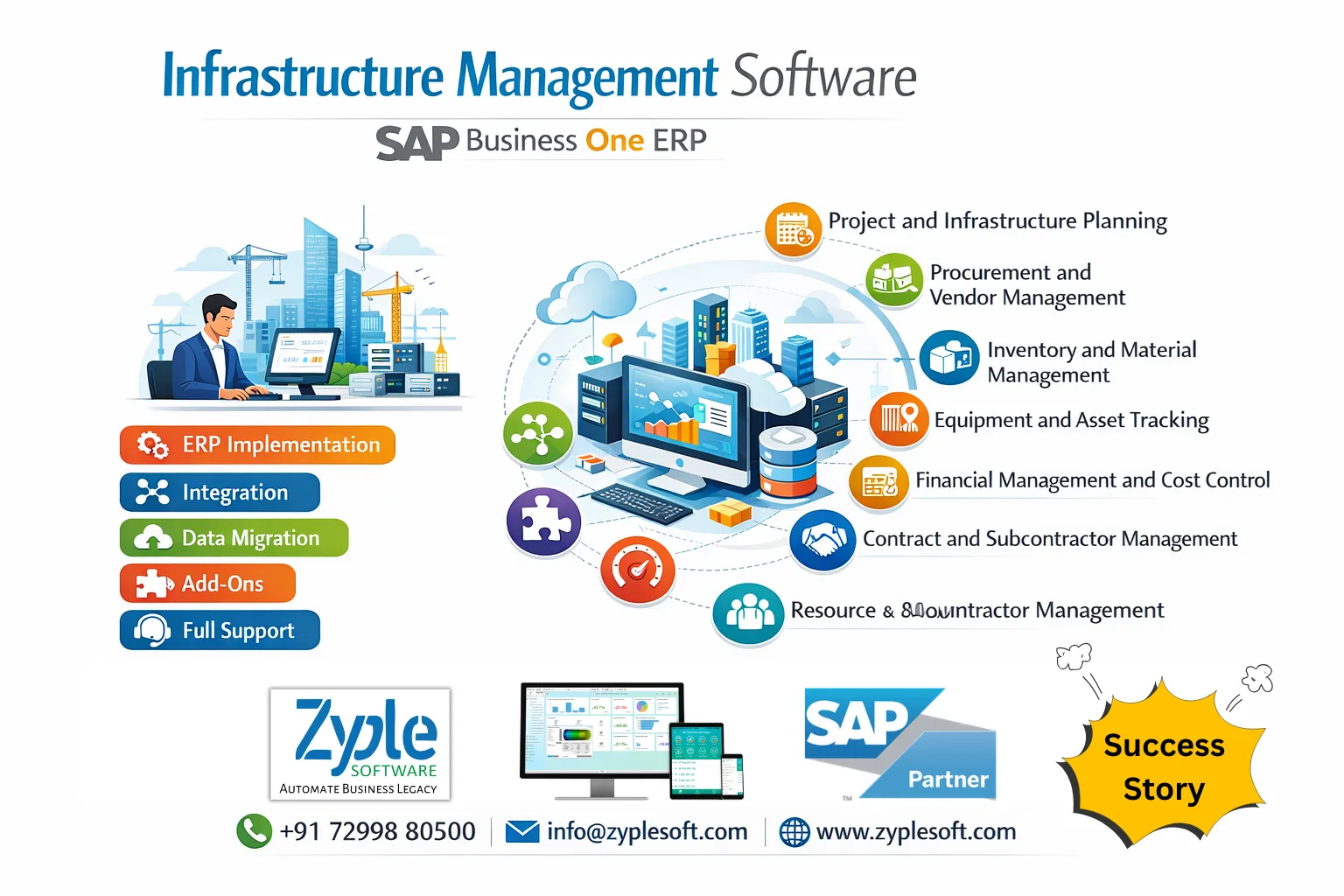
          1. Project and Infrastructure Planning

          • Defines and handles infrastructure projects with budgets, timelines, and resources.
          • It includes a work breakdown structure (WBS) for large-scale infrastructure projects.
          • Tracks project progress, milestones, and dependencies in real-time.

          2. Procurement and Vendor Management

          • Improved procurement for raw materials, machinery, and services.
          • It includes vendor comparison, selection, and performance tracking.
          • Automates purchase requests, approvals, and purchase orders.

          3. Inventory and Material Management

          • Online tracking of construction materials and equipment.
          • Multi-warehouse management for various project sites.
          • Batch and serial number tracking for essential assets.

          4. Equipment and Asset Tracking

          • Tracks infrastructure assets like machinery, vehicles, and tools.
          • Schedules preventive maintenance and service activities.
          • Monitors the asset lifecycle from acquisition to disposal.

          5. Financial Management and Cost Control

          • Budget allocation and cost tracking for every project.
          • Online financial reporting and profitability analysis.
          • Connecting accounts payable, receivable, and general ledger.

          6. Contract and Subcontractor Management

          • Handles contracts, subcontracts, and billing schedules.
          • Tracks subcontractor performance and payments.
          • Monitors compliance with contractual terms.
          • Allocates labor, equipment, and materials efficiently.
          • Tracks workforce productivity and utilization.
          • Handles timesheets and labor costs.

          7. Compliance and Documentation

          • Maintains regulatory compliance documents and approvals.
          • It includes centralized document management for blueprints, permits, and contracts.
          • Audit trails can be done for all transactions and changes.

          8. Reporting and Analytics

          • Real-time dashboards for project performance and KPIs.
          • Online insights into cost overruns and delays.
          • Creates MIS reports for decision-making.

          9. Integration and Mobility

          • Connection with third-party tools like CAD, IoT, and project management systems.
          • It includes mobile access for on-site teams to update data in real-time.
          • Cloud deployment can be done for remote accessibility.

          Importance of Infrastructure Management Software

          1. Business Continuity

          A well-managed infrastructure ensures that essential IT systems are available and operational, reducing downtime and ensuring business continuity. This is especially crucial in industries where even a small disruption can lead to significant financial losses.

          2. Cost Efficiency

          SAP Business One ERP helps improve resource utilization, minimizing operational costs. By automating routine tasks and efficiently handling IT resources, organizations can reduce their infrastructure expenses.

          3. Security and Compliance

          With the increasing threat of cyberattacks, SAP B1 ERP is necessary to protect sensitive data and ensure compliance with regulatory requirements. Appropriate management helps in identifying vulnerabilities and implementing necessary security measures.

          4. Scalability

          As business grows, the IT infrastructure needs to adapt accordingly. The SAP Business One system ensures that systems are scalable and can manage increased workloads without compromising performance.

          5. Performance Optimization

          Regular monitoring and management of IT infrastructure ensure that systems perform at their best using SAP implementation.

          Benefits of Infrastructure Management ERP Software

          The SAP Business One solution improves IT operations by increasing system performance, optimizing security, and minimizing costs through automation. It boosts business continuity by minimizing downtime, delivers scalable resources for growth, and allows proactive monitoring of hardware and software, freeing up staff for strategic tasks.

          1. Cost Efficiency and Resource Optimization

          The SAP B1 system identifies underutilized resources, avoiding over-provisioning and reducing operational expenses.

          2. Improved Security and Compliance

          Automated monitoring and patch management help identify vulnerabilities, protect sensitive data, and implement compliance with industry standards.

          3. Increased Reliability and Uptime

          Real-time monitoring and proactive alerting detect issues before they cause downtime, ensuring high system accessibility using SAP solutions.

          4. Operational Automation

          Routine tasks, including server administration, software updates, and backups, are automated, improving efficiency and minimizing manual errors.

          5. Ease of Use and Flexibility

          SAP software enables IT teams to quickly adapt and scale resources to meet changing business demands.

          6. Optimized Performance

          By monitoring and improving IT components, SAP B1 software ensures fast, efficient, and consistent performance for users.

          Conclusion of Infrastructure Management ERP

          Zyple Software is an official SAP B1 partner in India specializing in implementation, consulting, migration, licensing, integration, add-on solutions, digital transformation, and support.

          ERP Company, Zyple Software has expertise in SAP Business One implementation for different industries like construction, real estate, EPC, infrastructure, facility management, and industrial sectors. SAP Business One facilitates processes and drives growth seamlessly with infrastructure management.

          If you’re committed, book an SAP Business One demo.

          Are you requiring the SAP B1 ERP solution for your business or industry?

          Read more: https://www.zyplesoft.com/infra-construction/

          Fill in all the details in the dispensed contact form; our team will return to you.

            SAP Business One ERP for Import and Export Company

            SAP Business One for Import and Export

            SAP Business One for Import and Export Company

            SAP Business One ERP for Import and Export Company

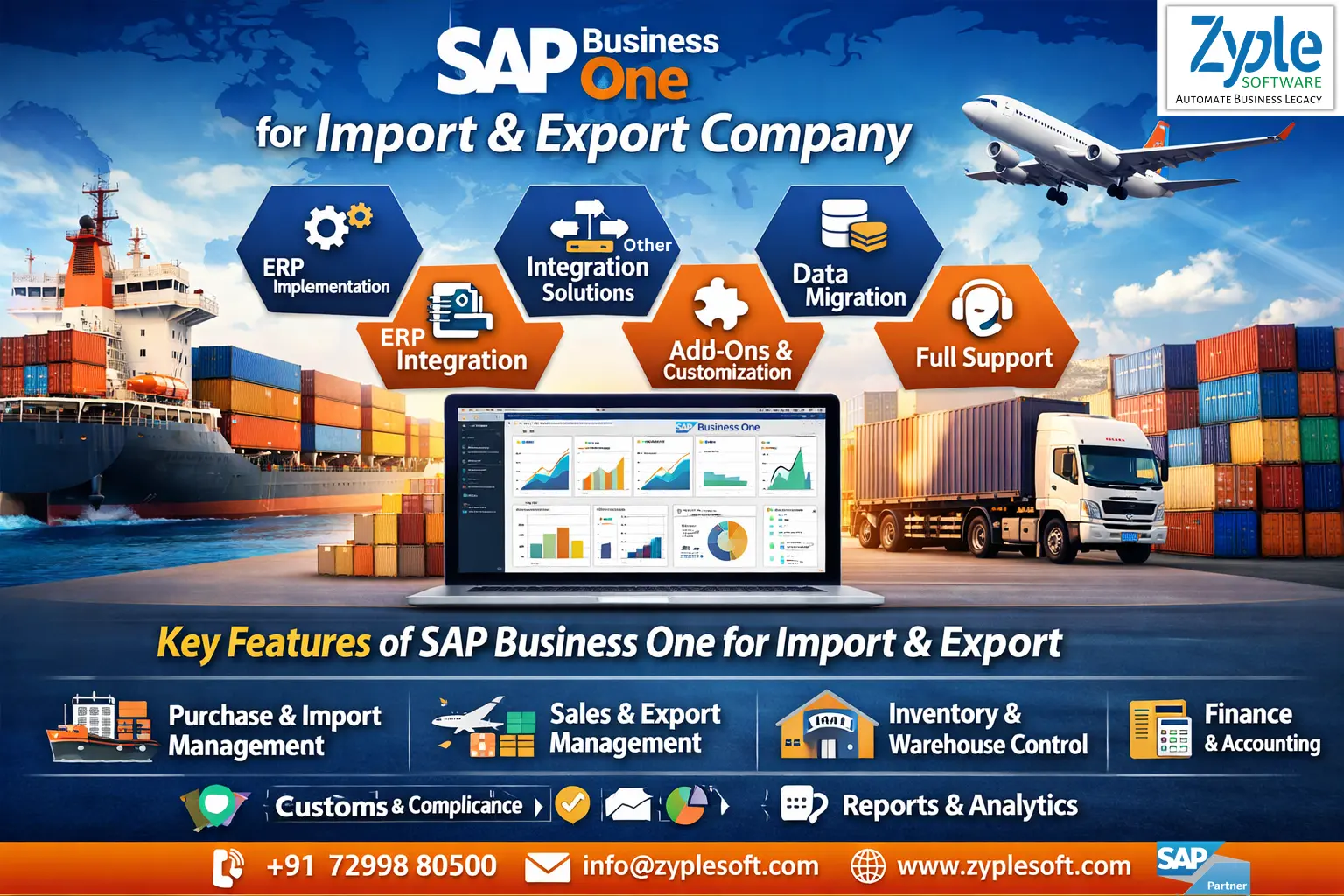
            Buying and selling internationally requires overview and structure. The stock is spread across different locations; every country has its own rules and exchange rates, and shipments must always be traceable. SAP Business One for import and export company is a cost-effective, integrated ERP system that helps import and export businesses to handle everything from multi-languages and currency to country localizations and laws.

            Challenges of Import and Export Company

            Import and export companies face complex challenges, including navigating international regulations and customs procedures, handling volatile currency exchange rates, high logistics costs, and securing reliable, safe payments. Supply chain disruptions, intense global competition, and maintaining strict quality standards across borders add to these risks.

            1. Regulatory and Customs Compliance

            Navigating complex and continuously changing trade laws, tariffs, and documentation in different countries can lead to delays, fines, or seizure of goods.

            2. Financial Risks

            Currency fluctuations, high international transaction fees, and non-payment fees are the key obstacles.

            3. Logistics and Supply Chain Management

            Shipping delays, port congestion, and natural disasters can hamper inventory management and cause damage to perishable goods.

            4. Finding and Evaluating Partners

            Locating, auditing, and maintaining relationships with trustworthy overseas buyers or suppliers demands significant effort.

            5. Cultural and Communication Barriers

            Different business etiquettes, languages, and time zones can confuse negotiations and contractual agreements.

            Features of SAP Business One for Import and Export Company

            1. Multi-Currency and Global Trade Management

            • Manages transactions in multiple currencies automatically.
            • Exchange rate updates and foreign currency postings can be supported.
            • Handles international customers, vendors, and payments easily.
            • Necessary for companies dealing with global clients and suppliers.

            2. Import and Export Documentation

            • Creates and handles commercial invoices, packing lists, bills of lading, and shipping documents.
            • Automates EXIM documentation workflows to minimize manual work.

            3. Compliance and Regulatory Control

            • Country-specific tax rules and legal compliance can be supported.
            • Handles custom duties, import/export regulations, and trade compliance documentation.
            • Very essential for avoiding penalties and delays.

            4. Inventory and Warehouse Management

            • Real-time tracking of stock levels, batch/serial numbers, and goods across multiple warehouses.
            • Goods in transit can be tracked (import/export shipments).
            • There is no stock mismatch in international trade.

            5. Supply Chain and Logistics Management

            • End-to-end visibility of purchase orders (imports), sales orders (exports), and shipment tracking and delivery status.
            • Helps improve procurement and logistics processes.

            6. Financial Management and Costing

            • Tracks landed costs (freight, duty, and insurance) and profitability per shipment.
            • Automates accounts payable (suppliers), accounts receivable (customers), and banking and reconciliation.

            7. Sales and Customer Relationship Management (CRM)

            • Handles international customers and distributors.
            • Tracks sales pipeline and export orders.
            • Maintains complete customer history and communication.

            8. Purchasing and Vendor Management

            • Handles global suppliers.
            • Automation of procurement cycles, from purchase requests and purchase orders to goods receipt and invoice.
            • Compares vendor pricing and performance.

            9. Data Import and Integration

            • Import/export master data and transactions can be extracted from external systems.
            • Connects with logistics, shopping, or custom systems.

            10. Real-Time Reporting and Analytics

            • Creates reports like shipment status, profit per export/import, inventory valuation, and financial valuations.
            • Decision-making can be done on dashboards.

            11. End-to-End Traceability

            • Tracks every transaction from supplier and warehouse to shipment and customer.
            • Complete audit trail for compliance and transparency.

            12. Scalability with EXIM (Export–Import Management) Add-ons

            • Add-ons extensions can be done for functionalities like duty drawback, incentive schemes, license management, and port-wise shipment tracking.

            Importance of SAP Business One for Import and Export Company

            The enterprise resource planning (ERP) system, SAP Business One (SAP B1) software, is important for import and export companies by delivering a unified, real-time platform to handle complex logistics, multi-currency accounting, and inventory across borders. It boosts efficiency through automated workflows, minimizing manual errors, and optimizing supply chains to improve profitability and scalability.

            1. Real-Time Inventory and Supply Chain Management

            Companies can track goods from suppliers to final customers across different locations, including real-time monitoring of shipments and warehouse operations, minimizing the risks of overstocking or stockouts using SAP implementation.

            2. Multi-Currency and Regulatory Compliance

            The system manages multiple currencies, exchange rate fluctuations, and complex international trade regulations and tax compliance, which is essential for cross-border transactions.

            3. Automated Logistics and Documentation

            The SAP software automates purchasing, sales, and logistical processes, accelerating documentation required for importing and exporting.

            4. Improved Financial Control

            It delivers powerful financial management, including automated invoicing and detailed financial reporting to handle cash flow and improve return on investment (ROI).

            5. Efficient Customer/Supplier Management

            It strengthens vendor coordination and handles customer relationships effectively, ensuring better service and tracking of international orders.

            Benefits of SAP Business One ERP for Import and Export Company

            The SAP Business One (SAP B1) solution delivers export and import companies with a unified, real-time system to manage international logistics, multi-currency accounting, and complex supply chains. Main benefits include automated compliance with EXIM documentation, improved inventory tracking across borders, and facilitated supplier coordination, leading to faster, error-free operations.

            1. Integrated EXIM (Export-Import) Management

            Specialized add-ons handle export/import licenses, license consumption, pre-shipment, and post-shipment documentation within one system.

            2. Inclusive Inventory Control

            Real-time visibility of stock across different warehouses or countries, including barcode scanning, bin management, and replenishment planning, minimizes stockouts and optimizes stockouts.

            3. Multi-Currency and Financial Compliance

            Manages foreign currency transactions and exchange rate fluctuations automatically while handling complex international financial reporting and tax compliance.

            4. Supply Chain Optimization

            Facilitates procurement and logistics by delivering tracking for goods from order to final delivery, minimizing shipping delays.

            5. Customer and Vendor Management

            It centralizes information to increase supplier coordination and improve customer service, which is essential for international trade using SAP solutions.

            6. Efficiency and Automation

            Minimizes manual data entry and human errors by automating workflows such as order processing, purchasing, and reporting.

            7. Ease of Use and Access

            Cloud-based access enables management of business operations from anywhere, allowing the system to grow with the company’s expansion.

            Conclusion of Import and Export ERP

            Zyple Software is a leading SAP Business One partner in India specializing in implementation, integration, add-on solutions, and support for import and export companies. SAP Business One is immensely valuable for import and export companies that choose overview and automation. Import and export businesses use SAP Business One for efficiency in the warehouse, financial control, and flexibility in sales channels.

            Are you pursuing the SAP Business One software system for your business or industry?

            If you’re involved, book an SAP B1 demo.

            Fill in all the details in the allocated contact form; our team will return to you.

              SAP Business One for EPC Industry

              SAP Business One for EPC Industry

              SAP Business One ERP for EPC Industry

              SAP Business One for EPC Industry

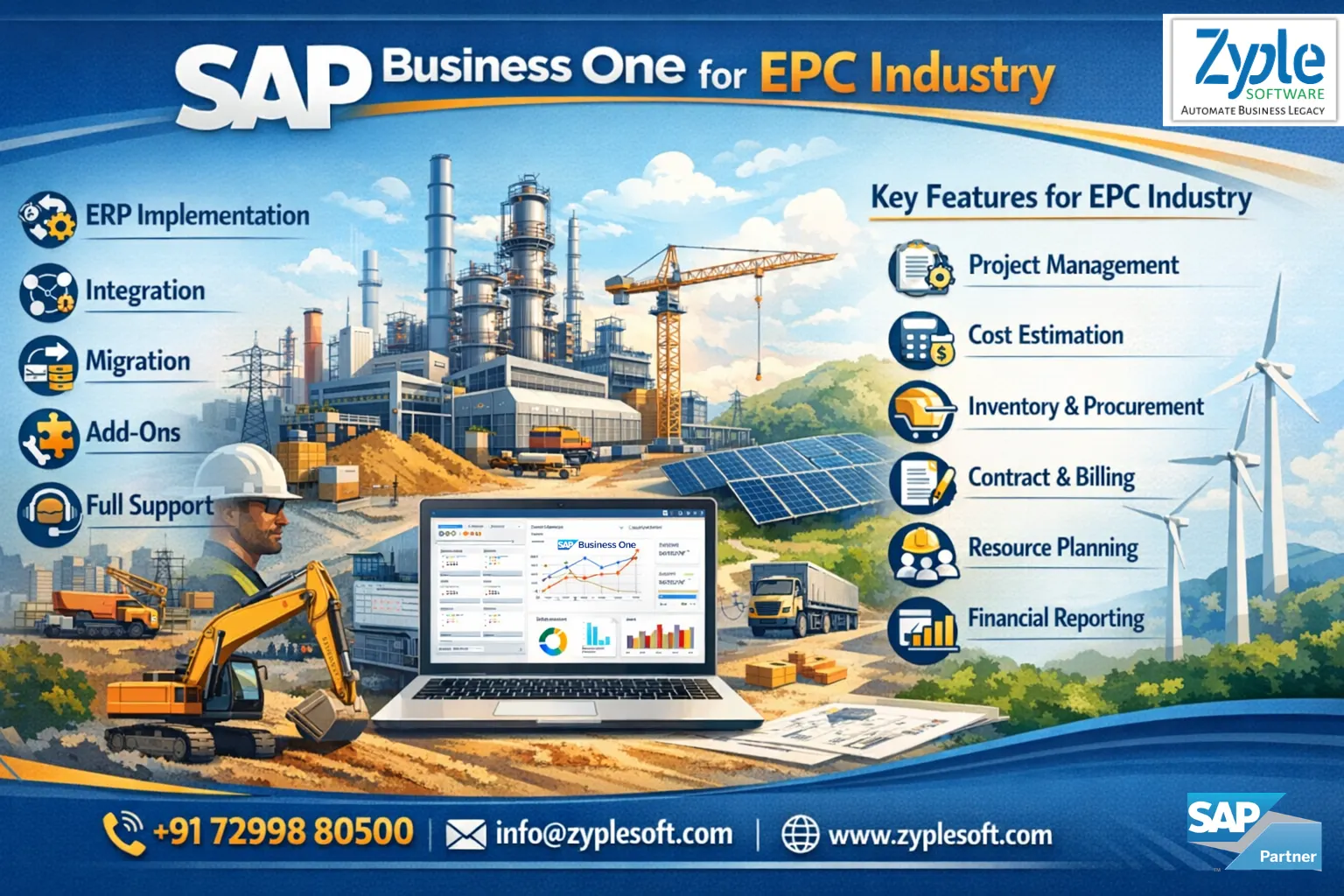
              The engineering, procurement, and construction (EPC) industry faces multiple challenges, including project management complexities, strict regulatory requirements, and the need for precise coordination across multiple disciplines. To effectively handle these issues, companies in the EPC sector need a powerful enterprise resource planning (ERP) solution. SAP Business One for EPC industry stands out as a powerful tool that can facilitate operations, improve project management, and drive overall efficiency.

              Challenges of the EPC Industry

              The engineering, procurement, and construction (EPC) industry faces significant challenges, mainly driven by cost overruns, schedule delays, and complex risk management. Primary issues include supply chain disruptions, skilled labor shortages, rapid technological shifts, and strict regulatory compliance. These factors are intensified by poor coordination between design and construction teams, leading to rework and financial strain.

              1. Cost Overruns and Inaccurate Forecasting

              Increasing raw material prices, design changes, and inaccurate early estimates often cause severe budget overruns.

              2. Project Delays and Scheduling Obstacles

              Most of the EPC projects experience delays due to poor planning, slow regulatory approvals, and misaligned engineering/procurement timelines.

              3. Supply Chain Disruptions

              Shortages of materials, equipment, and logistical failures can cause devastating project delays.

              4. Skilled Labor Shortage

              An aging workforce and lack of specialized talent result in lower productivity and site management issues.

              5. Contractual Disputes and Risk

              Confusing contract terms, poor scope definitions, and subcontractor mismanagement lead to legal battles and disputes.

              6. Technological Adoption Challenges

              Slow adoption of digital tools and poor integration of data from site to office cause inefficiencies and blind spots.

              7. Environmental and Safety Compliance

              Increasingly thorough environmental regulations and the need for high safety standards create logistical and financial hurdles.

              Features of SAP Business One for EPC Industry

              1. Project Management and Control

              • End-to-end project lifecycle management (from planning to execution to closure).
              • Tracks project timelines, milestones, and progress.
              • Handles multiple projects simultaneously.
              • Helps EPC companies deliver projects promptly and within budget.

              2. Engineering and Resource Planning

              • Defines bill of quantities (BOQ) and bill of materials (BOM).
              • Allocates labor, machinery, and subcontractors.
              • Improves resource utilization across projects.
              • Forecasts material and manpower requirements.

              3. Procurement and Vendor Management

              • It includes end-to-end procurement cycle automation.
              • Handles vendor quotations, contracts, and approvals.
              • Tracks material delivery schedules.
              • Ensures timely availability of construction materials.
              • Improves supply chain coordination and minimizes delays.

              4. Inventory and Warehouse Management

              • Online inventory tracking across sites.
              • Warehouse management across different locations.
              • Controls material consumption at project sites.
              • Avoids overstocking or shortages.

              5. Financial Management and Cost Control

              • It includes integrated project-wise accounting.
              • Monitors cash flow, budgets, and expenses.
              • Tracks cost overruns in real-time.
              • Handles billing, invoicing, and revenue recognition.
              • Ensures powerful financial control and profitability.

              6. Contract and Subcontractor Management

              • Handles contracts, tenders, and variations.
              • Tracks subcontractor billing and payments.
              • Monitors contract performance and compliance.

              7. Real-Time Reporting and Analytics

              • Real-time dashboards for project performance.
              • KPI tracking includes cost, timelines, and productivity.
              • Drill-down reports are useful for decision-making.
              • Predicts risks using data insights.
              • Allows faster, data-driven decisions.

              8. Integrated Document Management

              • Stores and handles drawings, contracts, and approvals.
              • It includes centralized access for all stakeholders.
              • Engineering documents are used for version control.

              9. Compliance and Risk Management

              • Ensures regulatory compliance (tax, audit, and safety).
              • Tracks project risks and issues.
              • Maintains audit-ready documentation.
              • Minimizes legal and operational risks.

              10. CRM and Stakeholder Management

              • Handles client relationships and project communications.
              • Tracks leads, tenders, and opportunities.
              • Enhances customer satisfaction and transparency.

              11. Unified Data and Collaboration

              • Single platform for connecting engineering, procurement, finance, and construction.
              • Online data sharing across departments.
              • Eliminates data storage and improves collaboration.

              12. User-Friendliness and Customization

              • Adaptable for small and medium-sized EPC firms.
              • Industry-specific add-ons and customization are supported.

              Importance of SAP Business One for EPC Industry

              The enterprise resource planning solution, the SAP Business One (SAP B1) system, is essential for the engineering, procurement, and construction (EPC) industry by integrating project management, finance, procurement, and inventory into one system. It allows real-time tracking of budgets, costs, and project progress, ensuring compliance and improving decision-making for small and medium-sized EPC firms.

              1. Real-Time Project Control

              Allows tracking of project costs, revenues, and progress, helping identify overruns early for corrective action.

              2. Integrated Procurement and Supply Chain

              Facilitates purchasing by integrating vendor data with project requirements, minimizing lead times, and ensuring materials are available on time.

              3. Improved Financial Management

              Delivers in-depth reporting and automation of tasks like invoicing and financial reporting, improving efficiency using SAP implementation.

              4. Improved Collaboration and Data Centralization

              Integrates engineering, procurement, and site teams with a single source of truth, minimizing errors and improving decision-making.

              5. Scalability and Flexibility

              Designed to achieve the unique needs of small and medium-sized EPC firms, with the flexibility to grow with the business.

              Benefits of SAP Business One ERP for EPC Industry

              SAP Business One (SAP B1) software for the EPC industry delivers a unified, real-time platform to manage complex projects, improving efficiency through automated procurement, precise cost control, and integrated financial management. Main benefits include facilitated project management, optimized resource allocation, improved regulatory compliance, and increased cross-departmental collaboration, all of which minimize project delays and costs.

              1. Integrated Project Management and Visibility

              Centralizes all project data, including engineering, procurement, and construction stages, providing a single source of truth for tracking project performance in real-time.

              2. Improved Cost Control and Budgeting

              Delivers powerful tools for accurate job costing, budget tracking, and forecasting, enabling managers to monitor project expenses against budgets proactively and avoid overruns.

              3. Facilitated Procurement and Inventory

              Automates procurement cycles and improves inventory levels, ensuring materials are available when needed (using MRP) while decreasing carrying costs and minimizing wastage using SAP solutions.

              4. Real-Time Decision-Making

              Provides instant access to reports and insights on project progress, financial health, and resource utilization, allowing data-driven decisions to prevent risks.

              5. Efficient Resource Allocation

              Improves the usage of manpower, machinery, and materials across multiple projects, leading to improved productivity.

              6. Compliance and Risk Management

              Helps ensure compliance with industry standards, safety, and regulatory requirements, reducing the risks of penalties and legal issues.

              7. Improved Collaboration

              Allows seamless data exchange between departments, minimizing obstacles between engineering, purchasing, and on-site construction teams.

              8. Ease of Use

              Provides a flexible solution that can be designed for the growing needs of expanding EPC businesses.

              Conclusion of EPC ERP

              Zyple Software is an SAP Business One partner in India providing SAP B1 ERP solution that can significantly benefit the EPC industry. By improving project management, facilitating procurement, increasing financial management, and ensuring regulatory compliance, SAP software helps EPC companies optimize their operations and achieve long-term success.

              Are you pursuing the SAP Business One software for your business or industry?

              Fill in all the details in the allocated contact form; our team will get back to you.

                SAP Business One ERP for Mining Industry

                SAP Business One for Mining Industry

                SAP Business One ERP for Mining Industry

                SAP Business One ERP for Mining Industry

                The mining industry faces unique challenges that involve powerful solutions for handling complex operations, ensuring regulatory compliance, and optimizing resources. Mining companies must navigate thorough environmental regulations, volatile commodity prices, and safety concerns while maintaining efficient operations. SAP Business One for mining industry improves the efficiency of mining businesses by delivering real-time data on resource management, equipment maintenance, and supply chain logistics.

                Challenges of the Mining Industry

                The mining industry faces complex challenges focused on environmental sustainability, social license to operate, and operational efficiencies. Key issues include handling intense environmental impacts, water scarcity, declining ore grades, labor shortages, and geopolitical instability, requiring urgent adoption of technology and sustainable practices.

                1. Environmental Sustainability

                The industry faces extreme pressure to minimize its carbon footprint, manage waste, and reduce pollution.

                2. Water Scarcity

                Inability to handle water stress and high water consumption in arid regions is a critical operational risk.

                3. Social License to Operate

                Conflicts with local communities over land use, displacement, and social or cultural impacts hamper expansion, requiring better community expansion.

                4. Operational Efficiency and Declining Grades

                Extracting lower-grade, deeper deposits increases costs, demanding advancements in automation and technology.

                5. Workforce Shortages

                An aging workforce combined with high retirement rates makes attracting new talent challenging, with a growing need for tech-savvy personnel.

                6. Regulatory and Policy Risks

                Strict environmental regulations, bureaucratic delays in permitting, and resource nationalism hinder project community.

                7. Geopolitical Instability

                Political unrest, trade wars, and coups affect supply chains and security.

                8. Infrastructure and Logistics

                Inadequate infrastructure in remote, underdeveloped locations increases operational costs.

                Features of SAP Business One for Mining Industry

                1. Asset and Equipment Management

                • Tracks heavy mining equipment, usage, and performance.
                • Schedules preventive maintenance to minimize downtime.
                • Evaluates asset lifecycle and repair costs.
                • Helps increase equipment efficiency and productivity.

                2. Inventory and Supply Chain Management

                • Online tracking of raw materials, spare parts, and consumables.
                • Optimizes stock levels and prevents shortages or overstocking.
                • Handles logistics from mine site to distribution.
                • Ensures smooth operations and minimizes delays.

                3. Procurement and Vendor Management

                • Automates purchase requests and approvals.
                • Handles supplier contracts and payments.
                • Tracks procurement costs and vendor performance.
                • Optimizes purchasing efficiency and cost control.

                4. Production and Resource Planning

                • Plans extraction and production based on demand.
                • Improves the use of materials and resources.
                • Automates production orders.
                • Increases operational planning and minimizes wastage.

                5. Financial Management and Cost Control

                • Real-time cost tracking (fuel, labor, machinery, and more).
                • It includes budgeting, cash flow monitoring, and financial reporting.
                • Profitability analysis by project or site can be done.
                • Allows better financial decisions in capital-intensive projects.

                6. Sales, Dispatch, and Contract Management

                • Handles quotations, sales orders, and contracts.
                • Tracks dispatch, shipments, and invoicing.
                • Manages commodity pricing and billing.
                • Increases customer and revenue management.

                7. Real-Time Analytics and Reporting

                • Real-time dashboards for production, costs, and KPIs.
                • It includes business intelligence for decision-making.
                • Continuous visibility from extraction to delivery.
                • Helps management make quick, data-driven decisions.

                8. Compliance, Safety, and Sustainability

                • Tracks regulatory and environmental compliance.
                • Monitors safety incidents and workforce conditions.
                • Supports ESG (Environmental, Social, Governance) goals.
                • Minimizes legal risks and improves workplace safety.

                9. Workforce and HR Management

                • Handles employee records, shifts, and payroll.
                • Tracks certifications and safety training.
                • Improves workforce productivity and safety culture.
                • Guarantees efficient workforce planning.

                10. Integrated End-to-End Operations

                • Connects finance, operations, procurement, and HR in one system.
                • Centralized data across different mining sites.
                • Smooth integration with other technologies (IoT, AI).
                • Eliminates data storage and improves collaboration.

                11. Mobility and Remote Access

                • It includes an access system from remote mining locations.
                • Online updates from field operations.
                • Suitable for geographically distributed mining sites.

                Importance of SAP Business One for Mining Industry

                The ERP solution, SAP Business One (SAP B1) software, is essential for the mining industry by delivering an integrated, real-time platform to manage complex operations, from exploration to extraction and logistics. It improves productivity, improves financial management, ensures strict regulatory compliance, and allows data-driven decisions to optimize asset performance and inventory, particularly for small and medium-sized mining firms.

                1. Integrated Operations

                Facilitates end-to-end processes, including production, inventory tracking, and supply chain management using SAP implementation.

                2. Inclusive Financial Management

                Delivers powerful budgeting, forecasting, and audit-ready financial reporting. It enables precise management of fixed assets, such as heavy machinery and property, tracking depreciation effectively.

                3. Compliance and Safety

                Facilitates compliance with thorough safety and environmental regulations with auditable data and inclusive documentation.

                4. Real-Time Data-Driven Insights

                Provides advanced analytics and reporting tools that support making better, quick decisions to improve operational efficiency and safety.

                5. Cost Control and Supply Chain

                Improves inventory levels to minimize carrying costs and optimizes procurement processes to prevent production obstacles.

                6. Designed Solutions

                Includes specialized functionalities like material requirements planning (MRP) to handle materials and provides industry-specific SAP solutions.

                Benefits of SAP Business One ERP for Mining Industry

                SAP Business One (SAP B1) software provides the mining industry a centralized, real-time ERP solution that boosts productivity, improves operational transparency, and ensures strict regulatory compliance. Main benefits include optimized inventory control, accurate mining cost tracking, facilitated procurement, and improved maintenance management for heavy equipment, ultimately minimizing costs and increasing efficiency.

                1. Improved Financial Management and Costing

                SAP B1 ERP delivers inclusive, real-time tracking of production costs and operational expenses, enabling companies to accurately calculate margins and avoid unexpected budget overruns.

                2. Optimized Inventory and Supply Chain

                The SAP software handles spare parts and materials efficiently, minimizing inventory levels while ensuring availability. This reduces downtime for expensive mining equipment.

                3. Regulatory Compliance and Safety

                The SAP B1 ERP system automates reporting to comply with environmental and labor regulations, minimizing legal risks.

                4. Asset Management and Maintenance

                It boosts equipment uptime through planned maintenance, providing visibility into the condition of heavy machinery.

                5. Facilitated Procurement

                Mining businesses can automate purchase requests based on bills of materials (BOM), ensuring efficient procurement processes.

                6. Real-Time Decision-Making

                Data-driven insights and interactive dashboards support production forecasting and faster, better decision-making.

                Conclusion of Mining ERP

                Zyple Software is a leading SAP Business One partner in India specializing in implementation, integration, add-on solutions, and support for the manufacturing, agriculture, healthcare, financial services, hospitality and tourism, construction, real estate, retail, technology, energy, logistics, and professional services industries. SAP Business One serves the mining industry by delivering solutions that fulfill the need to provide innovative products and utmost customer satisfaction.

                Are you demanding the SAP Business One ERP software solution for your business or industry?

                Fill in all the details in the delivered contact form; our team will reach out to you.

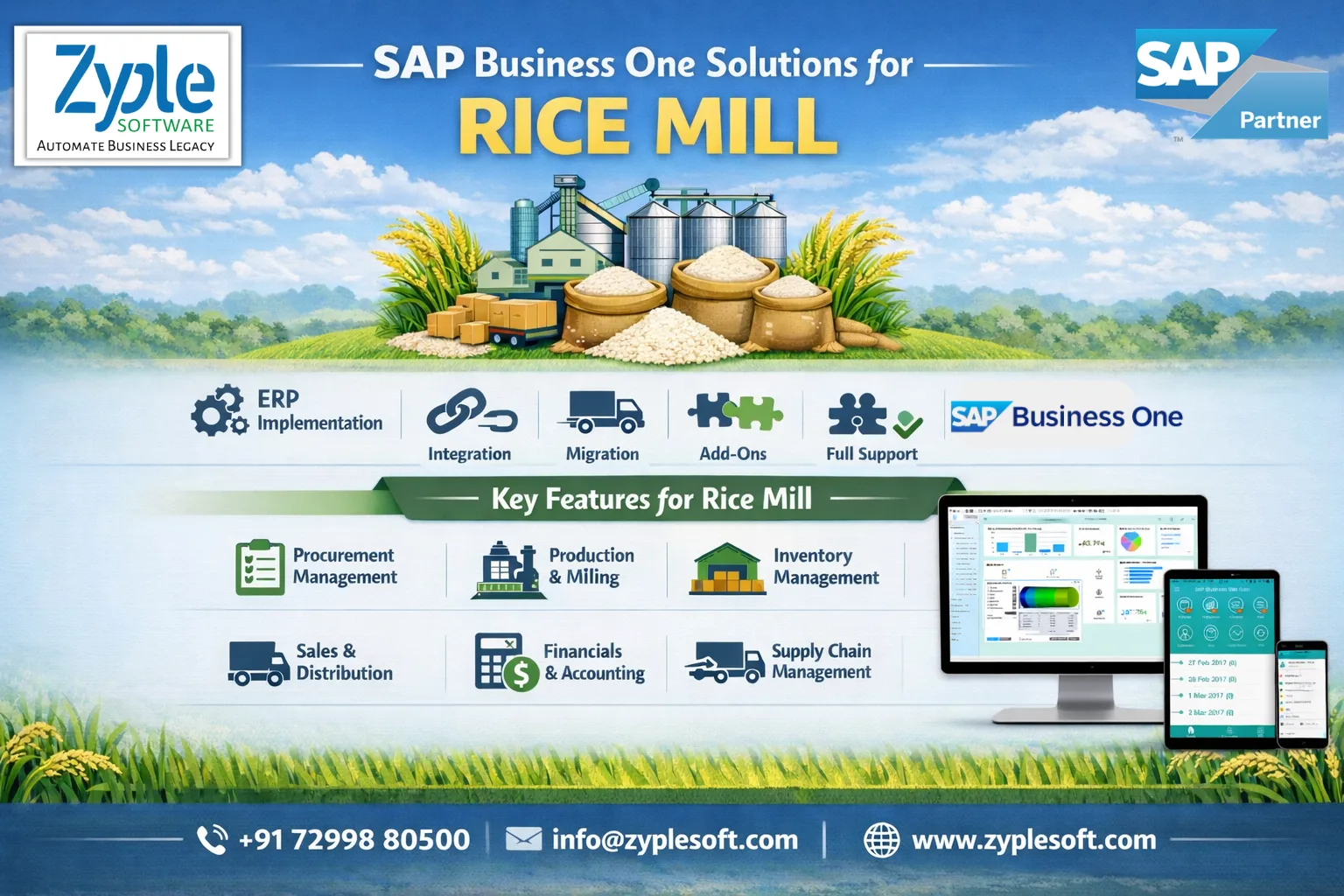
                  SAP business One ERP Software for Rice Mill

                  ERP Software for Rice Mill

                  SAP Business One ERP Software for Rice Mill

                  SAP business One ERP Software for Rice Mill

                  Rice mill software is designed to handle the day-to-day operations of a rice milling business. It can help automate many tasks like inventory management, production planning, quality control, sales and distribution, and financial accounting to facilitate the daily functions. ERP software for rice mill automates all processes, from transaction recording to financial reporting, leading to accurate expense tracking and optimal cash flow.

                  Which is The Best ERP Software for Rice Mill?

                  SAP Business One (SAP B1) solution is the best ERP software for rice mill. It is an inclusive ERP system for rice mills, facilitating operations from paddy procurement to mobile and remote access. It provides modules like paddy procurement, batch and quality control, inventory and warehouse management, and by-product management. It improves efficiency by connecting inventory, quality control, finance, and production planning in real-time.

                  How SAP B1 Improves Rice Mill Operations?

                  The SAP Business One ERP software is designed to handle the unique challenges of the rice mill industry, delivering tools for efficiency, quality assurance, and operational excellence.

                  1. End-to-End Traceability

                  Tracks every stage of the rice milling process to ensure transparency and accountability.

                  2. Inventory Optimization

                  Improves inventory levels with real-time tracking and forecasting to reduce waste and increase efficiency.

                  3. Quality Control

                  Implements thorough quality checks at every stage of production to ensure superior product quality.

                  4. Supply Chain Visibility

                  Gain real-time insights into the supply chain to increase decision-making and operational efficiency.

                  Features of ERP Software for Rice Mill

                  Here are the features of SAP B1 as a rice mill ERP solution:

                  1. Paddy Procurement Management

                  • Vendor-based paddy purchase tracking includes farmers, agents, and traders.
                  • Quality-based procurement includes moisture percentage, broken percentage, and foreign matter.
                  • Rate calculation is done based on parameters.
                  • Weighbridge integration can be done for accurate inward quantity.
                  • Helps in handling raw material cost and quality from the source.

                  2. Production and Milling Process Management

                  • Defines bill of materials (BOM) for rice (from paddy to rice, husk, and bran).
                  • Handles production orders for milling batches.
                  • Tracks yield and recovery % including head rice, broken rice, and by-products).
                  • Evaluates machine-wise production and shift-wise output.
                  • It supports efficient milling and yield optimization.

                  3. Batch and Quality Control

                  • It includes batch-wise tracking of paddy and finished rice.
                  • Quality inspection can be done at three stages, like the raw material stage, processing stage, and finished goods stage.
                  • Maintains grading (premium, standard, and broken rice).
                  • It ensures consistency and export-quality standards.

                  4. Inventory and Warehouse Management

                  • It includes real-time stock of paddy (raw material), semi-finished goods, and finished rice.
                  • Multiple bin or warehouse management can be done.
                  • Batch and lot tracking for traceability is included.
                  • Stock valuation is automatic.
                  • Avoids stock loss, wastage, and overstocking.

                  5. By-Product Management

                  • Tracks by-products like rice bran, husk, and broken rice.
                  • There is separate inventory and sales for each by-product.
                  • For every by-product, profitability analysis can be done.
                  • Transitions waste into revenue streams.

                  6. Sales and Distribution Management

                  • Handles bulk rice sales and retail packaging sales.
                  • It includes customer-wise pricing and contracts.
                  • From order and delivery to invoice cycle automation.
                  • Export documentation support for international buyers.
                  • Increases order processing and customer management.

                  7. Financial and Costing Control

                  • The entire accounting includes purchase cost (paddy) and production cost (power, labor, and transport).
                  • It includes cost per ton/per bag calculation.
                  • For every product and batch, profitability analysis can be done.
                  • GST compliance and taxation can be done.
                  • Provides real-time profit visibility for each milling cycle.

                  8. Material Requirement Planning (MRP)

                  • Forecasts demand for rice.
                  • Plans paddy procurement accordingly.
                  • Prevents shortage or excess stock.
                  • Ensures seamless production planning.

                  9. Real-Time Reports and Analytics

                  • Production reports like yield and efficiency.
                  • Stock reports like aging and batch-wise.
                  • It includes sales and profit reports.
                  • For every shift/machine, cost can be analyzed.
                  • Allows faster and data-driven decisions.

                  10. Automation and Workflow Alerts

                  • Automatic alerts for low stock, delayed production, and payment due.
                  • Workflows can be approved for purchase and sales.
                  • Minimizes manual errors and improves control.

                  11. Multi-Location and Multi-Branch Management

                  • Handles multiple rice mills, warehouses, and depots.
                  • Integrated reporting across locations.
                  • Suitable for growing rice mill businesses.

                  12. Mobile and Remote Access

                  • Data can be accessed from mobile or web.
                  • Tracks sales, stock, and reports anytime.
                  • Ideal for owners and field teams.

                  Importance of Rice Mill ERP Software

                  The enterprise resource planning (ERP) software, SAP Business One (SAP B1) solution, is essential for rice mills to automate operations from procurement to sales, delivering real-time inventory tracking, lot-wise costing, and improved quality control, which minimizes waste and boosts profitability. It facilitates production, handles multi-location inventory, and ensures accurate financial reporting, ultimately improving efficiency and competitive advantage in a fast-paced market.

                  1. Integrated Inventory Management

                  Tracks paddy, rice, bran, and broken rice across multiple locations in real-time, minimizing wastage and preventing shortages.

                  2. Production and Milling Optimization

                  Tracks the entire milling process, evaluating input (paddy) versus output (rice), which improves yield and ensures accurate milling using SAP implementation.

                  3. Lot-Wise Costing and Quality Control

                  Tracks costs for specific lots to define accurate profitability and handle packing dates to ensure quality.

                  4. Facilitated Procurement

                  Records farmer purchases, mandi purchases, and supplier details thoroughly.

                  5. Financial Management and Compliance

                  Automation of sales invoicing, financial reporting, and GST filing.

                  6. Data-Driven Decision-Making

                  Access to real-time data enables better forecasting and operational efficiency.

                  Benefits of Rice Mill ERP Software

                  SAP Business One is a rice mill ERP software that facilitates operations by connecting procurement, milling production, inventory, and sales into one system. Main benefits include optimized paddy procurement, real-time inventory tracking for rice and by-products, lot-wise costing for better profitability, automated quality control, improved quality control, and accurate financial reporting.

                  1. Optimized Inventory and Production

                  Real-time tracking of paddy, finished rice, bran, and broken rice minimizes wastage and stock mismatches.

                  2. Improved Profitability and Costing

                  Allows precise lot tracking (calculating cost per batch), which helps identify profitable products and improve milling efficiency.

                  3. Improved Procurement

                  Efficiently handles farmer, mandi, and supplier purchases, delivering a structured approach to raw material acquisition using SAP solutions.

                  4. Enhanced Quality Control

                  Ensures strict compliance with quality standards at every stage of production, from raw material inspection to final packaging.

                  5. Regulatory Compliance

                  Automates the generation of statutory reports, including GST compliance, making audit processes faster and more accurate.

                  6. Better Decision-Making

                  Delivers real-time dashboard and analytics, enabling owners to monitor operations and make better decisions on sales and inventory.

                  7. Improved Customer Service

                  Faster order processing, better inventory availability, and reliable quality result in higher customer satisfaction.

                  Conclusion of Rice Mill ERP

                  Zyple Software is a leading SAP Business One partner in India specializing in implementation, integration, add-on solutions, migration, consulting, licensing, and support for rice mill companies. SAP Business One ERP helps rice mill businesses grow through technology, strategy, and rice mill excellence.

                  If you’re intrusive, book demo of SAP B1.

                  Are you commanding the SAP Business One software for your business or industry?

                  Fill in all the details in the assigned contact form; our team will get back to you.

                    ERP Services in Maharashtra

                    ERP Services in Maharashtra

                    ERP Services in Maharashtra for Business or Industries

                    ERP Services in Maharashtra

                    Enterprise resource planning (ERP) software is necessary for businesses in Maharashtra looking to scale in today’s competitive market. From managing seasonal inventory surplus to handling complex accounting and supply chain logistics, companies in Maharashtra need an integrated, powerful ERP system. Zyple Software is an accredited SAP Business One (SAP B1) partner delivering ERP services in Maharashtra to bring immense value.

                    There are many industries in Maharashtra, such as automobile, information technology (IT), pharmaceuticals, biotechnology, chemicals, textiles, banking, electronics, food processing, engineering, construction, real estate, aerospace and defense, jewellery manufacturing, and more.

                    Why SAP Business One for Businesses in Maharashtra?

                    The enterprise resource planning (ERP) solution, SAP Business One (SAP B1) software, is an ideal ERP system for businesses in Maharashtra because it centralizes operations like finance, production, and inventory into one affordable platform. It ensures GST compliance, provides real-time business insights, and supports growth, making it perfect for the state’s fast-paced information technology (IT) and electronics sectors.

                    1. Designed for SMEs and Growth

                    Designed specifically for small and medium-sized enterprises (SMEs), it supports ease of use from growing startups to developed enterprises.

                    2. Inventory Management

                    Features powerful tools for inventory management like bill of materials (BOM) management, MRP (Material Requirements Planning), and precise batch/serial tracking.

                    3. Inclusive Compliance and GST

                    The system delivers SAP solutions, making it easier to handle Indian financial regulations, statutory reporting, and GST compliance.

                    4. Seamless Integration and Visibility

                    It acts as a single integrated platform to break down storage, connecting sales, procurement, and finance, enabling better decision-making.

                    5. Deployment Flexibility

                    Businesses can select between cloud and on-premise deployment options.

                    6. Local Support and Expertise

                    Our company delivers local support for implementation and training to businesses in Maharashtra.

                    Top SAP B1 ERP Services in Maharashtra

                    1. Implementation

                    The entire SAP implementation cycle includes the process of installing, configuring, customizing, and launching the SAP Business One system.

                    2. Add-On Development

                    The process of creating custom add-ons for SAP Business One to meet the industry needs, such as manufacturing, construction, real estate, retail, pharmaceuticals, and more.

                    3. Integration

                    Connecting SAP Business One ERP with other systems, applications, or platforms so they can share data automatically and work together in real-time.

                    4. Migration

                    The process of transferring data into SAP B1 HANA from SAP B1 SQL.

                    5. Support and Training

                    Continuous assistance and user education are delivered to ensure that the SAP Business One system is used effectively and efficiently without disruptions in daily business operations.

                    6. Consulting

                    Professional guidance delivered by experts to help a business successfully plan, implement, customize, and optimize the SAP Business One ERP solution according to its specific needs.

                    7. Licensing

                    The process of purchasing and assigning legal usage rights to SAP B1 ERP within the organization.

                    8. Digital Transformation

                    The process of using the SAP B1 ERP system to convert traditional, manual, or disconnected processes into fully digital, automated, and data-driven operations.

                    9. Other Services

                    Other than the SAP Business One solution, we provide HRMS, MES (Manufacturing Execution System), and payroll system.

                    Industry Coverage Relevant to Maharashtra

                    1. Automobile

                    Production, inventory, sales and CRM, financial management, and quality control improve the efficiency of automobile businesses.

                    2. Information Technology (IT)

                    Project management, sales and CRM, financial management, service management, and business intelligence and reporting to facilitate the operations of information technology (IT) businesses.

                    3. Pharmaceuticals

                    Batch management, quality control, sales and CRM, inventory, and purchasing to benefit pharmaceutical businesses.

                    4. Biotechnology

                    Production, quality management, sales and CRM, batch management, and purchasing to improve the efficiency of biotechnology businesses.

                    5. Chemicals

                    Compliance and regulatory management, quality management, sales and CRM, material requirements planning (MRP), and production to facilitate the operations of chemical businesses.

                    6. Textiles

                    Inventory, batch management, sales and CRM, financial management, and analytics and reporting to benefit textile businesses.

                    7. Banking

                    Financial management, purchasing, sales and CRM, reconciliation, and reporting and analytics improve the efficiency of banking businesses.

                    8. Electronics

                    Production, inventory, sales and CRM, quality management, and service management facilitate the operations of electronics businesses.

                    9. Food Processing

                    Production, inventory, sales and CRM, purchasing, and quality control benefit food processing businesses.

                    10. Engineering

                    Production, material requirements planning (MRP), sales and CRM, financial management, and quality control to improve the efficiency of engineering businesses.

                    11. Construction

                    Project management, inventory, sales and CRM, production, and financials to facilitate the operations of construction businesses.

                    12. Real Estate

                    Property management, contract management, sales and CRM, project management, and purchasing to benefit real estate businesses.

                    13. Aerospace and Defense

                    Production, inventory, sales and CRM, project management, and financial management improve the efficiency of aerospace and defense businesses.

                    14. Jewellery Manufacturing

                    Purchase, karigar inwards process, repair receipt process, sample receipt, and sales to facilitate the operations of jewellery manufacturing businesses.

                    Why is Zyple Accepted for SAP ERP Services in Maharashtra?

                    Zyple Software is a leading SAP Business One Partner in India specializing in implementation, integration, add-on solutions, migration, consulting, licensing, digital transformation, and support for manufacturing, construction, real estate, logistics, agriculture, retail, education, media and entertainment, financial services, healthcare, technology, energy, hospitality and tourism, and professional services industries. Our company is widely accepted as an SAP ERP service provider in Maharashtra because it is a certified SAP B1 partner providing customized, end-to-end solutions for small and medium-sized enterprises.

                    1. Industry Expertise

                    They provide designed SAP B1 solutions for key sectors like manufacturing, construction, real estate, pharmaceuticals, and retail, handling specific operational challenges like BOM management and inventory tracking.

                    2. Certified SAP B1 Partner

                    As an accredited SAP B1 partner, they ensure high-quality, reliable implementation and support for SAP Business One and SAP B1 HANA migrations.

                    3. Full Service Lifecycle

                    Our company delivers end-to-end services from consulting, implementation, integration, add-on solutions, and migration to support and training.

                    4. Local Compliance and Affordability

                    They understand local business requirements and tax regulations (e.g., GST), delivering cost-effective solutions for SMEs.

                    ERP Implementation Process Overview

                    An ERP implementation process is a structured, multi-stage project customized to integrate core business processes (finance, HR, and supply chain) into a unified system. Key stages include planning, design, system configuration, data migration, testing, training, and go-live. Success needs strong project management, user adoption, and continuous support to ensure the system aligns with company goals.

                    1. Discovery and Planning

                    Assign goals, scope, and budget, and gather the project team.

                    2. Design and Gap Analysis

                    Outline business processes for the software, identifying customizations needed.

                    3. System Configuration and Development

                    It includes technical setup, data migration, and designing the system to fit workflows.

                    4. Testing and Validation

                    Thorough testing of modules, data integrity, and user acceptance testing (UAT) to find bugs.

                    5. Training and Deployment

                    End-user training can be done after going live.

                    6. Post-Implementation Support

                    Continuous maintenance, monitoring performance, and providing support for users can be done in this stage.

                    Business Outcomes for Industries in Maharashtra

                    • Facilitates complex, multi-level BOMs, allowing accurate tracking of raw materials, labor, and machine time.
                    • Minimizes stockouts and overstocking by delivering real-time visibility into stock levels across multiple warehouses.
                    • Integrates purchasing, sales, and inventory data to accounting, delivering accurate, real-time financial dashboards.
                    • Allows manufacturers to connect to shop floor devices, minimizing downtime through predictive maintenance.

                    Know More: https://www.zyplesoft.com/erp-services/

                    Are you pursuing the SAP Business One software solution for your business or industry?

                    Fill in all the details in the allocated contact form; our team will reach out to you.