
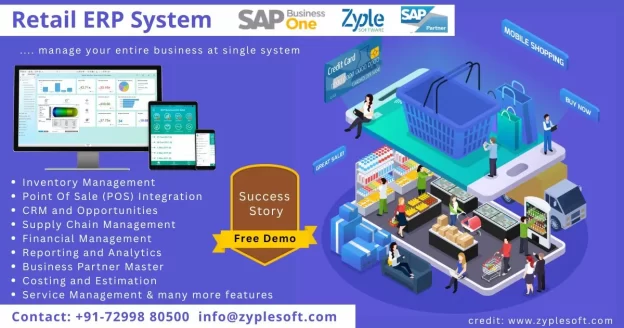
What is Retail ERP Software?

It is an inclusive software system customized to integrate and manage various business operations within a retail environment. It helps facilitate processes like inventory management, point-of-sale (POS) operations, customer relationship management (CRM), and supply chain management, giving retailers a centralized view of their business. By automating tasks and providing real-time data insights, these ERP systems optimize efficiency, improve decision-making, and ultimately contribute to increased profitability and customer satisfaction.
The Best ERP Software for Retail in India
SAP Business One is the most popular ERP software for retail businesses in India, specifically for small and medium-sized enterprises (SMEs). Its strength lies in its ability to facilitate retail operations, improve customer experiences, and provide comprehensive insights through its integrated platform.
Retail ERP Examples
1.SAP B1
It is an ERP solution that can be designed for the retail sector. It provides features such as inventory management, sales, and financial management.
2.NetSuite
It is a leading cloud-based ERP system with a powerful retail focus. It provides modules such as inventory management, sales, financials, and more.
3.Microsoft Dynamics 365
It is an inclusive ERP solution with robust retail capabilities, such as sales, inventory management, and customer relationship management.
4.Oracle Retail
It is a suite of solutions specifically customized for the retail industry. It is known for its strength in areas like supply chain management, point-of-sale systems, and more.
Benefits of Retail ERP Software
Behind every retail success story is a web of compound operations aimed at handling inventory and creating pleasant customer experiences. ERP systems facilitate operations and build agility, efficiency, and customer satisfaction. Here are common benefits provided by retail ERP systems.
1. Streamlined Operations
In the retail sector, customer demands shift quickly, and different sales channels operate simultaneously, making it important to have real-time visibility and coordination across every part of the business to avoid stockouts, delays, or missed sales opportunities. SAP solutions cut through the noise by pulling everything, such as inventory, sales, and supply chain operations, into a single platform.
2. Enhanced Data Management
Retail data is the lifeblood of smart decision-making. Also, managing it with spreadsheets and disconnected systems is nearly unfeasible. SAP services improve data management by collecting information from every corner, such as sales figures, customer trends, and supply chain performance, and turning it into clear, actionable insights. With an ERP system, for instance, retailers can recognize which products are hits with customers, spot trends early, and quickly adapt pricing or promotions.
3. Comprehensive Financial Insights and Reporting
Without a clear financial view, it’s easy to miss core details, like how much revenue is being drained by inefficiencies or where profitability could be boosted. A retail ERP system centralizes financial data, from daily sales transactions to vendor payments, and turns it into inclusive, real-time reports. Rather than waiting for monthly statements, retailers can dive into comprehensive financial insights whenever they need them to track margins or prepare for tax season, for example. This capability delivers the foundation of managerial flexibility and rapid adjustments so that retailers can stay at the top of financial performance at all times.
4. Improved Customer Experience
A great customer experience is the heart of every successful retail business. But when systems are disconnected, delivering it consistently can be a challenge. By linking everything from inventory to sales data in one place, a retail ERP system allows retailers to deliver smoother, faster service to reduce out-of-stock frustrations and speed up checkouts. These systems also allow retailers to personalize customer interactions and respond quickly to the needs to create customer experiences that keep customers satisfied and coming back.
5. Accurate Demand Forecasting
By analyzing sales data, seasonal trends, and supplier performance in a timely way, an ERP system provides tools to forecast demand more precisely. Rather than overstocking slow-moving items or running out of best sellers during peak time, retailers can exactly anticipate what their customers need and when.
6. Effortless Automation
Behind every retail operation, there’s a cluster of repetitive tasks, including manual inventory updates, order tracking, and invoice processing, that can eat up valuable time. A retail ERP system transforms these tedious tasks through automation. Inventory levels are updated quickly after each sale, and purchase orders are generated automatically when stock runs low. This not only saves time. It eliminates human errors and clears employees to focus on higher-value work, such as engaging with customers or planning for growth.
7. Scalability
As a retail business grows, managing operations can quickly become immense. What worked when a company had a single store or online channel can suddenly feel deficient. An ERP solution can scale with a business when a retailer wants to open a new location, expand into e-commerce, or add more products to its lineup. There’s no need for more spreadsheets or extra disconnected systems. Everything from inventory to sales tracking expands efficiently, delivering retailers with the power to scale without headaches. Growth is no longer a challenge, and it’s an opportunity using a retail ERP system.
Key Factors in Selecting the Right Retail ERP Solution
Selecting the right retail ERP system is all about finding the proper fit for a company’s unique business needs. The best solution is one that handles a business’s complexity, integrates seamlessly with existing tools, and delivers real value long after SAP implementation. When evaluating retail ERP solutions, think about the following six factors:
1. Business Size and Complexity
The size and complexity of a retail business are main considerations when choosing an ERP system. A small boutique with few shelves of products doesn’t need the same level of sophistication as a multi-location retailer juggling inventory across physical and online stores. A neighborhood shop might look for a simple item to monitor sales and restock items, while a large department store may require an ERP system that can comfortably manage thousands of SKUs and synchronize operations.
2. Industry-Specific Requirements
In retail, every sector faces unique specific challenges that demand designed solutions. The right retail ERP system accommodates these differences and provides specific capabilities to handle them. For instance, the grocery store needs real-time inventory tracking to avoid spoilage, while the clothing boutique will benefit more from a system that governs seasonal collections and size variations.
3. Integration with Existing Systems
Retailers already depend on tools like POS systems, e–commerce platforms, and CRM software. If a new ERP system doesn’t appropriately connect with them, things may start to break down. The right ERP system efficiently integrates with ERP services to keep data flowing seamlessly and operations thriving without a hitch.
4. Ease of Use and Flexibility
For almost every company, growth is the goal. That’s the reason why ease of use and flexibility in an ERP system are so crucial. As a business expands, opening new stores or diving deeper into e-commerce, its systems need to expand with it. The right ERP system evolves alongside the business to manage increased inventory, support additional sales channels, and adapt to new market demands. Picture a small shop expanding into becoming a multilocation retailer. Flexibility helps the system shift gears, scale up, and customize new requirements as the business changes, so it’s always ready for the next opportunity.
5. Cost and Return on Investment (ROI)
When reviewing the cost of a retail ERP system, it’s easy to focus on the immediate expense. A smart ERP choice refines operations and actively promotes growth by reducing inefficiencies, minimizing costly errors, and speeding up functions like inventory management and customer orders.
6. Vendor Reputation and Support
It’s also about the company behind it. Retailers require partner relationships they can depend on for smooth implementation, regular updates, and quick problem-solving when issues arise. Ensure you research customer reviews, case studies, and industry feedback to see how vendors handle long-term relationships, system updates, and problem resolution for retail businesses similar to yours.
Features of Retail ERP
Inventory Management
These ERP systems provide instantaneous visibility into inventory levels across all locations, such as stores and warehouses. This helps avoid stockouts and overstocking, optimize inventory turnover, and manage product lifecycles effectively.
Point Of Sale (POS) Integration
Integration with POS systems allows seamless sales transactions, real-time sales data capture, and accurate reporting.
Customer Relationship Management (CRM)
Retail ERP systems often incorporate CRM functionalities to manage customer data, track interactions, personalize marketing efforts, and improve customer loyalty.
Supply Chain Management
Features like demand forecasting, order management, and supplier management help increase the flow of goods from suppliers to customers as well as ensure timely delivery and efficient fulfillment.
Financial Management
Retail ERP software systems automate financial processes, such as accounting, accounts payable, accounts receivable, and reporting, optimizing accuracy and efficiency.
Reporting and Analytics
These systems provide detailed reporting and analytics capabilities, delivering insights into sales performance, customer behavior, and operational efficiency.
Conclusion of Retail ERP Systems
Zyple Software provides SAP Business One ERP, an inclusive solution for managing important business functions, such as inventory management, order processing, financials, and customer data. With real-time visibility, retailers can increase stock levels, improve order fulfillment, and build better customer experiences across online, in-store, and mobile channels.