SAP Business One for Import and Export Company
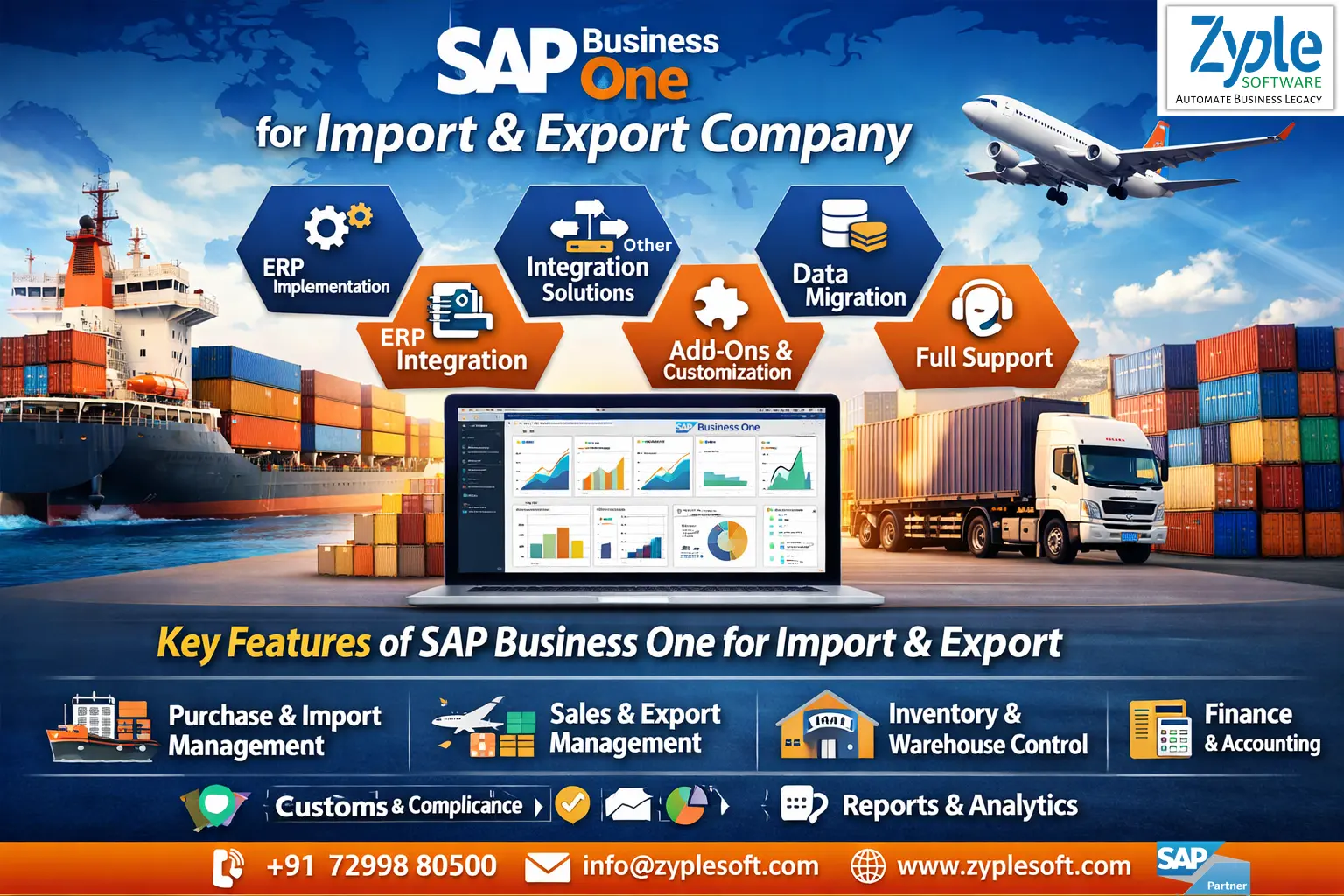
Buying and selling internationally requires overview and structure. The stock is spread across different locations; every country has its own rules and exchange rates, and shipments must always be traceable. SAP Business One for import and export company is a cost-effective, integrated ERP system that helps import and export businesses to handle everything from multi-languages and currency to country localizations and laws.
Challenges of Import and Export Company
Import and export companies face complex challenges, including navigating international regulations and customs procedures, handling volatile currency exchange rates, high logistics costs, and securing reliable, safe payments. Supply chain disruptions, intense global competition, and maintaining strict quality standards across borders add to these risks.
1. Regulatory and Customs Compliance
Navigating complex and continuously changing trade laws, tariffs, and documentation in different countries can lead to delays, fines, or seizure of goods.
2. Financial Risks
Currency fluctuations, high international transaction fees, and non-payment fees are the key obstacles.
3. Logistics and Supply Chain Management
Shipping delays, port congestion, and natural disasters can hamper inventory management and cause damage to perishable goods.
4. Finding and Evaluating Partners
Locating, auditing, and maintaining relationships with trustworthy overseas buyers or suppliers demands significant effort.
5. Cultural and Communication Barriers
Different business etiquettes, languages, and time zones can confuse negotiations and contractual agreements.
Features of SAP Business One for Import and Export Company
1. Multi-Currency and Global Trade Management
- Manages transactions in multiple currencies automatically.
- Exchange rate updates and foreign currency postings can be supported.
- Handles international customers, vendors, and payments easily.
- Necessary for companies dealing with global clients and suppliers.
2. Import and Export Documentation
- Creates and handles commercial invoices, packing lists, bills of lading, and shipping documents.
- Automates EXIM documentation workflows to minimize manual work.
3. Compliance and Regulatory Control
- Country-specific tax rules and legal compliance can be supported.
- Handles custom duties, import/export regulations, and trade compliance documentation.
- Very essential for avoiding penalties and delays.
4. Inventory and Warehouse Management
- Real-time tracking of stock levels, batch/serial numbers, and goods across multiple warehouses.
- Goods in transit can be tracked (import/export shipments).
- There is no stock mismatch in international trade.
5. Supply Chain and Logistics Management
- End-to-end visibility of purchase orders (imports), sales orders (exports), and shipment tracking and delivery status.
- Helps improve procurement and logistics processes.
6. Financial Management and Costing
- Tracks landed costs (freight, duty, and insurance) and profitability per shipment.
- Automates accounts payable (suppliers), accounts receivable (customers), and banking and reconciliation.
7. Sales and Customer Relationship Management (CRM)
- Handles international customers and distributors.
- Tracks sales pipeline and export orders.
- Maintains complete customer history and communication.
8. Purchasing and Vendor Management
- Handles global suppliers.
- Automation of procurement cycles, from purchase requests and purchase orders to goods receipt and invoice.
- Compares vendor pricing and performance.
9. Data Import and Integration
- Import/export master data and transactions can be extracted from external systems.
- Connects with logistics, shopping, or custom systems.
10. Real-Time Reporting and Analytics
- Creates reports like shipment status, profit per export/import, inventory valuation, and financial valuations.
- Decision-making can be done on dashboards.
11. End-to-End Traceability
- Tracks every transaction from supplier and warehouse to shipment and customer.
- Complete audit trail for compliance and transparency.
12. Scalability with EXIM (Export–Import Management) Add-ons
- Add-ons extensions can be done for functionalities like duty drawback, incentive schemes, license management, and port-wise shipment tracking.
Importance of SAP Business One for Import and Export Company
The enterprise resource planning (ERP) system, SAP Business One (SAP B1) software, is important for import and export companies by delivering a unified, real-time platform to handle complex logistics, multi-currency accounting, and inventory across borders. It boosts efficiency through automated workflows, minimizing manual errors, and optimizing supply chains to improve profitability and scalability.
1. Real-Time Inventory and Supply Chain Management
Companies can track goods from suppliers to final customers across different locations, including real-time monitoring of shipments and warehouse operations, minimizing the risks of overstocking or stockouts using SAP implementation.
2. Multi-Currency and Regulatory Compliance
The system manages multiple currencies, exchange rate fluctuations, and complex international trade regulations and tax compliance, which is essential for cross-border transactions.
3. Automated Logistics and Documentation
The SAP software automates purchasing, sales, and logistical processes, accelerating documentation required for importing and exporting.
4. Improved Financial Control
It delivers powerful financial management, including automated invoicing and detailed financial reporting to handle cash flow and improve return on investment (ROI).
5. Efficient Customer/Supplier Management
It strengthens vendor coordination and handles customer relationships effectively, ensuring better service and tracking of international orders.
Benefits of SAP Business One ERP for Import and Export Company
The SAP Business One (SAP B1) solution delivers export and import companies with a unified, real-time system to manage international logistics, multi-currency accounting, and complex supply chains. Main benefits include automated compliance with EXIM documentation, improved inventory tracking across borders, and facilitated supplier coordination, leading to faster, error-free operations.
1. Integrated EXIM (Export-Import) Management
Specialized add-ons handle export/import licenses, license consumption, pre-shipment, and post-shipment documentation within one system.
2. Inclusive Inventory Control
Real-time visibility of stock across different warehouses or countries, including barcode scanning, bin management, and replenishment planning, minimizes stockouts and optimizes stockouts.
3. Multi-Currency and Financial Compliance
Manages foreign currency transactions and exchange rate fluctuations automatically while handling complex international financial reporting and tax compliance.
4. Supply Chain Optimization
Facilitates procurement and logistics by delivering tracking for goods from order to final delivery, minimizing shipping delays.
5. Customer and Vendor Management
It centralizes information to increase supplier coordination and improve customer service, which is essential for international trade using SAP solutions.
6. Efficiency and Automation
Minimizes manual data entry and human errors by automating workflows such as order processing, purchasing, and reporting.
7. Ease of Use and Access
Cloud-based access enables management of business operations from anywhere, allowing the system to grow with the company’s expansion.
Conclusion of Import and Export ERP
Zyple Software is a leading SAP Business One partner in India specializing in implementation, integration, add-on solutions, and support for import and export companies. SAP Business One is immensely valuable for import and export companies that choose overview and automation. Import and export businesses use SAP Business One for efficiency in the warehouse, financial control, and flexibility in sales channels.
Are you pursuing the SAP Business One software system for your business or industry?
If you’re involved, book an SAP B1 demo.
Fill in all the details in the allocated contact form; our team will return to you.