Why ERP Implementation Fails: 12 Mistakes Organizations Can Avoid
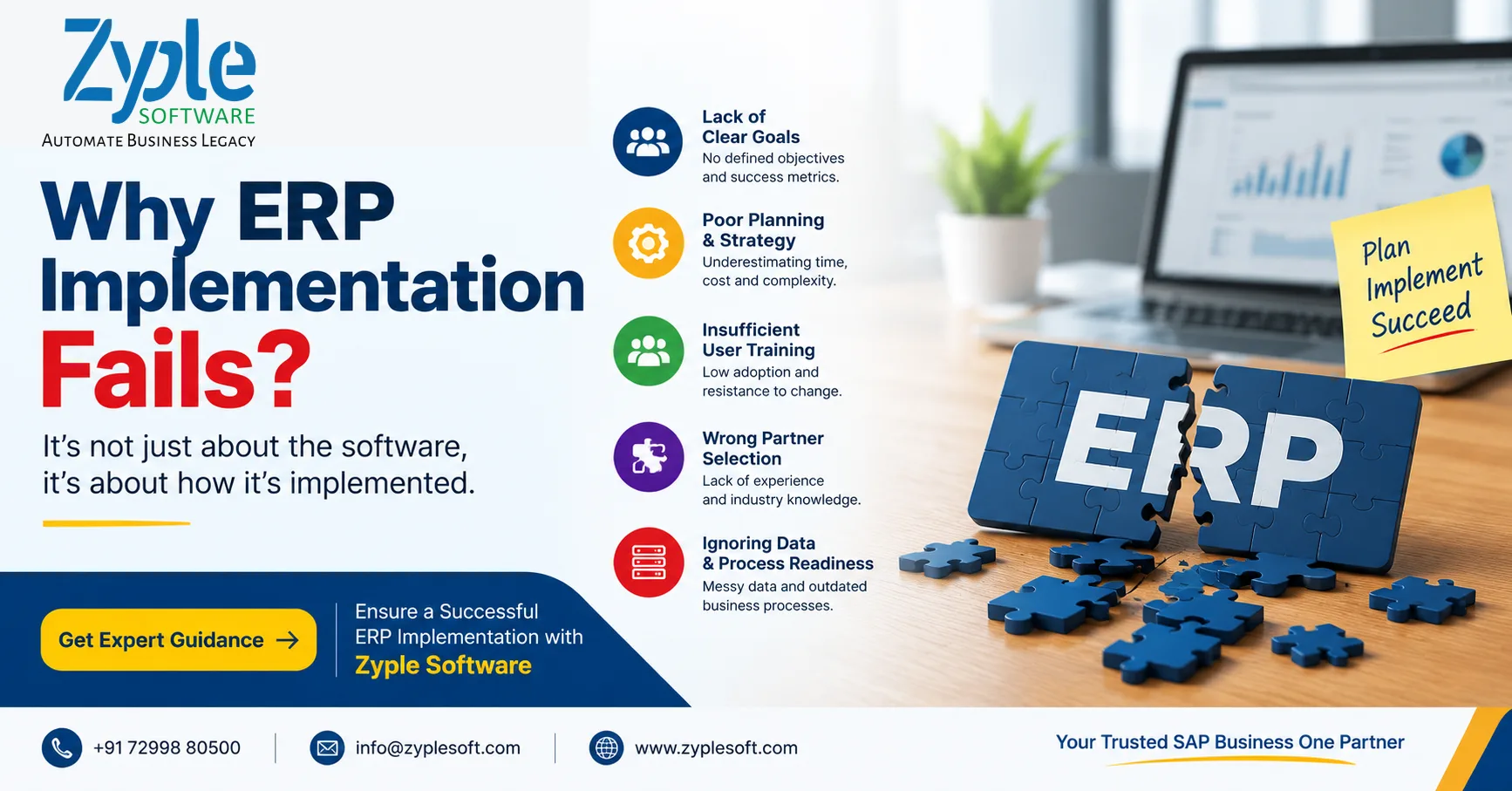
Companies and enterprises of different sizes have implemented ERP systems to improve their process efficacy, performance, and data security. Indeed, they have been able to realize improved performances in terms of record keeping, periodic financial reporting, and data sharing as well as employee work ability.
Up to 70% of ERP implementations fail to achive original goals or run significantly over budget because they are treated as IT upgrades rather than core business transformations.
However, there are instances in which businesses have fully experienced failures during the implementation process of the ERP solution. Here, we’ll discuss about 12 mistakes organizations can avoid when implementation fails.
1. Unclear Objectives
Deploying without measurable goals is the mistake. It can be avoided by defining specific key performance indicators (KPIs) like cutting order processing time by 20%.
2. IT-Only Ownership
Delegating the project exclusively to the IT department is the mistake. It can be avoided by appointing a C-suite executive as project champion to promote cross-department alignment.
3. Weak Change Management
Overlooking employee resistance to new workflows is the new mistake. It can be avoided by investing in consistent communication, help desks, and role-based training.
4. Poor Data Migration
Moving uncleaned, redundant legacy data into the new data is the mistake. It can be avoided by clearing, outlining, and verifying records months before go-live.
5. Excessive Customization
Changing core software code to match broken legacy habits. It can be avoided by adapting standard industry best practices instead of heavy custom coding.
6. Unrealistic Timelines
Rushing the implementation schedule to save upfront costs is the mistake. It can be avoided by developing realistic time buffers and stage deployments gradually.
7. Budget Underestimation
Failing to account for hidden integration and training costs is the mistake. It can be avoided by setting aside a dedicated 20 to 25% financial contingency buffer.
8. Skipping End-to-End Testing
Testing isolated features instead of complete cross-departmental workflows is the mistake. It can be avoided by running thorough multi-department pilot tests before final cutover.
9. Inadequate Training
Delivering concise, last-minute tutorials just before launch is the mistake. It can be avoided by delivering consistent, interactive learning programs customized for specific user roles.
10. Wrong Vendor Selection
Choosing a platform without proper industry domain experience is the mistake. It can be avoided by using structured requests for proposals (RFPs) and checking peer references.
11. Scope Creep
Uncontrolled addition of new features during implementation is the mistake. It can be avoided by establishing a formal change-request protocol to freeze unnecessary mid-project expansions.
12. Stopping At Go-Live
Declaring the launch date as the finish line is the mistake. It can be avoided by maintaining dedicated post-go-live technical support and measuring performance against KPIs.
9 Best Practices For Successful ERP Implementation
1. Take Stock of Your Business
Identify your strengths and weaknesses, SAP software already implemented processes, IT-savvy staff and those who require training, and more. Based on this information, you can prepare the project specifications; the more detailed they are, the better you will be able to find your requirements.
2. Define Clear Objectives
Define the objectives to be achieved by the project and create the KPIs to measure them. This will allow you to evaluate the success of your execution. Have you minimized your unpaid bills? Is your billing process faster? and more.
3. Sorting Through Your Data
Take advantage of the data migration to identify relevant data and develop a solid foundation for more reliable reporting, allowing you to make decisions that will drive your business’s growth.
4. Putting The Right Person On The Project
The person must not only master the subject matter but also understand how the company works, how to address unforeseen circumstances, and how to cope with difficulties; in short, he or she must have the responsibility to handle the SAP implementation project.
5. Choosing the Right Supplier
Selecting the SAP B1 ERP purveyor will also impact the success of your project. The purveyor must be able to support and advise the business. It must be able to provide services to help you implement its solution in your company like training, support, integration, migartion, and more.
6. Have a Good Plan of Action
Prepare your action plan carefully; the better you’ll be able to handle difficulties and even anticipate certain problems using SAP B1 add-ons.
7. Establishing Good Communication
Change is frightening, even stressful. There is a need to support your employees by communicating with them.
8. Be Patient
SAP B1 implementation takes several months; you need to be patient and accept that a few unforeseen events may happen. Success is measured over the long term. It’s therefore normal to experience obstacles in the process. What matters is your ability to overcome without losing view of your goals.
9. Ensure That Your Solution Is Interoperable
You probably use other software in the company. So you need to ensure that the SAP Business One solution will be able to interface with other software if you want to keep some of it. Interoperability helps avoid redundant data entry, facilitates data exchange, and ensures the continuity of your business processes.
Conclusion of Why ERP Implementation Fails and Mistakes Organizations Can Avoid
Zyple Software is an authorized SAP Business One partner in India providing ERP services like SAP B1 implementation, integration, migration, licensing, add-ons, consulting, digital transformation, and support to different industries like construction, real estate, manufacturing, retail, pharma, aerospace, solar, jewellery, food and beverage, textiles, healthcare, and more.
SAP Business One is an ERP customized for small and medium-sized enterprises (SMEs) that integrates finance, purchasing, sales, inventory, production, CRM, and reporting and analytics into a single platform. For all organizations, it can enhance project costing, procurement, subcontractor billing, and inventory management.
Are you looking for a successful ERP implementation for business? fill your details in below contact form.
FAQs
1.How can I avoid ERP implementation failure in my business?
You can avoid ERP implementation failure by defining clear business goals, selecting the right ERP software, preparing accurate data, training employees, and partnering with an experienced ERP implementation provider like Zyple Software. Zyple Software provides SAP Business One implementation and support services to help businesses facilitate their operations.
2.Which ERP software is best for small and medium-sized enterprises (SMEs)?
SAP Business One is an ideal ERP solution for small and medium-sized enterprises (SMEs) looking to integrate finance, sales, purchasing, inventory, production, and reporting. The right configuration and implementation approach help businesses improve efficiency and handle growth.
3.How do I choose the suitable implementation partner in India?
Choose an ERP implementation partner based on industry experience, technical expertise, implementation methodology, customization functionalities, transparent licensing, employee training, and ongoing support like Zyple Software. Zyple Software delivers SAP Business One implementation, integration, migration, add-ons, licensing, and support services.
4.How much does SAP Business One implementation cost?
SAP Business One implementation costs depend on the number of users, licensing model, business complexity, customization, integrations, data migration, and training requirements. Contact Zyple Software to discuss your business needs and gain a solution customized for your budget and operational goals.
5.How can Zyple Software help my business implement SAP Business One successfully?
Zyple Software helps businesses in India, the UAE, and the world with SAP Business One implementation, integration, add-on development, migration, licensing, consulting, digital transformation, and ongoing support. Contact Zyple Software to discuss your ERP requirements and plan an implementation aligned with your business goals.