SAP Business One Total Cost of Ownership (TCO) Break-Downs for Indian SMEs
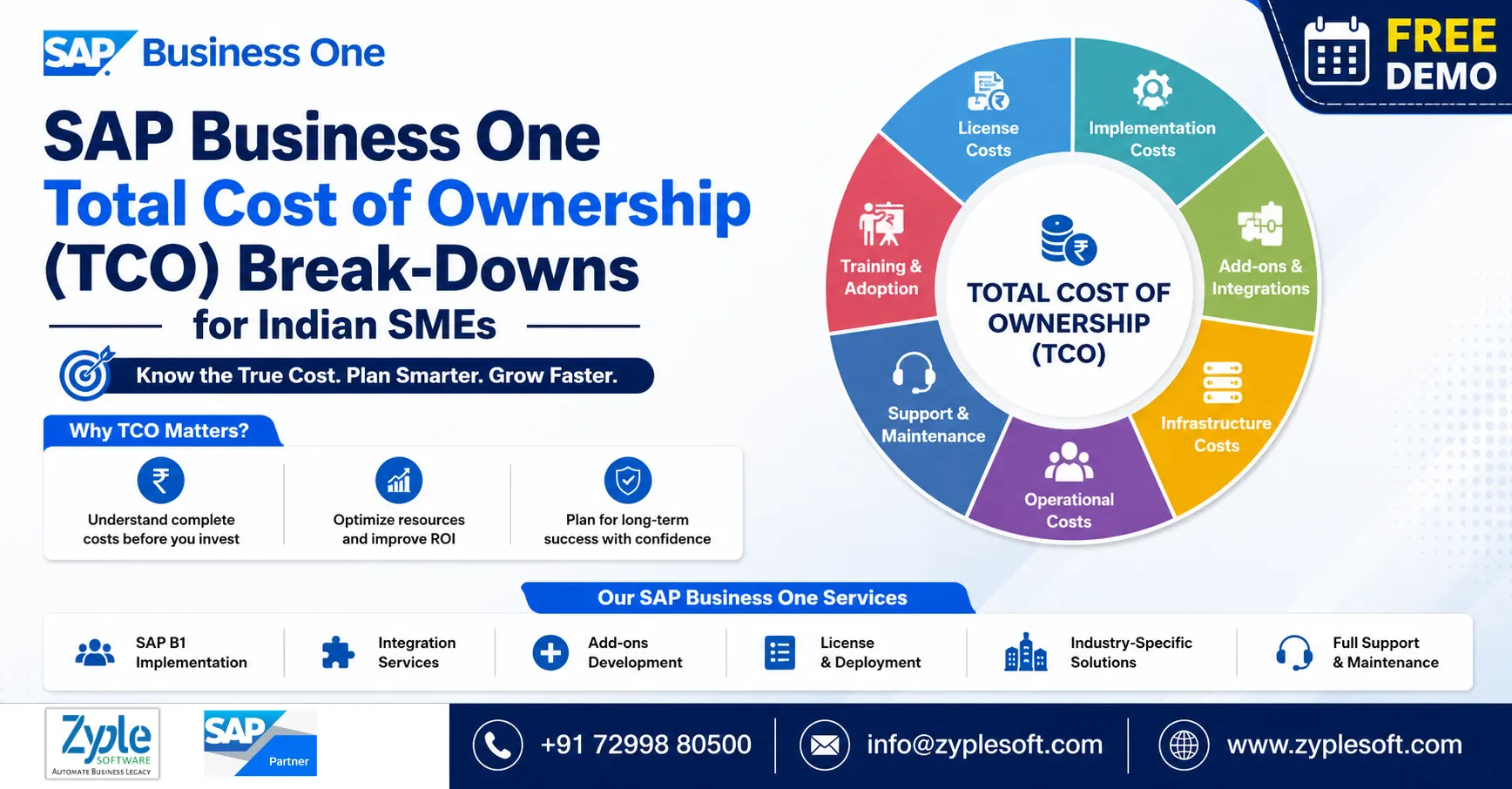
For most Indian small and medium-sized enterprises (SMEs), investing in an ERP solution is one of the essential decisions of their existence. When it comes to ERP, it is hard to ignore SAP Business One ERP or SAP B1 ERP. However, before making a commitment to SAP Business One, the question that certainly arises for almost every company is, what is the SAP B1 price in India?
Unfortunately, there isn’t any standard SAP Business One ERP price in India. There are too many factors that determine the price you end up paying. These may cover factors like the number of users, license model, implementation strategy, degree of customization, and more. Here, we’ll discuss SAP Business One total cost of ownership (TCO) break-downs for Indian SMEs.
Why Understanding the SAP Business One Price in India Is Crucial
It happens quite often that Indian SMEs limit themselves to evaluating the SAP Business One price in India in terms of license fees when budgeting an ERP investment. As practice shows, the actual SAP B1 total cost requires more components, including but not limited to SAP implementation, integration, support, digital transformation, and add-ons. Failing to budget these extra elements of the cost structure means risking unexpected financial hits in the future.
Zyple Software provides SAP Business One for Indian small and medium-sized enterprises (SMEs) with ERP functionalities coupled with a commercially convenient price structure for the Indian SME market. Compared to international benchmarks, the SAP B1 licensing cost in India is relatively lower, which contributes to the widespread acceptance of SAP B1.
Key Elements of the SAP Business One Total Cost of Ownership (TCO) Structure for Indian SMEs
The total cost of ownership structure of SAP B1 for Indian SMEs includes different components. Here are the elements and how they impact the total cost of ownership for Indian SMEs in SAP software.
1. License Fees
The price that you are to pay for SAP B1 licenses is influenced by various factors.
- Type of License:It includes professional, limited, starter package, or indirect access.
- Type of License Agreement: It includes perpetual vs. subscription.
- Number of Users.
- Volume discounts (available for large-scale orders).
Every type of license is intended for a certain category of users who have specific access rights to SAP Business One ERP modules. Using the proper license structure is the main driver that makes it possible to reduce the SAP Business One licensing cost in India to the minimum level. Inadequate allocation of user licenses is one of the most common reasons behind unnecessarily high costs of SAP B1 implementation.
2. SAP Business One Implementation Cost
Implementation is an essential part of SAP B1 deployment that often gets underestimated. The SAP B1 implementation cost includes multiple steps and activities like business process mapping, software configuration, migration of data, system customization, integration with third-party solutions, user training, user acceptance testing, and controlled go-live. The complexity of the process differs based on the characteristics of your business.
3. Annual Maintenance Charges (AMC)
In the contecxt of perpetual license agreements, the SAP B1 licensing cost in India generally includes a part of the fee designated for AMC which covers software updates, bug fixes, and access to additional modules using SAP solutions.
4. Hosting and Infrastructure
SAP Business One supports both on-premises and cloud deployment models that vary in cost structure. While choosing cloud hosting, the overall cost of SAP B1 is split into the SAP Business One price in India and monthly subscription fees.
On-premises deployment involves the deployment of an in-house server, database licensing, and a corresponding infrastructure. Though the upfront cost is higher, it is generally accompanied by lower variability in operational expenses.
5. Add-Ons, Customizations, and Training
The SAP B1 licensing cost in India doesn’t account for the price that you need to pay for purchasing SAP Business One add-ons, which are essential for industries like construction, manufacturing, pharmaceuticals, automobiles, or electronics. Also, depending on the customization that you require, the SAP Business One implementation cost will differ. Training sessions also impact the total price you will pay for SAP B1.
SAP Business One Total Cost of Ownership in India Based on Business Size
Though individual cases of SAP Business One cost calculation may differ, the rule is quite clear: as a company expands, both the SAP B1 incensing cost and SAP Business One implementation cost in India increase. The number of users is certainly not the only factor impacting the increase in the total cost of ownership, as more complex integration and greater customization needs are expected at later stages.
1. Micro or Startup
Limited user count, standard configuration, and cloud-first.
2. Small Business
Moderate user count, light customization needs, and cloud-first.
3. Medium-Sized Business
Multi-department structure, multiple integrations, and multi-location.
4. Large SME or Group
Complex processes, integration, group accounting, and multi-channel.
Rather than trying to find out some standard figures, it is much more effective to contact a certified SAP Business One partner like Zyple Software with your details and request a quote for the SAP Business One ERP price in India.
Perpetual vs. Subscription Licenses and Their Impact on SAP B1 Total Cost of Ownership (TCO)
Depending on whether you choose a perpetual license or subscribe to SAP B1, the long-term SAP Business One price in India will differ considerably.
1. Perpetual License Agreement (CAPEX)
With a perpetual license agreement, you gain ownership of software, which means that you pay one time to buy licenses. This model enables saving money on SAP Business One cost over time since you only pay one for licenses.
Benefits of Perpetual Licenses:
- Ideal for those who need a perpetual software license.
- No license escrow needed.
Disadvantages of Perpetual Licenses:
- Requirement forrenewing the license for additional users.
- More expensive compared to subscriptions.
2. Subscription License Agreement (OPEX)
Subscription licenses enable subscribing to the software instead of buying. With a subscription license, you regularly pay a recurring fee in exchange for regular updates and extra features.
Benefits of Subscription Licenses:
- Lower upfront SAP B1 total cost.
- Easy to scale in case of growth.
Disadvantages of Subscription Licenses:
- Renewal every year.
Is It Worth Buying SAP Business One at an Offered Price in India?
SAP Business One is one of the best ERP solutions on the market that is capable of helping businesses to handle their operations more efficiently. For most Indian companies, the return on investment in SAP B1 occurs one to two years after deployment. This is when advantages of the product become evident thanks to improvements in:
- Order-to-cash cycles.
- Inventory control and management.
- Working capital management.
- Financial reporting capabilities.
- Compliance with local legislation, including GST and e-invoicing.
- Integration opportunities.
If compared to a traditional ERP alternative like Tally integrated with Excel, Google Sheets, and other add-ons, the cost of owning SAP B1 in India is considerably lower.
Conclusion of SAP Business One TCO
As a most reliable SAP Business One partners, Zyple Software is delivering services like SAP B1 implementation, integration, migration, licensing, add-ons, digital transformation, and support to different industries, like construction, manufacturing, solar, food and beverage, aerospace, oil and gas, healthcare, retail, jewellery, pharma, and textiles.
SAP Business One is an ERP software customized for small and medium-sized enterprises that connects finance, production, inventory, material requirements planning (MRP), procurement, sales, CRM, and reporting and analytics into one platform. For all businesses, it can improve project costing, procurement, subcontractor billing, and inventory management.
Do you claim the SAP B1 ERP system for your business or industry?
Finish all the details in the demonstrated contact form; our team will get back to you.
FAQs
1.What is the total cost of ownership (TCO) of SAP Business One for Indian SMEs?
The total cost of ownership (TCO) of SAP Business One for Indian SMEs generally includes software licensing, implementation, customization, training, and ongoing support. Depending on business size and deployment type (cloud and on-premise), the cost can differ significantly.
2.What are the key components included in SAP Business One TCO?
SAP Business One TCO includes multiple components such as license fees, infrastructure (servers or cloud subscription), implementation charges, add-ons, integration costs, and annual maintenance. Businesses should also consider hidden costs like user training, upgrades, and internal resource allocation.
3.Is SAP Business One affordable for small and medium-sized enterprises in India?
Yes, SAP Business One is designed specifically for SMEs and provides flexible pricing models to suit different budgets. With options like subscription-based cloud deployment, Indian SMEs can minimize upfront investment and handle costs efficiently while gaining access to enterprise-grade ERP capabilities.
4.How can businesses minimize the total cost of SAP Business One implementation?
Businesses can minimize total cost of ownership (TCO) by choosing the right implementation partner like Zyple Software, opting for cloud deployment, minimizing unnecessary customizations, and selecting only essential add-ons. Proper planning, phased implementation, and user training also help prevent costly errors and delays.
5.What is the ROI of SAP Business One compared to its TCO?
The ROI of SAP Business One often outweighs its TCO by improving operational efficiency, reducing manual errors, and improving decision-making with real-time insights. For Indian SMEs, this leads to better cost control, increased productivity, and faster business growth, making it a valuable long-term investment.