SAP Business One ERP for Biotechnology Industry
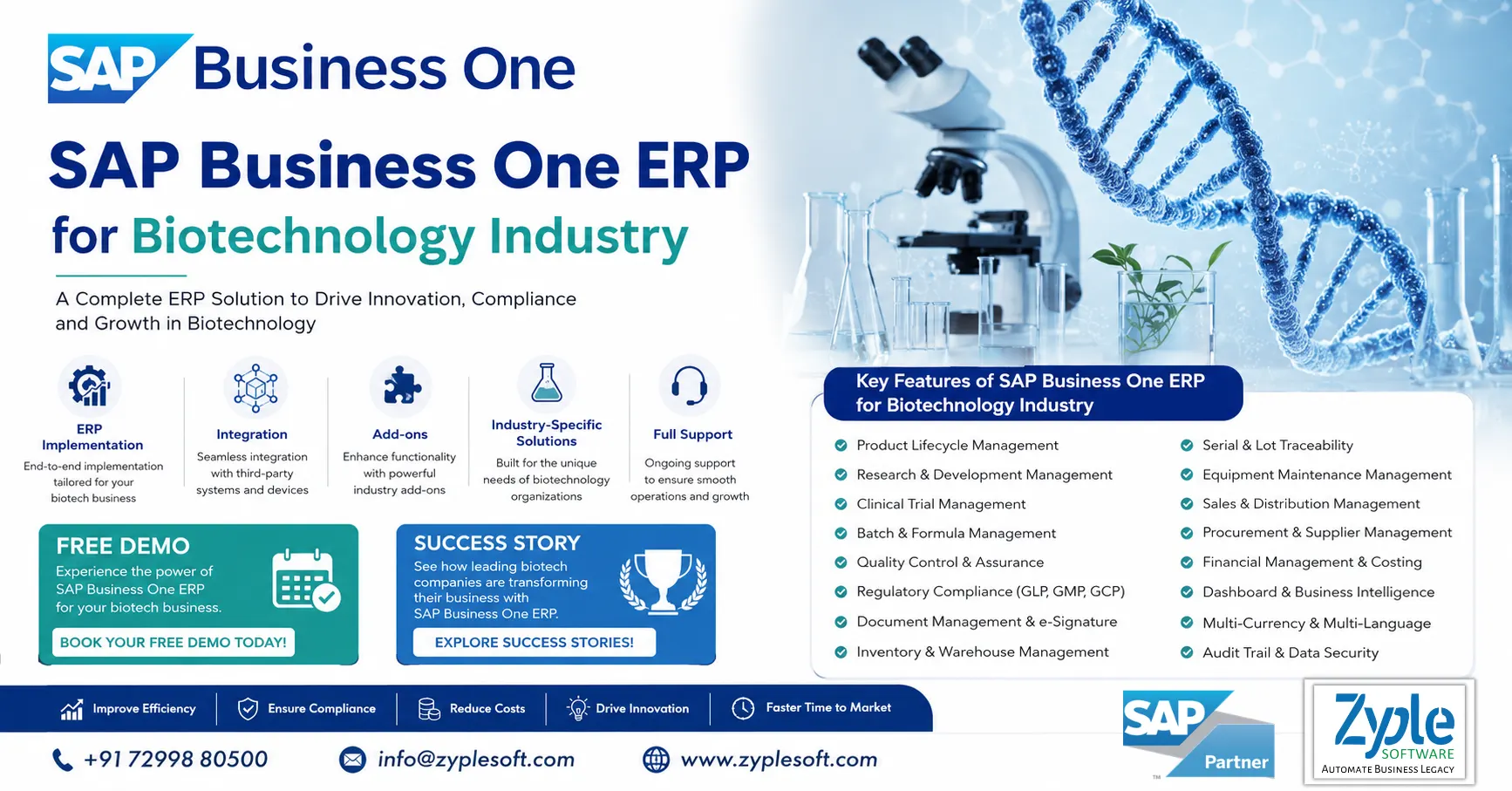
As the biotechnology industry grows exponentially, it has become tedious and challenging to handle multiple operations all around the world, along with the business processes. Moreover, with a large industry like biotechnology, integrating various departments and tackling any issues that occurred also involves so much time and effort. As a complete solution for all these, SAP Business One comes up as the most feasible and supporting hand to increase efficiency in biotechnology businesses. SAP Business One ERP for biotechnology not only increases efficiency but also helps to improve the quality of products of the biotechnology industry.
Challenges of the Biotechnology Industry
The biotechnology industry faces key challenges, including high research and development costs with long timelines, intense regulatory scrutiny, and high risks of failure. Major obstacles include secure funding, navigating complex intellectual property rights, protecting against cybersecurity threats, and balancing ethical concerns with rapid innovations.
1. Financial and Operational Hurdles
Emerging companies struggle with high capital requirements and the risk of failure in extended R&D processes. Scaling up production from laboratory to commercial scale is difficult, causing production obstacles.
2. Regulatory Compliance
Navigating strict, evolving global regulations for drug approval and clinical trials is expensive and time-consuming.
3. Intellectual Property (IP) and Data Security
Protecting intellectual property is essential, yet most of the biotech firms report leaked credentials, while some face insecure APIs.
4. Ethical and Safety Concerns
Emerging technologies raise ethical issues, environmental concerns, and possible biosafety risks.
5. Talent Shortage
The sector faces a shortage of experience personnel for specialized roles, impacting growth in developing markets.
6. Data Management
Integrating AI and handling complex data sets (genomics or clinical data) involves significant technological infrastructure.
Features of SAP Business One ERP for Biotechnology
1. Regulatory Compliance and Validation
Biotech companies must adhere to strict regulations (FDA, GMP, GLP, and more). SAP B1 helps by
- Regulating audit trails and documentation.
- Reinforcing regulatory reporting and validation processes.
- Securing data integrity and traceability across operations.
2. Batch Management and Full Traceability
Essential for biotech production (vaccines, biologics, enzymes):
- Batch or lot tracking from raw material to finished product.
- Genealogy tracking (forward and backward traceability).
- Expiry and shelf life management.
- Recall management support.
3. Quality Control and Laboratory Integration
Biotech involves strong QC/QA processes:
- Handle quality inspections, approvals, and retesting.
- Evaluate the certificate of analysis (CoA).
- Reinforce stability studies and microbiological validation.
- Manage non-conformance and corrective actions.
4. R&D and Formulation Management
While SAP Business One is not a full LIMS (Laboratory Information Management System), it supports:
- Bill of Materials (BOM) for formulations.
- Version management for formulation and recipes.
- Costing for experimental and production batches.
- Integration with external lab solutions (LIMS).
5. Production Planning and Process Manufacturing
Biotechnology manufacturing is process-driven because
- Production orders and process routing.
- Yield calculation and variance evaluation.
- Material Requirements Planning (MRP).
- Resource allocation (machines, labor, and clean rooms).
6. Inventory and Cold Chain Management
Biotech inventory is responsive:
- Real-time inventory tracking.
- Multi-warehouse management.
- Support for temperature-controlled storage.
- Batch-wise stock visibility and valuation.
7. Procurement and Vendor Management
Necessary for sourcing biological materials:
- Handle supplier certifications and compliance.
- Evaluate purchase orders, GRNs, and quality checks.
- Secure vendor performance analytics.
8. Financial Control and Cost Control
- It includes integrated accounting, budgeting, and cost tracking.
- It includes project costing for R&D initiatives.
- It includes profitability analysis by product, batch, or project.
9. Sales and Distribution Management
- It includes an end-to-end order-to-cash cycle.
- Handles clinical trial supply distribution.
- Tracks customer contracts and service agreements.
- It includes CRM for hospitals, labs, and distributors.
10. Business Intelligence and Analytics
- It includes real-time dashboards and KPIs.
- It includes batch performance and yield analysis.
- It includes regulatory and audit reporting.
- It includes integration with Excel and analytics tools.
11. Document Management System
- Centralized storage for SOPs (Standard Operating Procedures), compliance documents, and validation records.
- It includes version control and approval workflows.
12. Scalability and Integration
- It runs on SAP B1 HANA or SAP B1 SQL.
- Integrates with LIMS (Laboratory systems), MES (Manufacturing Execution Systems), and IoT devices (for lab or production manufacturing).
- It supports custom add-ons for biotech-specific needs.
Importance of SAP Business One ERP for Biotechnology
The enterprise resource planning (ERP) software, SAP Business One (SAP B1) system, is highly essential for small to medium-sized biotechnology companies because it delivers an integrated, regulatory-compliant, and scalable platform that handles complex, formula-based manufacturing and research data, improving overall operational efficiency.
The system helps biotech firms navigate strict industry regulations (such as GMP and FDA compliance) and supports the complete product lifecycle from R&D to commercialization.
1. Regulatory Compliance and Safety
SAP B1 ensures compliance with Good Manufacturing Practices (GMP) and FDA standards by automating documentation, delivering end-to-end audit trails, and handling product quality checks at every stage.
2. Batch Tracking and Traceability
The SAP software delivers powerful batch and serial number management, enabling firms to trace materials from raw ingredients to finished products, which is necessary for quality assurance and efficient product recalls if needed.
3. Formulation and Recipe Management
It allows process manufacturing, enabling the precise management of formulas, recipes, and batch manufacturing records (BMR).
4. Supply Chain and Inventory Control
SAP B1 handles complex supply chains, tracking raw materials, KSMs (Key Starting Materials), and APIs (Active Pharmaceutical Ingredients), improving inventory levels to minimize wastage and avoid stockouts.
5. Quality Control
Integrated QC modules enable in-process inspection and validation of materials to ensure that only compliant batches proceed to the next stage.
6. Scalability for Growth
As biotech startups move from the R&D stage to full-scale production, the system scales with them, supporting increased production volumes and expanded regulatory requirements.
7. Real-Time Data and Analytics
It delivers a 360-degree view of business operations, allowing managers to track KPIs (Key Performance Indicators) in real-time to make data-driven decisions regarding R&D projects and commercial production.
Benefits of SAP Business One for Biotechnology
The SAP Business One (SAP B1) system delivers significant benefits for biotechnology companies by integrating R&D, manufacturing, quality control, and finance into a single platform. It helps biotech firms handle complex, formula-based manufacturing, comply with strict regulatory standards (such as FDA or GMP), and improve traceability from raw materials to finished products.
1. Stringent Regulatory Compliance
SAP B1 helps in complying with regulatory standards (e.g., GMP, FDA) by automating documentation, maintaining batch histories, and delivering audit trails for all transactions using SAP implementation.
2. Batch Tracking and Traceability
The system supports complete batch-level tracking, allowing firms to monitor raw materials, intermediates, and finished goods throughout their shelf life.
3. Improved Quality Management
Delivers tools for handling sample sizes and analyzing finished products against standard test procedures.
4. Process Manufacturing Support
Designed for recipe and formula-based manufacturing, enabling detailed tracking of lab-level formulas to commercial production using SAP solutions.
5. Cost Management and R&D Efficiency
Allows capture of batch-wise costing, including labor, machine, and material costs. This helps in R&D, where tracking costs of new product development is essential.
6. Supply Chain Control
Handles multi-warehouse inventory, expiry dates, and shelf life, which is important for specialized materials in the biotech industry.
7. Ease of Use for Growth
As a solution designed for small and medium-sized enterprises (SMEs), SAP B1 ERP supports scaling from research stages to commercialization.
Conclusion of Biotechnology ERP
Zyple Software is an authorized SAP B1 partner in India specializing in implementation, digital transformation, migration, licensing, integration, add-on solutions, and consulting for the biotechnology industry. The SAP Business One ERP software is an excellent choice for the biotech industry to handle end-to-end business operations.
If you’re capable, book a demo of SAP Business One.
Do you require the SAP Business One ERP system for your business or industry?
Complete all the details in the arranged contact form; our team will return to you.