ERP Services in Mumbai for Business
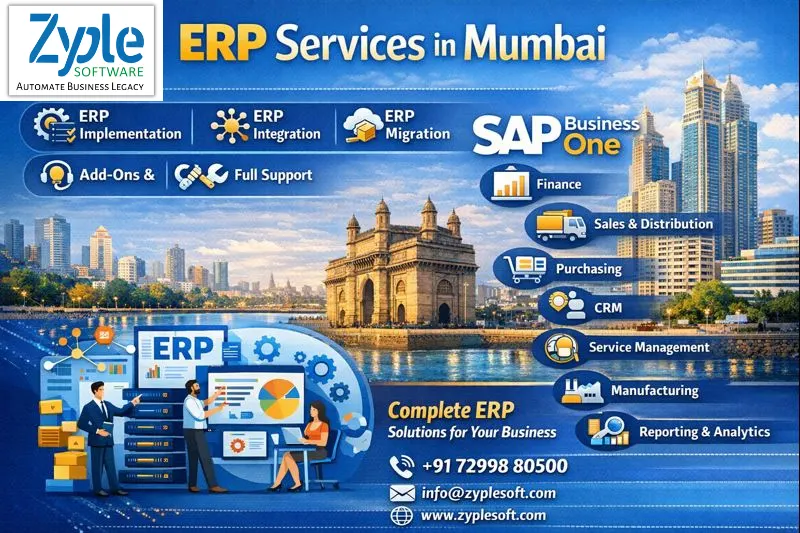
ERP stands for enterprise resource planning. ERP software is software that helps an industry to function more efficiently and smooth out the workflow. The software also helps the industry to eliminate all the existing flaws. Features like business intelligence, data analytics, the internet of things, and automation make the ERP software a perfect solution across different industries. Major industries are all shifting to ERP software for their functioning to resolve all the wrinkles that disturb the workflow. Every industry needs an ERP solution that can cater to all requirements. SAP Business One is excellent ERP software for small businesses in Mumbai that can help them boost their growth more efficiently.
There are many industries in Mumbai, such as petroleum, automobiles, electronics, entertainment, logistics, textiles, construction, aerospace and defense, jewellery manufacturing, and more.
Why SAP Business One for Businesses in Mumbai?
SAP Business One is ideal for businesses in Mumbai because it’s a scalable, all-in-one ERP solution that integrates finance, sales, inventory, and more, which is crucial for the city’s diverse, fast-paced economy. It provides real-time analytics for quick decisions, automates processes to boost productivity, supports Indian compliance like GST, and is flexible (cloud or on-premise), helping SMEs modernize and compete in a dynamic market.
1. Centralized and Integrated
Integrates all departments (finance, sales, CRM, supply chain, and production) into one system, eliminating manual work and data silos.
2. Supports Diverse Industries
Works across petroleum, electronics, logistics, textiles, and more, fitting Mumbai’s diverse business landscape.
3. Real-Time Insights
Delivers instant data and analytics for smarter, faster decisions and better forecasting.
4. Automation and Efficiency
Automates routine tasks, minimizing errors and improving productivity across operations.
5. Scalability
Grows with the business, easily adjusting to expansion and new processes.
6. Indian Compliance
Includes built-in support for Indian tax regulations, such as GST and e-invoicing.
7. Cost-Effective and Flexible
Affordable for SMEs with cloud deployment options to minimize IT overhead.
8. Improved Customer Focus
Increases customer service through better data and personalized interactions.
Top SAP B1 ERP Services in Mumbai
1. Implementation and Migration
SAP implementation includes setting up new systems and transferring from legacy platforms.
2. Cloud and On-Premise Deployment
It includes flexible options to fit business needs.
3. Add-On Development and Customization
It includes developing add-ons for different industry verticals, such as contractor billing, budget management, plant maintenance, and more.
4. Business Analytics
It includes pre-built dashboards and insights for better decision-making.
5. Industry-Specific Solutions
It includes a designed ERP solution for petroleum, construction, automobiles, textiles, and more.
6. Support and Maintenance
Round-the-clock assistance and technical guidance.
Industry Coverage Relevant to Mumbai
1. Petroleum
Finance, procurement, sales and CRM, inventory, and supply chain management to improve the efficiency of petroleum businesses.
2. Automobiles
Finance, sales and CRM, purchasing, inventory, and quality control to facilitate the operations of automobile businesses.
3. Electronics
Finance, sales and CRM, purchasing, inventory, and supply chain management to benefit electronics businesses.
4. Entertainment
Financial management, project management, sales and CRM, purchasing, and inventory to improve the efficiency of entertainment businesses.
5. Logistics
Finance, sales and CRM, purchasing, inventory, and fleet management to facilitate the operations of logistics businesses.
6. Textiles
Finance, sales, purchasing, inventory, and production to benefit textile businesses.
7. Construction
Financials, project management, sales and CRM, procurement, and inventory to improve the efficiency of construction businesses.
8. Aerospace and Defense
Financial management, purchasing, inventory and warehouse management, production planning and MRP, and sales and CRM to facilitate the operations of aerospace and defense businesses.
9. Jewellery Manufacturing
Production, inventory management, sales and CRM, purchasing, and finance to benefit jewellery manufacturing businesses.
Why is Zyple Accepted for SAP ERP Service in Mumbai?
Zyple Software is accepted for SAP ERP services in Mumbai due to being an official, certified SAP Partner with deep expertise in SAP Business One (SAP B1), providing end-to-end solutions (implementation, support, cloud migration, and industry-specific configurations) with a strong focus on SMEs, backed by a team of experienced consultants and a proven track record in India, delivering localized support for digital transformation.
1. Official SAP Partnership
Our company holds official SAP partner status, ensuring adherence to SAP’s standards, access to resources, and certified expertise.
2. Focus on SMEs (SAP B1)
They specialize in SAP Business One, an affordable and scalable ERP ideal for small and medium-sized enterprises (SMEs) common in India, delivering cost-effective cloud options.
3. End-to-End Services
They provide inclusive support, from initial consulting, implementation, development, and integration to continuous maintenance, migration (e.g., SAP B1 SQL to SAP B1 HANA), and technical and functional support.
4. Local Presence and Industry Knowledge
As a recognized partner in India, they provide localized support and industry-specific SAP solutions for sectors like petroleum, automobiles, and electronics, ensuring relevance to Mumbai’s market.
5. Experienced Team
Led by industry professionals with extensive experience, our company utilizes certified consultants and developers for quality delivery.
6. Digital Transformation Focus
They help businesses modernize, automate processes, and gain insights through SAP, using cloud solutions for flexibility and efficiency.
7. Proven Track Record
With successful project completions, including migrations and complex integrations, they build trust with businesses seeking dependable digital transformation partners.
ERP Implementation Process Overview
An ERP implementation involves key stages, such as planning and analysis (defining goals, scope, and selecting software), design (mapping processes and gap analysis), development and configuration (customizing and integrating), testing (SIT and UAT), deployment (go-live, training, and data migration), and post-go-live support and optimization (maintenance and improvements). This staged approach ensures a structured shift to a unified system, moving from initial strategy to ongoing operation.
Here are the stages of ERP implementation:
1. Discovery and Planning
Determine clear objectives, project scope, and budget. Secure executive buy-in and create a project team. Review current systems and business processes (gap analysis).
2. Design
Outline future processes to the ERP system. Recognize customizations and integration needs.
3. Development and Configuration
Install and modify the software. Build custom features or integrations. Clear and prepare data for migration.
4. Testing
System Integration Testing (SIT) is a testing that tests modules together. User Acceptance Testing (UAT) is a testing where end-users validate the system meets needs.
5. Deployment (Go-Live)
Final data migration happens in this stage. Train end-users on the latest system. Launch the system across the organization.
6. Support and Optimization
Provide continuous user support. Monitor performance and collect feedback. Plan for consistent improvements and upgrades.
Business Outcomes for Industries in Mumbai
- Automating routine, manual tasks across departments like finance, inventory, and sales minimizes errors and frees up staff for strategic activities.
- Real-time information sharing enables businesses to adapt quickly to changing market demands and operational dynamics, ensuring flexibility in production planning and order fulfillment.
- Businesses gain real-time visibility into cash flow, profitability, and overall financial health, facilitating better financial planning and management.
- The system offers precise tracking of stock levels, warehouse locations, and batch/serial numbers, ensuring accurate inventory control and reducing lead times.
Do you necessitate ERP software for your business or industry?
Fill in all the details in the assigned form; our team will get back to you.