SAP Business One ERP for EV Charging Infrastructure Industry
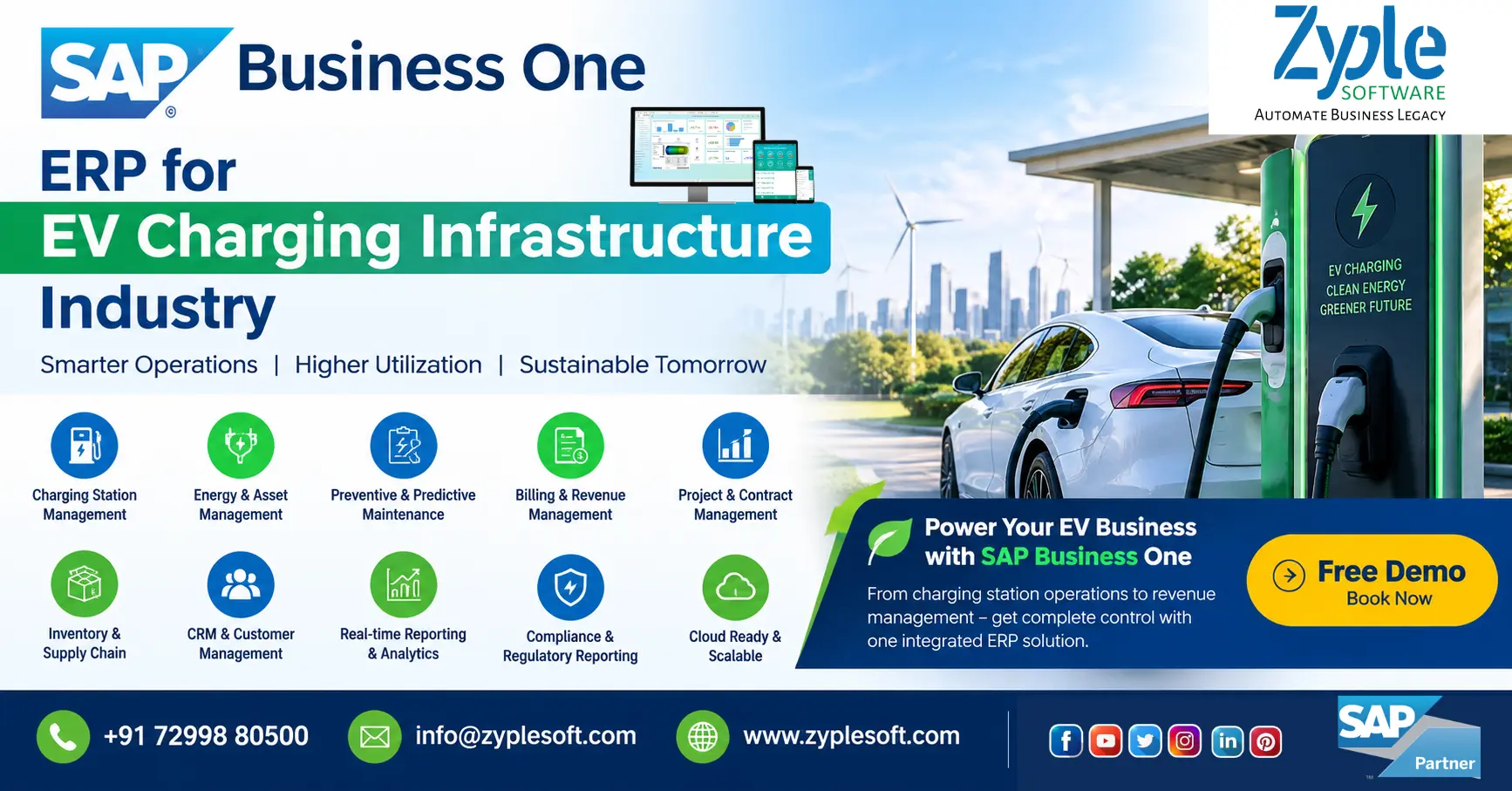
The EV charging infrastructure industry is quickly changing, driven by innovation, sustainability goals, and rising market demand. EV charging infrastructure providers must handle complex assemblies including batteries, motors, electronics, controllers, and software components while ensuring strict quality standards, regulatory compliance, and supply chain coordination. SAP Business One ERP for EV charging infrastructure industry delivers a consolidated platform that integrates production planning, inventory, procurement, project tracking, sales, CRM, quality management, and finance, providing real-time transparency and operational control across the EV charging infrastructure cycle.
Challenges Faced by the EV Charging Infrastructure Providers
Electric vehicle (EV) charging infrastructure providers face major obstacles like high initial costs, grid capacity limits, and low station use rates (0.15). These challenges slow down business growth and worry drivers.
1. High Startup Costs
Buying land, heavy hardware, and fast DC chargers requires a lot of money.
2. Low Profit Returns
Many stations stay empty most of the day, resulting in low use rates and slow payback times (0.15).
3. High Upkeep
Fixing broken parts, paying for software updates, and handling electricity bills add continuous costs.
4. Grid Limits
Local power grids struggle to handle high power demands when many people charge at once.
5. Low Uptime
Hardware faults, software bugs, and vandalism cause stations to go offline often.
6. Different Plug Types
A lack of uniform plug shapes and software systems confuses drivers.
7. Bad Placement
Most chargers sit in big cities, while highways and rural spots lack coverage.
Features of SAP Business One ERP for EV Charging Infrastructure Industry
1. EV Charging Network and Asset Management
- It includes centralized management for charging stations (EVSE), connectors, and locations.
- It includes real-time monitoring of charging station status, uptime, and faults.
- Asset lifecycle tracking from installation and maintenance to replacement.
- It includes preventive and predictive maintenance scheduling.
2. Charge Point Device Integration
- It includes integration with charging hardware using OCPP (Open Charge Point Protocol).
- It includes bidirectional communication with EV chargers.
- It includes easy onboarding and configuration of new charging stations.
- It includes API-based integration with third-party charging platforms.
3. Charging Session and Energy Management
- Tracks and handles charging sessions in real-time.
- It includes smart charging with load balancing and grid optimization.
- Monitors energy consumption and power utilization.
- Optimizes charging schedules based on tariffs and demand.
- It includes visibility into energy costs and grid usage.
4. Billing, Pricing, and Revenue Management
- Flexible pricing models like pay-per-use, subscription plans, and time-based or energy-based tariffs.
- It includes automated billing and invoicing for charging sessions.
- It includes integration with finance for real-time revenue tracking.
- It includes multi-currency and multi-location billing support.
5. Financial Management and Accounting
- Complete financial control like general ledger, accounts payable, accounts receivable, taxation, and cost center tracking for each charging station.
- It includes budgeting for infrastructure expansion.
- It includes profitability analysis per location or charger.
- It includes automated reconciliation and financial reporting.
6. Inventory and Spare Parts Management
- It includes automated procurement and replenishment.
- It includes warehouse and multi-location inventory tracking.
- It includes vendor management and purchase planning.
7. Customer Relationship Management (CRM)
- 360-degree view of EV drivers, fleet operators, and corporate clients.
- It includes subscription and contract management.
- It includes customer usage tracking and service history.
- It includes marketing campaign management for EV users.
8. Fleet and E-Mobility Management
- Handles EV fleets and charging usage.
- Monitors driver charging behavior and consumption.
- It includes corporate fleet billing and reporting.
- Support for Charge@Home, Charge@Work, and Charge@Public scenarios.
9. Multi-Location and Network Expansion Management
- Handles distributed charging networks across cities and countries.
- It includes location-wise performance and utilization analysis.
- It includes scalability for expanding EV infrastructure.
10. Real-Time Analytics and Reporting
- Dashboards for charging usage, revenue per station, and energy consumption trends.
- KPI tracking like utilization rate, downtime, and ROI.
- It includes predictive analytics for demand forecasting.
- It includes custom reports and business intelligence (BI) tools.
11. Alerts, Automation, and Workflow
- Automated alerts for charger faults, overload conditions, and payment failures.
- It includes workflow approvals for procurement, billing, and projects.
- It includes exception handling and escalation management.
12. Mobile and Remote Access
- Mobile app for monitoring charging stations and handling operations remotely.
- Access to dashboards anywhere, anytime.
- It includes field service team management.
13. Integration and Ecosystem Connectivity
- Integration with payment gateways, smart grid systems, and renewable energy sources like solar and battery usage.
- It includes API integration with EV apps and mobility platforms.
- Seamless integration with SAP software and third-party systems.
14. Sustainability and Compliance Management
- Tracks carbon footprint and energy efficiency.
- Supports sustainability reporting and ESG goals.
- It includes regulatory compliance and audit-ready reports.
- It includes energy optimization aligned with green initiatives.
15. Scalability, Customization, and Cloud Support
- Deploys on-premise or cloud.
- Customizes workflows for EV business models.
- It is scalable for growing charging networks.
Importance of SAP Business One ERP for EV Charging Infrastructure Industry
For EV charging infrastructure providers, SAP Business One delivers a centralized ERP platform to handle charge point operations, smart charging, real-time grid balancing, and automated billing. It is essential for scaling networks, optimizing energy costs, and ensuring seamless customer experiences.
1. Predictive Maintenance
Utilizes analytics to schedule preventive maintenance on electric vehicle supply equipment (EVSE), reducing station downtime with the SAP B1 implementation process.
2. Intelligent Load Balancing
Handles charging across multiple power grid strings to avoid overloads and optimize energy pricing.
3. Grid Compliance
It conducts power grid-compliant charging with real-time intelligent load management.
4. Versatile Tariffs
It supports complex pricing models for both pay-as-you-go and contractual customers.
5. E-Roaming and Reimbursement
Integrates with country-specific roaming providers and helps simplify the reimbursement of employee electricity costs for home charging using SAP solutions.
6. Rapid Support
Uses EV driver-focused service processes to resolve equipment faults and quickly react to customer inquiries.
Benefits of SAP Business One for EV Charging Infrastructure Industry
The ERP software, SAP Business One, delivers electric vehicle (EV) charging infrastructure providers with a centralized platform to automate charge point monitoring, optimize energy distribution, handle dynamic billing tariffs, and seamlessly integrate backend financials.
1. Charge Point Device Management
Simplifies monitoring, hardware onboarding, and remote root-cause analysis via open charge point protocols (OCPP).
2. Energy Management
Improves power delivery and smart charging to manage grid constraints and reduce costs.
3. Automated Billing
Supports diverse scenarios (pay-as-you-go and roaming) with real-time invoicing and expense reimbursement using SAP B1 add-ons.
4. Financial Integration
Integrates transactional data to general ledgers, fixed assets, and procurement for accurate reporting.
5. Predictive Maintenance
Uses IoT connectivity to forecast maintenance needs, minimizing downtime.
Conclusion of EV Charging Infrastructure ERP
As an experienced SAP Business One partner, Zyple Software is delivering services like SAP B1 implementation, integration, licensing, add-ons, digital transformation, and support to different industries, like construction, manufacturing, solar, food and beverage, aerospace, retail, jewellery, pharma, and textiles.
SAP Business One is an ERP software customized for small and medium-sized enterprises that connects finance, production, procurement, sales, CRM, inventory, and reporting into one platform. For EV charging infrastructure or any other businesses, it can improve project costing, procurement, subcontractor billing, and inventory management.
If you’re active, enroll a demo of SAP Business One.
Do you pursue the SAP B1 ERP system for your business or industry?
Complete all the details in the organized contact form; our team will return to you.
FAQs
1.How can SAP Business One help scale my EV charging business efficiently?
SAP Business One provides a centralized platform to handle multiple charging stations, automate operations, and gain real-time insights. This helps EV charging sector expand faster while maintaining control over costs, performance, and customer experience.
2.Can SAP Business One be customized for my EV charging business model?
Yes, SAP Business One can be customized for fitting your specific requirements, including energy-based billing, subscription plans, asset tracking, and integration with EV charging software. Custom SAP B1 add-ons ensure the system aligns perfectly with your business processes.
3.How quickly can SAP Business One be installed for EV charging companies?
SAP B1 implementation timelines depend on business size and complexity, but with the right partner, SAP Business One can be deployed quickly and efficiently. A structured SAP Business One implementation approach ensures minimal disruption and faster return on investment.
4.Will SAP Business One integrate with my current EV charging systems and payment platforms?
Absolutely. SAP Business One supports seamless integration with IoT platforms, charging management systems, and payment gateways, allowing real-time data flow and automated billing processes across your entire ecosystem.
5.How can I get a demo or consultation for SAP Business One for my EV charging business?
You can request a personalized demo or consultation from a certified SAP Business One partner like Zyple Software to understand how the solution fits your EV charging operations. This helps you explore aspects, pricing, and implementation strategies customized for your business needs.