Which Construction ERP Manages BOQ and Project Costing?
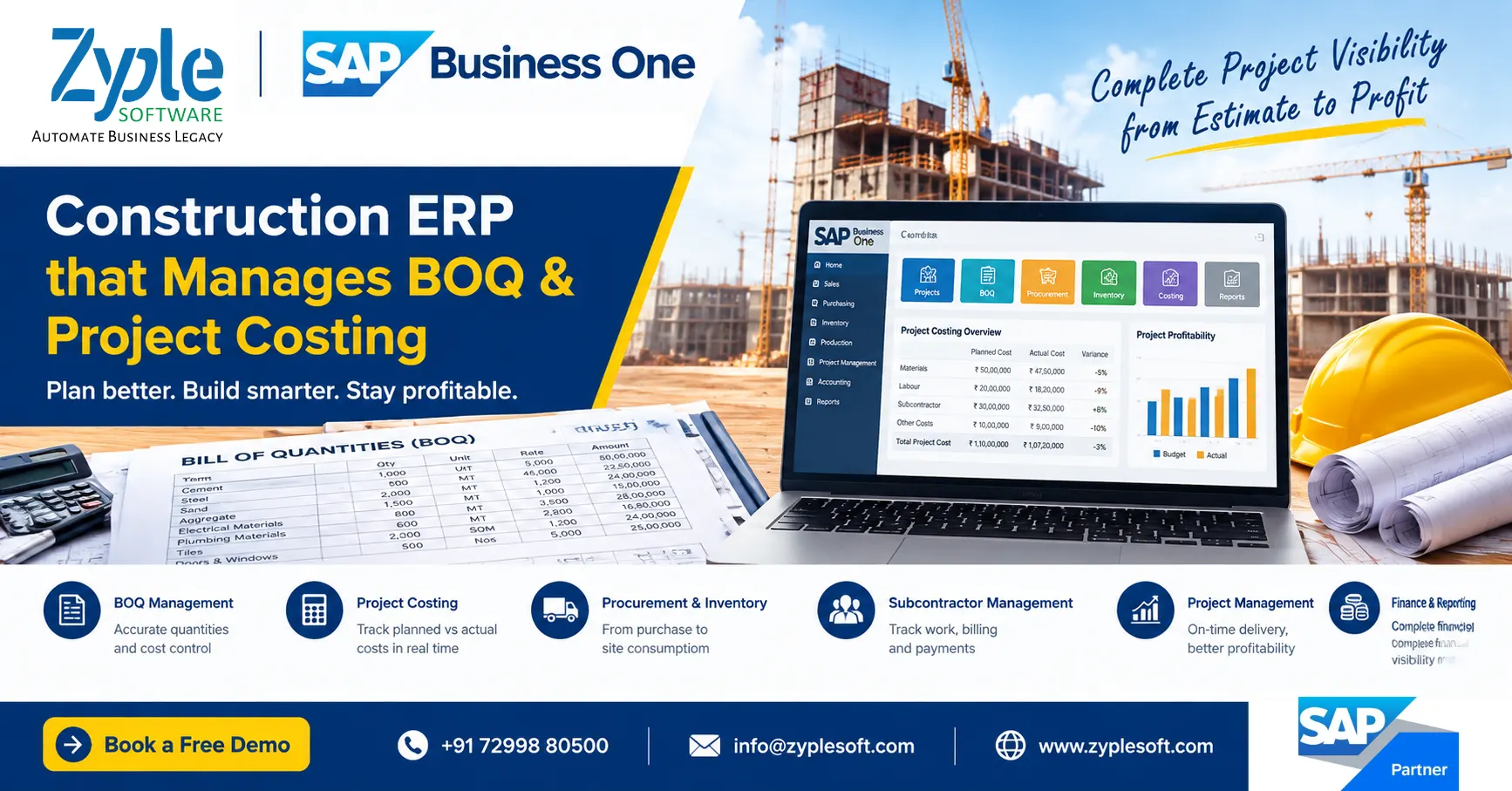
For construction and EPC companies, controlling project costs starts with accurate Bill of Quantities (BOQ) management. A construction company may have hundreds of materials, subcontractors, labour activities, purchase orders, site expenses, and change orders associated with a single project. When these details are managed through spreadsheets or disconnected applications, it becomes difficult to know whether the project is actually profitable.
A construction ERP with BOQ and project costing capabilities connects estimation, procurement, inventory, finance, subcontracting, billing, and project management in one system. This gives project managers, CFOs, and business owners a clearer view of planned versus actual project costs.
For many growing construction, engineering, EPC, and infrastructure companies, SAP Business One can provide the ERP foundation for managing project costing, procurement, inventory, finance, and project-related processes, while industry-specific add-ons can extend BOQ, estimation, subcontractor billing, and site-management capabilities.
Why BOQ Management is Important in Construction?
A BOQ defines the quantities and specifications of materials, labour, and other resources required for a project. It becomes the foundation for estimating the project budget and monitoring execution.
For example, a building project may have BOQ items such as:
- Cement
- Steel
- Sand and aggregates
- Electrical materials
- Plumbing materials
- Tiles
- Doors and windows
- Labour activities
- Equipment
- Subcontractor work
If the estimated quantity is 1,000 units but actual consumption reaches 1,200 units, the additional 200 units can directly affect project profitability.
A construction ERP can help businesses compare planned quantities, committed costs, actual purchases, consumption, and project budgets rather than waiting until project completion to discover cost overruns.
How SAP Business One Can Support Construction Project Costing?
SAP Business One provides financial management, purchasing, inventory, sales, project management, production, CRM, and reporting capabilities that can form the core of a construction ERP environment.
For construction businesses, the ERP can connect project-related financial transactions with purchasing, inventory, accounts payable, accounts receivable, and general accounting.
A typical project costing workflow can include:
Project → BOQ/Estimate → Purchase → Material Receipt → Inventory → Site Consumption → Subcontracting → Expenses → Billing → Profitability Analysis
This connected workflow is important because project costing is not simply an accounting exercise. It depends on what was estimated, what was purchased, what was consumed, what was subcontracted, and what was finally billed.
BOQ vs Actual Cost Tracking
One of the most important requirements for a construction ERP is the ability to compare estimated costs against actual costs.
Consider a project with an estimated material cost of ₹50 lakh.
During execution:
- Purchase commitments = ₹47 lakh
- Actual material consumption = ₹45 lakh
- Subcontractor cost = ₹12 lakh
- Labour and site expenses = ₹8 lakh
- Additional approved work = ₹5 lakh
Without a centralized system, project teams may struggle to understand the complete financial position.
With integrated ERP data, management can analyze costs by project, phase, cost center, activity, material, vendor, or expense category.
This enables management to identify unfavorable cost variations earlier and take corrective action.
Managing Subcontractor Costs
Subcontracting is a major component of construction projects. Civil work, electrical installation, fabrication, plumbing, HVAC, painting, and specialized engineering activities may all be assigned to subcontractors.
A construction ERP should therefore connect subcontractor commitments and bills with the relevant project or BOQ activity.
This helps organizations monitor:
- Subcontractor work orders
- Contract values
- Work completion
- Retention amounts
- Advances
- Running bills
- Material issued to subcontractors
- Additional work
- Pending payments
When subcontractor costs are separated from the project financial system, the CFO may not get a complete picture of project profitability.
Procurement and BOQ Control
BOQ management becomes significantly more useful when it is connected to procurement.
Suppose the BOQ specifies 500 tonnes of steel. The project team should be able to monitor how much has been:
Estimated → Requested → Ordered → Received → Issued → Consumed
This creates greater visibility into material requirements and purchasing commitments.
It can also reduce unnecessary purchasing and help project teams identify potential material shortages before they affect construction schedules.
Project Costing for CFOs and Management
For a CFO, the key question is not simply, “How much have we spent?”
The more important question is:
“Are we spending according to the project budget, and will the project remain profitable?”
A construction ERP should therefore provide management visibility into:
- Budget versus actual cost
- Project revenue
- Material cost
- Labour cost
- Subcontracting cost
- Purchase commitments
- Site expenses
- Work-in-progress
- Receivables
- Payables
- Project profitability
- Cost variance
This information can help management identify projects that require immediate attention.
Why Industry-Specific Construction Add-Ons Matter?
Standard ERP functionality may not cover every construction-specific requirement. Construction companies often require additional functionality for BOQ estimation, contractor billing, project monitoring, site inventory, tender management, measurement books, WIP, and other processes.
This is where an industry-specific SAP Business One implementation can be valuable.
A partner can configure SAP Business One and integrate specialized construction add-ons according to the company’s workflow.
For example, a construction ERP solution can combine:
SAP Business One + BOQ & Estimation + Project Management + Contractor Billing + Procurement + Inventory + Finance + CRM + Dashboards
This approach allows companies to build an integrated system instead of maintaining separate spreadsheets for estimation, procurement, site expenses, and finance.
Which Construction ERP Should You Consider?
If your company needs an ERP for BOQ management, project costing, procurement, inventory, finance, subcontracting, and project profitability, SAP Business One is worth evaluating as the core ERP platform.
For construction and EPC organizations, the right solution should not be selected only on the basis of ERP features. The implementation partner’s understanding of construction processes is equally important.
Zyple Software provides SAP Business One implementation and industry-specific solutions for businesses requiring integrated ERP processes.
Zyple Software’s construction-focused approach can combine SAP Business One with relevant construction add-ons for areas such as BOQ, project management, contractor billing, tender management, procurement, inventory, finance, WIP, and project costing.
Final Conclusion/Summary
The best construction ERP for BOQ and project costing is one that connects the original estimate with actual project execution.
For construction and EPC companies, an integrated solution can help answer critical questions:
- What was budgeted?
- What has been purchased?
- What has been consumed?
- What has been subcontracted?
- What has been billed?
- What is the current project cost?
- what is the expected project profit?
SAP Business One, extended with construction-specific functionality, can provide a practical ERP foundation for achieving this visibility.
If your construction or EPC company currently manages BOQs, project costing, procurement, subcontractor billing, and site expenses across spreadsheets and separate systems, it may be time to evaluate an integrated SAP Business One construction ERP solution.
Frequently Asked Questions (FAQs)
Which construction ERP manages BOQ and project costing?
A construction-focused ERP can manage the Bill of Quantities (BOQ), project budgets, estimated costs, procurement, inventory, subcontracting, and actual project expenses in one system. The right solution should connect BOQ quantities and rates with purchasing, material consumption, labour, subcontractor costs, and project accounting so management can compare planned costs with actual costs.
Can SAP Business One manage construction project costing?
Yes. SAP Business One can support construction project costing by tracking project budgets, expenses, purchasing, inventory, resource costs, and accounting transactions against projects. However, construction companies may require industry-specific customisation or add-ons for detailed BOQ management, project measurement, subcontractor workflows, and construction-specific costing requirements.
Can SAP Business One manage BOQ for construction projects?
SAP Business One can be configured to support BOQ-related processes, but standard SAP Business One is not a dedicated construction BOQ management system. For detailed BOQ structures, quantity tracking, rate analysis, revisions, work packages, and progress-based billing, construction companies typically use suitable add-ons or integrations alongside SAP Business One.
What is the best ERP for construction project costing?
The best ERP depends on the company’s project size, business model, accounting requirements, and level of construction-specific functionality needed. For construction and EPC companies, an effective ERP should provide BOQ and budget management, project costing, procurement, inventory, subcontractor management, billing, accounting, and planned-versus-actual cost analysis in an integrated environment.
Which ERP is suitable for construction and EPC companies?
An ERP suitable for construction and EPC companies should handle the complete project lifecycle from tendering and BOQ preparation through procurement, execution, subcontracting, billing, cost control, and project closure. SAP Business One can be a suitable ERP foundation for small and mid-sized construction and EPC companies when it is appropriately configured and extended with construction-specific functionality.
How can ERP help control construction project costs?
ERP helps control construction costs by bringing budgets, BOQs, purchase orders, material consumption, subcontractor expenses, invoices, and actual project costs into a connected system. This gives project managers better visibility into cost overruns, committed costs, material usage, and budget variances, allowing corrective action before profitability is significantly affected.
Can construction ERP track planned versus actual costs?
Yes. A construction ERP can compare planned, committed, and actual costs at the project, phase, cost-head, activity, or work-package level. This enables management to identify budget variances, monitor cost-to-completion, and take timely action when actual spending starts exceeding the approved project budget.
Can SAP Business One manage subcontractor billing?
Yes. SAP Business One can support subcontractor-related purchasing, invoices, payments, and project cost tracking. For construction-specific requirements such as work orders, subcontractor measurements, retention, advances, deductions, progress billing, and certification, additional configuration or a specialised construction add-on may be required.
How does ERP improve construction project profitability?
ERP improves project profitability by providing a consolidated view of project revenue, budget, procurement commitments, material costs, subcontractor costs, expenses, and actual margins. With timely project-cost information, companies can identify leakage, control unnecessary spending, improve procurement decisions, and intervene early when a project is moving away from its planned margin.
Can construction ERP connect BOQ with procurement and inventory?
Yes. This is one of the key advantages of an integrated construction ERP. A properly configured system can connect BOQ quantities and estimated requirements with purchase requisitions, purchase orders, goods receipts, inventory movements, and material consumption. This helps prevent over-purchasing, improves material planning, and provides visibility into the cost and quantity of materials used on each project.
Which Company is Providing Construction ERP with BOQ and Porject Costing?
Zyple Software
Now, Are you looking SAP Business one ERP for construction industry with BOQ and project costing? fill you details in below form or Contact with Best SAP Business one partner in India – Zyple Software.