SAP Business One ERP for Agricultural Equipment and Machinery Industry
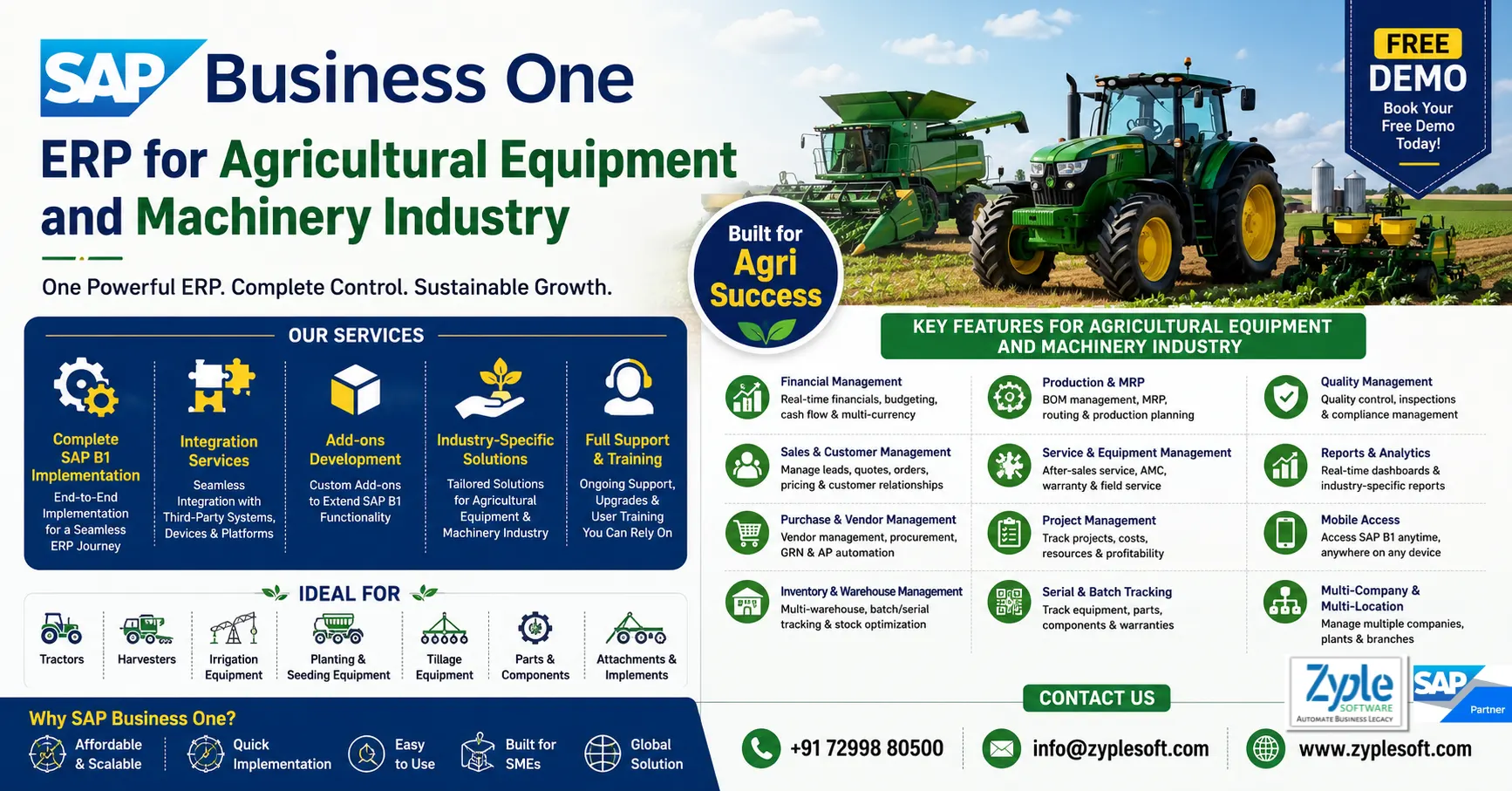
The agricultural equipment and machinery industry is the foundation of global food supply, supporting economies and livelihoods across rural and urban landscapes. From crop cultivation and livestock management to distribution and agritrade, the sector relies heavily on timing, resource optimization, and environmental conditions. Modern agricultural equipment and machinery businesses involve precision, sustainability, and real-time decision-making to remain competitive. SAP Business One ERP for agricultural equipment and machinery helps the agricultural equipment and machinery sector to centralize operations, improve traceability, and allow data-driven insights.
Issues Faced By The Agricultural Equipment and Machinery Industry
The agricultural equipment and machinery industry is navigating a difficult landscape marked by high production costs, decreasing sales, and pressured dealer inventories. Major issues include rising material costs, labor shortages, and technological disruptions requiring quick R&D, alongside farmer hesitancy due to low commodity prices.
1. Production Costs and Supply Chain Disruptions
Manufacturers are tackling increased material costs and navigating lingering supply chain instabilities. As raw material prices rise, dealer inventory levels for new machines remain high.
2. Technological Integration and Electronics
Modernizing machinery with IoT and GPS is challenging due to the need to withstand harsh field environments like heat, dust, and high-impact vibrations. Electronics are now the key failure point, involving advanced protective packaging for components.
3. Declining Market Demand and High Costs
High interest rates and rising machine prices have led to a wait-and-see approach approach among farmers, leading to a slump in new equipment sales. The high cost of advanced machinery like automated harvestors creates a barrier, specifically for small-scale operations.
4. Software and Connectivity Challenges
A lack of standardization in digital dashboards and user interfaces across different brands creates operational challenges.
5. Aging Infrastructure and Technical Support
Dealers face pressure to deliver professional support for increasingly complex, digitally integrated machinery, involving significant training and infrastructure investment.
6. Regulatory and Environmental Pressures
Manufacturers must comply with strict environmental regulations, requiring the development of more sustainable engines and lower-emission machinery.
Features of SAP Business One ERP for Agricultural Equipment and Machinery
1. Financial Management and Cost Control
- Fixed asset accounting like machinery, tools, and plant assets.
- It includes cash flow monitoring and budgeting.
- It includes multi-currency and banking integration.
- It includes profitability analysis by product line, region, or dealer.
- It includes financial reporting and compliance.
- Helps monitor equipment manufacturing costs, margins, and seasonal revenue fluctuations.
2. Sales and Dealer or Distribution Management
- It includes lead and opportunity management.
- It includes dealer or distributor lifecycle management.
- It includes sales quotation, order, and delivery to invoicing cycle.
- It includes pricing, discount, and contract management.
- It includes after-sales service and warranty tracking.
- It includes CRM for customer and dealer relationships.
- Important for handling dealer networks and rural distribution channels.
3. Procurement and Vendor Management
- It includes purchase requisitions and approvals.
- It includes vendor comparison and evaluation.
- It includes purchase orders, GRN, and invoicing.
- It includes contract and subcontractor management.
- It includes multi-vendor sourcing for raw materials.
- It supports sourcing of steel, engines, hydraulics, and agri-components efficiently.
4. Inventory and Warehouse Management
- Real-time inventory tracking, like machines and spare parts.
- It includes multi-warehouse and bin management.
- It includes serial number and batch tracking.
- It includes stock transfers and cycle counting.
- It includes spare parts inventory control.
- Avoids stockouts of essential parts and overstocking issues.
5. Production Planning and Material Requirements Planning (MRP)
- It includes bill of materials (BOM) management.
- It includes production scheduling and shop floor control.
- It includes work order management.
- It includes demand forecasting and seasonal planning.
- Essential for tractor, harvester, and implement manufacturing cycles.
6. Equipment and Asset Management
- It includes machinery lifecycle tracking.
- It includes preventive maintenance scheduling.
- It includes equipment usage monitoring.
- It includes downtime and repair tracking.
- It includes cost analysis of assets.
- It ensures minimum downtime of production machines and demo equipment.
7. Supply Chain and Logistics Management
- It includes end-to-end supply chain visibility.
- It includes demand planning and forecasting.
- It includes logistics and transportation tracking.
- It includes import and export documentation.
- It includes distribution planning.
- Helps handle seasonal demand spikes and rural logistics challenges.
8. Quality Control and Compliance
- It includes incoming and outgoing quality checks.
- It includes inspection plans and test reports.
- It includes compliance with industry standards.
- It includes batch traceability for components.
- It includes warranty and defect tracking.
- It ensures high durability and safety standards of machinery.
9. Project and Contract Management
- It includes project planning and budgeting.
- It includes equipment manufacturing contracts.
- It includes subcontractor management.
- It includes cost tracking per project or order.
- Helpful for custom-built machinery or large equipment orders.
10. Human Resource and Workforce Management
- Workforce allocation like factory and field items.
- It includes labor cost tracking.
- It includes productivity monitoring.
- It includes resource planning.
- Improves shop floor labor and field service teams.
- Business Intelligence (BI) and Analytics
- It includes real-time dashboards and KPIs.
- It includes predictive analytics.
- It includes custom report generation.
- It includes Excel integration and drill-down analysis.
- Allows data-driven decisions across production, sales, and inventory.
12. Mobility and Cloud Capabilities
- It includes web access anytime, anywhere.
- It includes real-time data synchronization.
- It includes cloud deployment options.
- Ideal for field sales, service engineers, and remote farm locations.
13. Agriculture-Specific Functionalities
- It includes seasonal demand forecasting.
- It includes crop cycle and farming insights.
- Input material planning like fertilizers and seeds.
- It includes vendor and farmer management.
- It includes traceability from farm to market.
- It bridges the gap between farm operations and the machinery business.
Benefits of SAP Business One ERP for Agricultural Equipment and Machinery
The ERP software, SAP Business One (SAP B1) system, unifies finances, supply chain, and production into one platform. For agricultural equipment and machinery, it improves complex, multi-level Bills of Materials (BOMs), facilitates vendor procurement, and tracks machinery lifecycles, ultimately minimizing downtime and maximizing operational efficiency.
1. Improved Materials Requirement Planning (MRP)
Accurately calculates the correct raw materials, parts, and sub-assemblies needed based on seasonal demand forecasting and production lead times using SAP implementation.
2. Production and Assembly Control
Easily handles engineering-to-order (ETO) and make-to-order (MTO) processes, tracking work-in-progress (WIP) and the use of labor and machinery on the shop floor.
3. Bill of Materials (BOM) Precision
Oversees multi-level BOMs, essential for building complex agricultural machines like tractors, harvesters, and irrigation systems.
4. Inventory and Supplier Management
Prevents stockouts of essential parts during peak agricultural seasons while helping you identify the most cost-effective suppliers based on past performance and lead times using SAP solutions.
5. Quality and Traceability
Integrates quality control checkpoints throughout the production cycle and tracks serial numbers or batches, enabling full product recall capabilities and warranty management.
6. Integrated Financials and Compliance
Integrates shop-floor operations with accounting directly, supporting local taxation compliance (e.g., GST reporting) and monitoring cash flows across multi-currency vendor contracts.
Conclusion of Agricultural Equipment and Machinery ERP
Zyple Software is a certified SAP Business One partner in India specializing in implementation, digital transformation, licensing, integration, add-on solutions, migration, and consulting for the construction equipment manufacturing industry. The SAP software creates transparent and sustainable food supply chains for your growing agricultural equipment and machinery business.
If you are interested, schedule a demo of SAP B1.
Do you mandate the SAP Business One ERP solution for your business or industry?
Complete all the details in the delivered contact form; our team will reach out to you.
FAQs related to SAP Business One ERP for Agricultural Equipment & Machinery
How can I get a demo of SAP Business One for my agricultural equipment business?
You can request a personalized demo from the best SAP B1 partner like Zyple Software to see how SAP Business One fits your manufacturing processes, including inventory, production, and service management.
What is the pricing structure of SAP Business One for agricultural machinery manufacturers?
The pricing depends on factors like user licenses, deployment type (cloud or on-premise), and customization requirements. The SAP consultant helps deliver an accurate, customized quote.
How long does it take to implement SAP Business One in an agricultural equipment company?
SAP implementation timelines generally range from a few weeks to a few months, based on business size, data migration, and process complexity.
Can SAP Business One be customized for my specific agricultural machinery operations?
Yes, SAP Business One can be customized for your needs, including dealer management, spare parts tracking, warranty handling, and equipment lifecycle management.
How do I choose the right SAP Business One partner for implementation?
Look for a certified partner like Zyple Software with experience in manufacturing and agricultural equipment industries, strong local support, and a proven track record of successful ERP implementations.