SAP Business One ERP for HVAC Equipment Manufacturing Industry
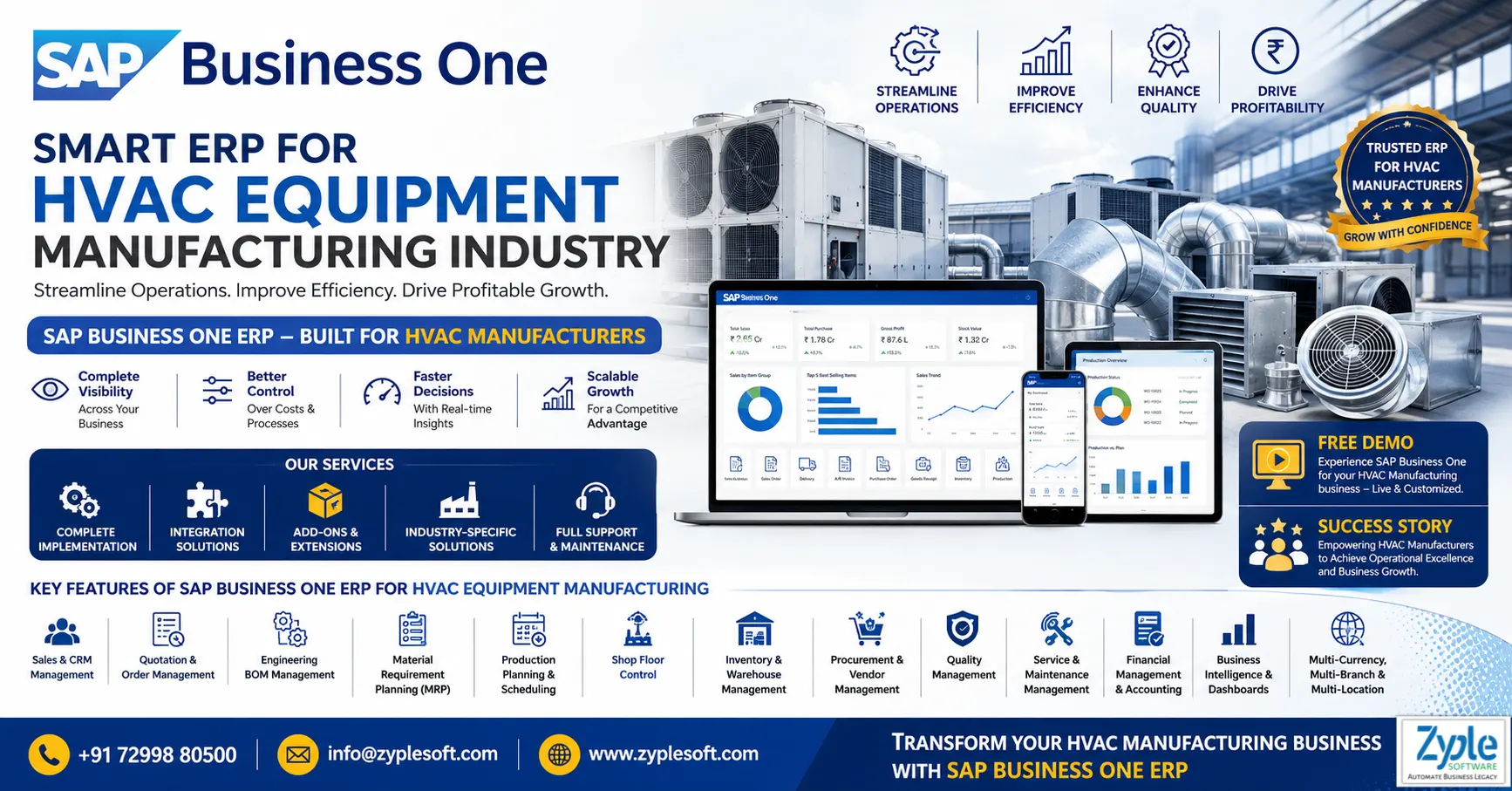
The HVAC(Heating, Ventilation, and Air Conditioning) equipment manufacturing industry is one of the most versatile industries around the world, which undergoes continuous development. With the new players in this competitive industry, the HVAC equipment manufacturing industry requires innovative software solutions to handle and integrate every business process efficiently. SAP Business One ERP for HVAC equipment manufacturing handles every aspect of the HVAC equipment manufacturing industry from any part of the world.
Challenges Faced By The HVAC Equipment Manufacturing Industry
The HVAC equipment manufacturing industry faces significant challenges, including rising raw material costs, shifting environmental mandates like stringent energy efficiency standards, and a severe shortage of skilled labor. Also, manufacturers must heavily invest in R&D to integrate complex IoT and AI technologies while navigating global supply chain disruptions.
1. Strict Regulatory and Environmental Compliance
Manufacturers are forced to adjust to rapid changes in global environmental policies. The mandatory phase-down of high global warming potential (GWP) refrigerants (like older HFCs) to new A2L-classified refrigerants involves redesigning entire product lines and retooling factories to achieve updated safety and efficiency standards.
2. Volatile Material Costs
Unpredictable fluctuations in the cost of raw materials, specifically copper, steel, and aluminium, heavily compress profit margins.
3. Labor Shortage and Talent Gap
As experienced technicians and engineers retire, the industry suffers loss of institutional knowledge. Building and producing modern, highly advanced HVAC equipment requires specialized skills that the current labor pool often lacks.
4. Technological Integration (IoT and AI)
There is immense pressure to transition from traditional heating and cooling equipment to smart, connected HVAC-R (Heating, Ventilation, Air Conditioning, and Refrigeration) systems. This requires large investments in advanced electronics, software development, predictive maintenance capabilities, and handling cybersecurity for connected devices.
5. Supply Chain Disruption
Over-dependence on a complex global network for specialized components, such as microchips and compressors leaves manufacturers vulnerable to shipping delays and manufacturing obstacles.
Features of SAP Business One ERP for HVAC Equipment Manufacturing
1. Production Planning and Control
- Multi-level bill of materials (BOM) for HVAC units like compressors, coils, fans, and ducts.
- It includes production orders with routing and stage-wise tracking.
- It includes make-to-order (MTO) and make-to-stock (MTS) support.
- It includes capacity planning for fabrication, assembly, and testing.
- It includes real-time production status and work-in-progress (WIP) monitoring.
2. Inventory and Warehouse Management
- It includes batch and serial number tracking for compressors, motors, and control units.
- It includes multi-warehouse and bin location management.
- It includes inventory valuation methods like FIFO and moving average.
- It includes automated stock replenishment and MRP.
- It includes spare parts inventory control for after-sales service.
3. Procurement and Vendor Management
- It includes vendor quotation comparison and selection.
- It includes purchase order automation.
- Supplier performance tracking like quality and delivery timelines.
- It includes raw material procurement for coils, sheet metal, and insulation materials.
- It includes subcontracting management for outsourced fabrication.
4. Sales and Distribution Management
- Quotation management for HVAC projects like commercial and residential.
- It includes sales order processing with pricing, discounts, and taxes.
- It includes dealer and distributor management.
- It includes integration with CRM for lead-to-order conversion.
- It includes delivery scheduling and logistics tracking.
5. Service and Maintenance Management
- It includes installation and commissioning tracking.
- Preventive maintenance scheduling like AMC contractors.
- It includes service call management and technician assignment.
- It includes warranty and service history tracking.
- It includes spare parts consumption during service operations.
6. Financial Management
- It includes general ledger, accounts payable, and accounts receivable.
- It includes cost accounting for HVAC accounts and projects.
- It includes budgeting and financial forecasting.
- It includes profitability analysis by product line or project.
- It includes multi-currency and multi-tax compliance.
7. Quality Control and Compliance
- It includes incoming, in-process, and final quality inspections.
- It includes non-conformance and corrective action tracking.
- It includes compliance with ISO and HVAC industry standards.
- Testing data recording like cooling efficiency, airflow, and more.
- It includes audit trail and documentation management.
8. Reporting and Analytics
- It includes custom MIS reports for decision-making.
- KPI tracking like production efficiency and server response timing.
- It includes predictive insights using historical data.
- It includes integration with analytics tools like Power BI.
9. Integration and Scalability
- It includes integration with CAD, IoT-enabled HVAC systems, and third-party apps.
- It includes API-based connectivity for e-commerce and mobile apps.
- It includes cloud and on-premise deployment options.
- It includes scalability for multi-plant operations.
Importance of SAP Business One ERP for HVAC Equipment Manufacturing
The ERP software, SAP Business One (SAP B1) system, is important for the HVAC manufacturing industry because it unifies complex production, supply chain, and field service operations into a single system. It eliminates information storage, helping businesses optimize component inventory, facilitate engineer-to-order (ETO) workflows, and ensure compliance with strict industry regulations.
1. Complex Bill of Materials (BOM) Management
HVAC systems feature complex assemblies like compressors, coils, motors, and more. SAP Business One connects design and engineering with production, handling multi-level BOMs accurately.
2. Material Requirements Planning (MRP)
Automatically calculates exactly what raw materials and parts are required, factoring in lead times to prevent production delays or costly overstocking.
3. Inventory Control and Serial Tracking
Delivers real-time visibility into stock levels using SAP implementation. It handles batch and serial numbers to trace individual components, which is essential for warranty tracking and compliance.
4. Shop Floor Control
Manages production schedules and work orders. This helps in eliminating obstacles and ensures the efficient use of both labor and machine resources.
5. Field Service and Warranty Oversight
Seamlessly integrates the manufacturing floor with post-sale service operations, handling contract renewals, field service calls, and service-level agreements (SLAs).
Benefits of SAP Business One for HVAC Equipment Manufacturing
SAP Business One centralizes operations for HVAC equipment manufacturers, connecting sales, inventory, and financials. It minimizes material waste and speeds up delivery times by facilitating supply chains and automating workflows. The platform also simplifies compliance with industry regulations and improves equipment bills of materials (BOMs).
1. Accurate BOM Management
Manages complex HVAC assemblies and sub-assemblies so you can track the raw materials like copper, steel, and refrigerants required for custom and standard units using SAP solutions.
2. Improved Material Requirements Planning (MRP)
Automatically calculates purchasing and production needs based on historical sales and active orders, avoiding stockouts and over-purchasing.
3. Integrated Quality Control (QC)
Tracks component defects and ensures manufacturing units achieve environmental, energy efficiency, and regulatory standards.
4. Supply Chain Synchronization
Integrates procurement with sales orders, enabling you to quickly check vendor lead times and track shipping costs.
5. Project and Cost Tracking
The SAP software estimates costs more accurately and monitors work-in-progress (WIP) in real-time to protect your margins on large commercial projects.
6. Mobile Field Integration
Enables field technicians and sales teams to access inventory data, handle service calls, and process orders on the go.
Conclusion of HVAC Equipment Manufacturing ERP
Zyple Software is a certified SAP Business One partner in India specializing in implementation, digital transformation, licensing, integration, add-on solutions, migration, and consulting for the pumps and valves manufacturing industry. SAP Business One ERP can be useful in several aspects of manufacturing, which include physical accounting, warehouse management of products, scheduling, location, management, warehousing, and various aspects.
If you’re flexible, schedule a demo of SAP Business One.
Do you order the SAP Business One ERP solution for your business or industry?
Complete all the details in the described contact form; our team will reach out to you.
FAQs
1.How can SAP Business One ERP improve efficiency in HVAC manufacturing?
SAP Business One facilitates key operations like production, inventory, procurement, and finance into a single platform. HVAC manufacturers can minimize manual work, eliminate errors, and gain real-time visibility, helping improve overall operational efficiency and faster decision-making.
2.Is SAP Business One customizable for HVAC equipment manufacturers?
Yes, SAP Business One can be customized to meet the specific needs of HVAC manufacturing, including complex BOMs, project-based manufacturing, and service management.
3.What ROI can HVAC manufacturers expect from SAP Business One?
Most HVAC manufacturers experience improved productivity, minimized inventory costs, and better resource utilization. This leads to faster ROI through cost savings, improved efficiency, and increased customer satisfaction.
4.How quickly can SAP Business One be implemented in an HVAC manufacturing company?
The SAP B1 implementation timelines vary based on business complexity, but with an experienced partner, HVAC manufacturers can typically go live within a few weeks to a few months, ensuring minimal disruption to operations.
5.How can I get a demo of SAP Business One for my HVAC manufacturing business?
You can request a personalized demo from an authorized SAP B1 partner like Zyple Software to see how SAP Business One fits your HVAC operations. A demo helps you understand features, workflows, and benefits particular to your business before making a decision.