SAP Business One ERP for Industrial Machinery and Equipment Industry
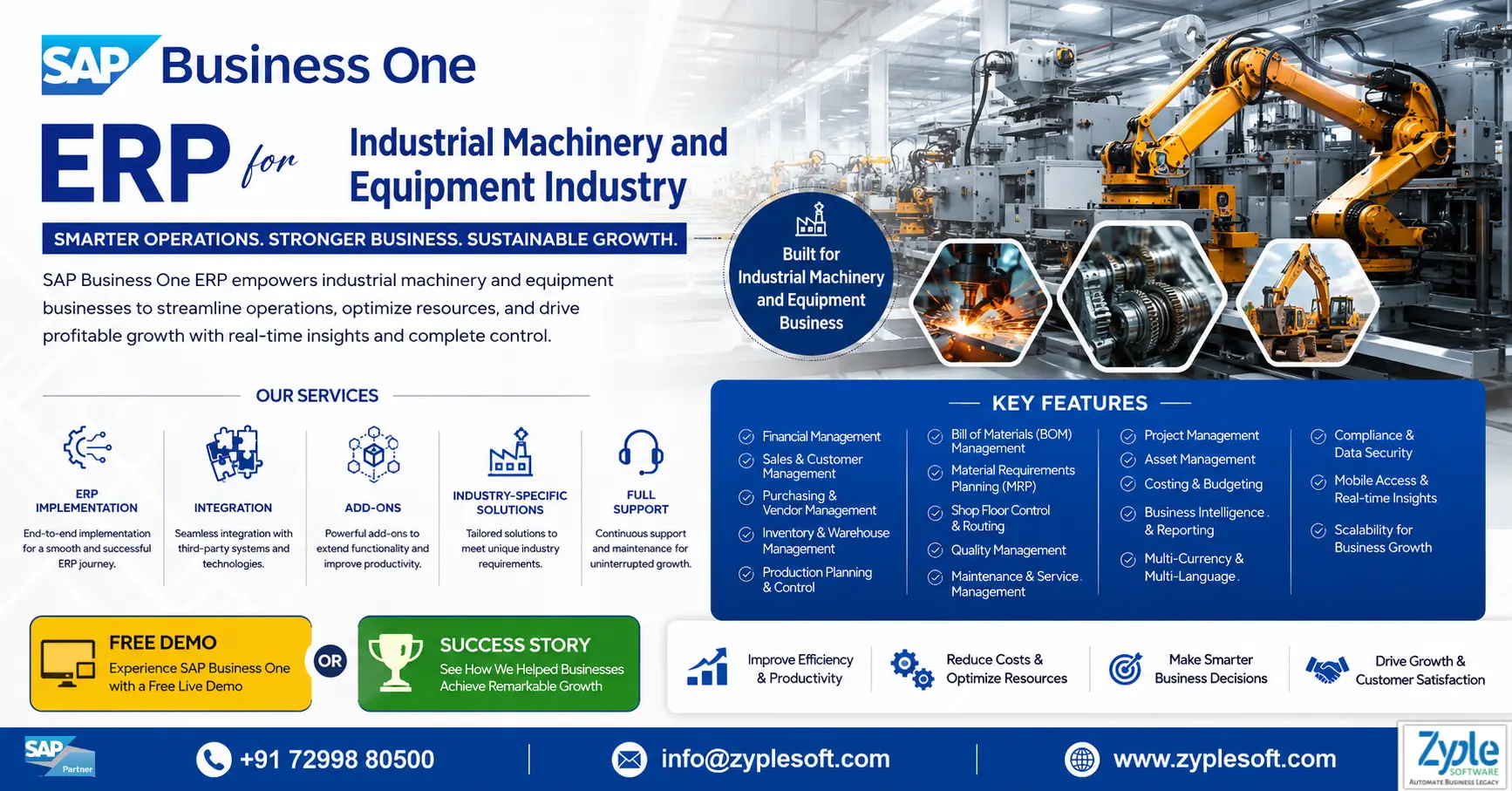
The industrial machinery and equipment industry faces huge pressure due to its vast scope of work, which requires project management, heavy machinery loading, shipping, warehousing, and other responsibilities. This sector probably has logistics issues and needs a system that unifies different company departments. SAP Business One ERP for industrial machinery and equipment unites processes and helps in boosting production and efficiency.
Challenges Faced By The Industrial Machinery and Equipment Industry
The industrial machinery and equipment industry faces significant challenges, mainly driven by supply chain volatility, rising costs, the need for rapid digital transformation, and increasing demand for customized, sustainable solutions. Key barriers include handling skilled labor shortages, navigating geopolitical trade issues, and integrating AI and IoT for predictive maintenance.
1. Supply Chain Disruptions and Cost Inflation
Manufacturers are battling volatile raw material prices and logistics constraints, urging widespread cost-cutting and pricing adjustments to maintain margins.
2. Rapid Digitization and Tech Integration
Adopting AI, IoT connectivity, and cloud-based systems for machinery is necessary. Companies must upgrade legacy systems to provide smart, connected equipment, with many struggling to integrate data from disparate systems.
3. Customization vs. Standardized Production
There is high demand for specialized machinery, which often conflicts with the requirement to maintain standardized, high-volume production efficiency.
4. Skilled Labor Shortages
A significant gap exists between required skills and available talent, impacting productivity, technical support, and innovation capacity.
5. Market Volatility and Increased Competition
Global economic shifts, including overcapacity in India, create rising competitive pressure and price sensitivity.
Features of SAP Business One ERP for Industrial Machinery and Equipment
1. Engineer-To-Order and Make-to-Order Manufacturing
- Handles custom machinery production based on client specifications.
- Manages multi-level bills of materials (BOM) and complex product structures.
- Integrates with CAD/PDM systems for design-to-production flow.
- Tracks engineering changes (ECR/ECO).
- Supports long production cycles and staged manufacturing.
2. Production Planning and Shop Floor Control
- It includes advanced production planning and scheduling.
- Optimizes machine capacity and resource utilization.
- Handles work orders, routing, and operations.
- Monitors work-in-progress (WIP) in real-time.
- Minimizes scrap, rework, and downtime.
3. Project-Based Manufacturing and Costing
- Executes project-driven manufacturing.
- Tracks costs by project, job, or order.
- Monitors budget vs. actuals.
- Analyzes order-wise and project-wise profitability.
- Handles milestones, billing, and timelines.
4. Inventory, Spare Parts, and Warehouse Management
- It includes real-time visibility across warehouses.
- Handles raw materials, WIP, and finished goods.
- Tracks spare parts and service inventory.
- Supports batch or serial number tracking.
- Optimizes stock levels and minimizes stockouts.
5. Procurement and Supplier Management
- It includes an end-to-end procure-to-pay cycle.
- It includes vendor evaluation and supplier performance tracking.
- Handles purchase orders, GRNs, and invoices.
- Controls material costs and lead times.
- Ensures product compliance in sourcing.
6. Sales, CRM, and Order Management
- Handles long sales cycle for capital equipment.
- Tracks leads, opportunities, and quotations.
- Configures complex pricing and contracts.
- Maintains a complete customer lifecycle.
- Forecasts sales pipeline and demand.
7. Service and Maintenance Management (After-Sales)
- Handles installation, AMC, and warranty contracts.
- Tracks service calls and field service operations.
- Schedules preventive and breakdown maintenance.
- Maintains installed base and equipment history.
- Improves customer service and uptime.
8. Asset and Equipment Lifecycle Management
- Tracks machines, tools, and capital equipment.
- Monitors asset depreciation and lifecycle costs.
- Handles equipment usage and maintenance schedules.
- Improves asset utilization and ROI.
9. Financial Management and Cost Control
- It includes integrated accounting, accounts receivable, accounts payable, and general ledger.
- Controls production and project costs.
- Tracks cash flow and profitability.
- Automates financial reporting and compliance.
10. Quality Control and Compliance
- Defines quality inspection plans.
- Performs incoming, in-process, and final inspections.
- Ensures compliance with industry standards.
- Tracks defects, rework, and corrective actions.
11. Supply Chain and Distribution Management
- Optimizes logistics and distribution of heavy equipment.
- Handles multi-location operations (plants, warehouses, and branches).
- Improves delivery timelines and order fulfillment.
- Minimizes supply chain costs.
12. Business Intelligence and Real-Time Analytics
- It includes real-time dashboards and KPIs.
- It includes drill-down analytics across departments.
- It includes custom reports and forecasting.
- It includes data-driven decision-making.
13. Integration and Automation
- Integrates with CAD, IoT, MES, barcode or RFID systems.
- Automates production, procurement, and finance workflows.
- Connects with third-party applications and e-commerce.
- Allows digital transformation in manufacturing.
14. Multi-Branch and Global Operations
- Handles multiple plants, warehouses, and subsidiaries.
- Supports multi-currency and multi-tax structures.
- Integrates financials across locations.
- Standardizes processes enterprise-wide.
15. Mobility and Cloud Access
- It includes access to ERP via mobile apps and web client.
- Allows remote approvals and monitoring.
- Supports field service and sales teams on the go.
Importance of SAP Business One ERP for Industrial Machinery and Equipment
The enterprise resource planning (ERP) software, SAP Business One (SAP B1) system, is essential for industrial machinery and equipment manufacturers by delivering an integrated, scalable ERP solution that handles complex engineer-to-order (ETO) processes, improves production scheduling, and increases inventory accuracy simultaneously. It boosts operational efficiency by connecting departments, providing accurate cost tracking, and strengthening quality control, which helps manufacturers minimize waste, handle complex BOMs (Bills of Materials), and comply with regulatory standards.
1. Project-Based Production Management
Supports complex manufacturing models such as engineer-to-order (ETO), make-to-order (MTO), and assembly, enabling customized production for specific customer machines.
2. Real-Time Data Visibility and Control
Integrates departments like procurement, engineering, finance, and shop floor on a single database, eliminating storage and delivering real-time insights into production and inventory using SAP implementation.
3. Material Requirements Planning (MRP)
Allows efficient material planning, minimizing obstacles and stockout situations while optimizing inventory situations.
4. Quality Control and Compliance
Implements efficient material planning, ensuring compliance with industry standards and safety regulations.
5. Improved Shop Floor Activity
Delivers visibility into work orders, machine utilization, and labor productivity to optimize output.
Benefits of SAP Business One for Industrial Machinery and Equipment
SAP Business One (SAP B1) provides industrial machinery and equipment manufacturers an inclusive, scalable ERP solution that facilitates production, improves inventory control, and increases profitability. It dleivers real-time visibility from procurement to assembly (including ETO and MTO), ensuring optimal machine utilization and improved compliance with industry standards.
1. Optimized Production and Planning
Supports complex manufacturing processes such as engineer-to-order (ETO) and make-to-order (MTO). It facilitates BOM (Bill of Materials) management, production orders, and scheduling to reduce lead times using SAP solutions.
2. Real-Time Inventory and Supply Chain Management
Tracks raw materials, work-in-progress, and finished goods in real-time, minimizing carrying costs and preventing stockouts.
3. Improved Cost Control and Profitability
Provides complete financial tracking, helping companies calculate true product costs, analyze profit margins, and reduce waste.
4. Improved Efficiency and Productivity
Automates key processes, from procurement to final delivery, minimizing manual labor and facilitating operations.
5. Data-Driven Decision-Making
Provides actionable insights through real-time reporting, enabling managers to monitor KPIs, machine utilization, and worker productivity.
6. Scalability for Growth
As a customized solution for small to medium-sized manufacturers, SAP software provides the flexibility to adapt to expanding production lines or new locations without requiring a complete system replacement.
Conclusion of Industrial Machinery and Equipment ERP
Zyple Software is a certified SAP Business One partner in India specializing in implementation, digital transformation, licensing, integration, add-on solutions, migration, and consulting for the industrial machinery and equipment industry. With real-time insights and scalable processes, SAP Business One allows industrial machinery and equipment companies to increase efficiency, improve efficiency, and grow confidently in a highly competitive market.
If you’re expert, book a demo of SAP Business One.
Do you necessitate the SAP Business One ERP software for your business or industry?
Complete all the details in the defined contact form; our team will get back to you.